
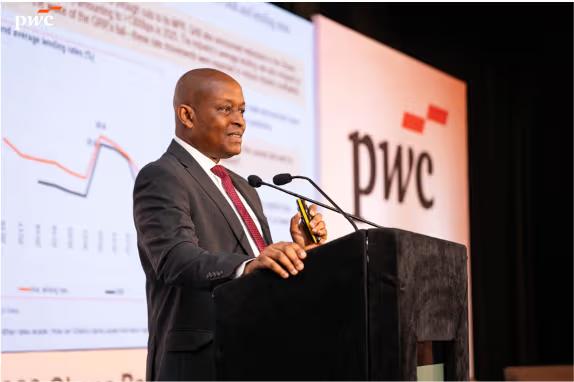

PricewaterhouseCoopers (PwC) Country Senior Partner, George Arhin, has called on government to carefully coordinate its fiscal and monetary policies to preserve Ghana’s improving macroeconomic conditions while creating sufficient room for sustainable economic expansion.
Mr Arhin cautioned that increased public expenditure, anticipated disbursements under the Domestic Debt Exchange Programme (DDEP) and expanding private sector operations could collectively inject substantial liquidity into the economy, making prudent financial management essential to preventing renewed inflationary pressures.

Speaking at PwC’s 2027 Post Budget Forum, he explained that the anticipated movement of additional money through the financial system would require corresponding fiscal discipline and effective monetary interventions to ensure that economic expansion did not undermine the progress made in stabilising prices.

He observed that government spending, payments to holders of restructured domestic debt and increased private sector participation would all contribute to greater liquidity within the economy, stressing that these developments must be carefully coordinated.

Mr Arhin consequently expressed the expectation that government would pursue a more restrictive fiscal approach to prevent excessive liquidity from circulating within the financial system and ensure that available financial resources were channelled into productive economic activities.
He maintained that monetary policy would continue to play an important role in containing inflation, particularly where increased money supply was not accompanied by corresponding improvements in production, investment and economic productivity.

Meanwhile, Technical Advisor at the Ministry of Finance, Dr Theo Acheampong, disclosed that the introduction of commitment authorisation had improved government’s oversight of public expenditure while helping to prevent the accumulation of unbudgeted financial obligations.
Dr Acheampong explained that under the previous expenditure management arrangements, certain government institutions operating outside the central spending framework were able to undertake financial commitments that had not been adequately incorporated into approved budgetary allocations.

He noted that such practices frequently resulted in unexpected expenditure claims and substantial outstanding bills emerging towards the end of financial years, thereby complicating government’s efforts to maintain expenditure discipline.

However, he indicated that the introduction of the commitment authorisation framework had strengthened central government’s ability to monitor spending decisions and exercise greater control over financial obligations incurred by public institutions.
The Finance Ministry advisor expressed satisfaction with the progress achieved, maintaining that government now possessed considerably stronger oversight of expenditure commitments and that the previous situation was no longer the case.
On business taxation, PwC Associate Director for Tax, Laura Torgbenoo Fiagome, disclosed that proposed tax concessions for enterprises operating at Ghana’s ports would be linked to clearly defined performance requirements, particularly employment generation and additional investment.
She explained that the incentives were not designed to provide companies with automatic or unconditional tax exemptions but rather to encourage measurable business activities capable of expanding economic production, creating employment and ultimately strengthening government’s revenue base.
Ms Fiagome indicated that participating companies would be required to enter into formal performance agreements, with their compliance and delivery against stipulated commitments subjected to monitoring.
She stressed that businesses benefiting from the arrangements would be expected to demonstrate tangible contributions to employment creation rather than simply enjoying tax concessions without corresponding economic benefits.
She further explained that increased investment and recruitment would generate additional government revenue through Pay As You Earn (PAYE) deductions and other applicable taxation categories, potentially creating a mutually beneficial relationship between business expansion and public revenue mobilisation.
Separately, Associate Director at Fitch Solutions, Mike Kruiniger, cautioned that climate related developments, particularly the emerging El Niño weather phenomenon, could introduce fresh uncertainties into Ghana’s inflation outlook in 2027.
He warned that the weather pattern could produce severe dry conditions in certain geographical areas while triggering excessive rainfall and flooding elsewhere, with potentially damaging consequences for agricultural production, food availability and consumer prices.
Mr Kruiniger observed that the anticipated climatic disturbances could intensify existing price pressures, particularly if adverse weather conditions disrupted farming activities and constrained the supply of agricultural commodities.
He also indicated that the developing El Niño event was taking shape as one of the strongest recorded, raising concerns about its potential implications for countries whose food supply and inflation dynamics are particularly exposed to climatic conditions.
The concerns were raised against the backdrop of Ghana’s 2027 Budget, which projects total government expenditure of GH¢389 billion without introducing additional taxes.
The fiscal programme also allocates GH¢30 billion towards the first year of the government’s four year New Economy initiative, a US$10 billion investment programme scheduled to run from 2027 to 2030.
The discussions at PwC’s Post Budget Forum therefore highlighted the importance of coordinating government expenditure, monetary interventions, private sector incentives and climate resilience measures as Ghana seeks to sustain its economic stabilisation efforts while expanding productive activity.

