
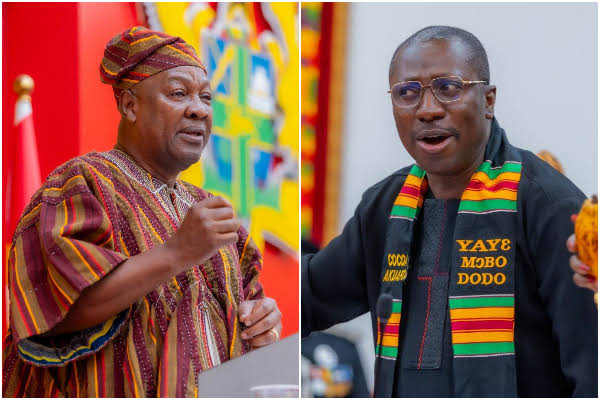

Minority Leader Alexander Afenyo-Markin has accused the government of discriminating against Ghanaian-owned businesses on political grounds, alleging that contractors who undertook projects during the previous New Patriotic Party administration continue to face outstanding payments while other companies are allegedly receiving prompt settlements under the current government.
The Effutu legislator expressed concern that what he described as politically motivated treatment of local entrepreneurs was undermining confidence in the domestic business environment and creating unequal conditions for Ghanaian companies seeking to conduct business with the state.

Addressing journalists, Mr Afenyo-Markin urged the administration to adopt an impartial approach towards local businesses, insisting that political affiliations should not determine whether contractors receive payment for services rendered or projects completed.

He identified the alleged politicisation of commercial activities as one of the most troubling developments confronting Ghanaian entrepreneurs, particularly those whose businesses depend on government contracts and public infrastructure projects.

According to the Minority Leader, several companies that supplied goods, provided services and executed public works, including classroom blocks, hospitals, bridges and roads, under the previous administration are still awaiting payments for their completed assignments.
He alleged that some of these contractors were being denied their legitimate financial entitlements because their projects were undertaken during the NPP administration, while other businesses were allegedly receiving payments shortly after submitting their certificates for work performed.

Mr Afenyo-Markin argued that such disparities, if allowed to persist, would weaken the capacity of indigenous businesses to expand, discourage private sector participation in public procurement and erode confidence in the government’s contractual obligations.
He nevertheless acknowledged that the practice was not exclusive to the governing National Democratic Congress, conceding that successive administrations, including those led by the NPP, had contributed to the recurring problem.

The Minority Leader maintained that both major political parties must accept responsibility for addressing the situation rather than attributing the challenges solely to their political opponents.

He consequently called on the government to guarantee a business environment in which Ghanaian entrepreneurs enjoy predictable commercial conditions, equal treatment and confidence that contractual agreements will be honoured irrespective of the political circumstances under which they were secured.
While expressing support for foreign investment, Mr Afenyo-Markin questioned why international investors should enjoy greater commercial certainty than indigenous business owners, arguing that Ghanaian entrepreneurs deserved comparable protection and institutional support.
He maintained that political actors had contributed to an environment in which businessmen perceived to have relationships with outgoing administrations risk being subjected to scrutiny or commercial difficulties following changes in government.
Describing the situation as a recurring feature of Ghana’s political transitions, he questioned the practice of identifying and targeting local entrepreneurs believed to be sympathetic to a previous governing party, warning that such conduct was detrimental to the country’s broader economic development.
Beyond the concerns surrounding contractor payments and the treatment of indigenous businesses, the Minority Leader also cautioned that Ghana’s economic expansion could lose momentum by the fourth year of President John Dramani Mahama’s administration if the Finance Minister failed to sustain the country’s current growth trajectory.
He urged the government to place greater emphasis on productive investments capable of expanding economic activity, generating employment and strengthening the country’s revenue base rather than directing an excessive proportion of public resources towards consumption.
Mr Afenyo-Markin argued that a reorientation of government expenditure towards productive sectors was necessary to preserve economic growth and prevent a slowdown as the administration progresses through its tenure.
His remarks have brought renewed attention to two important economic questions: the treatment of local contractors following political transitions and the government’s ability to sustain economic expansion through investment in productive activities.
The allegations surrounding outstanding contractor payments, however, remain claims advanced by the Minority Leader and would require verification through payment records, contract documentation and responses from the relevant government agencies. The government has yet to provide a response to the specific allegations presented in his remarks.

