
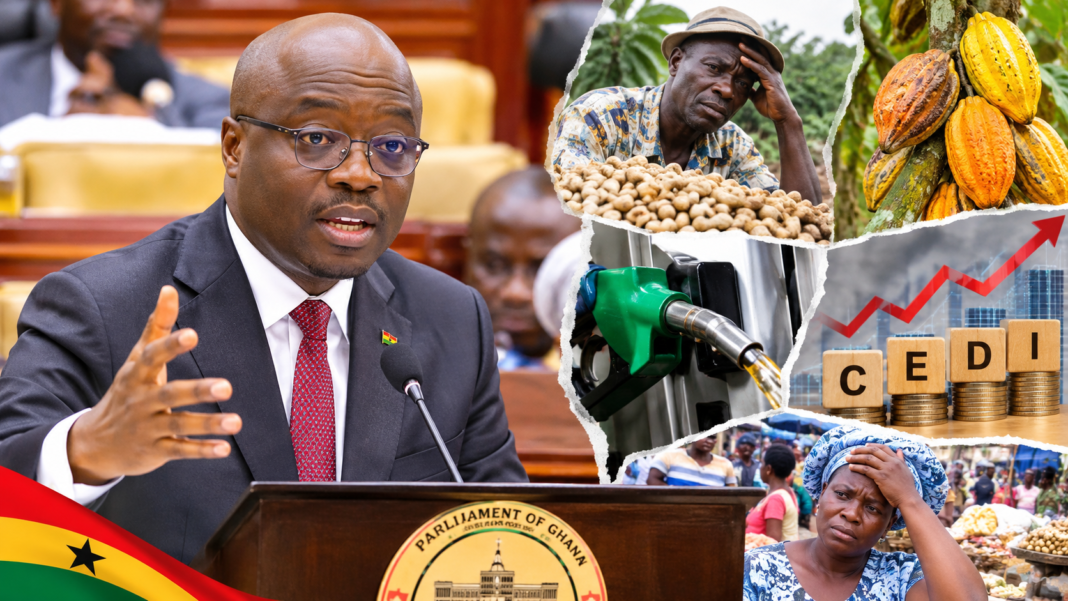

As Dr Cassiel Ato Forson prepares to present the 2027 Budget on November 12, the government faces a critical test: translating macroeconomic stabilisation into tangible improvements in household incomes, agricultural earnings, business confidence and the cost of living.
Ghana’s 2027 Budget Statement and Economic Policy, scheduled for presentation to Parliament on Thursday, November 12, 2026, must go beyond an impressive recital of economic recovery statistics. It must confront the persistent pressures facing households, farmers, manufacturers and businesses, particularly the renewed increase in inflation, deteriorating conditions in parts of the agricultural economy, elevated energy costs and vulnerabilities in the foreign exchange market.

Finance Minister Dr Cassiel Ato Forson will present the government’s fiscal and economic programme at a time when the administration has considerable macroeconomic improvements to showcase. However, the central question confronting the government is whether those improvements are translating into meaningful economic relief for ordinary Ghanaians.

The distinction matters. An economy can record stronger growth, accumulate foreign reserves, reduce its inflation rate from previous peaks and improve its debt position without necessarily delivering comparable improvements in the financial circumstances of households and productive enterprises.

The November 12 presentation must therefore be assessed not simply by the strength of its headline economic projections but by the credibility of its interventions, the resources allocated to them and the measurable outcomes they are expected to produce.
The announcement of the presentation was made by Parliament’s Majority Leader and Chairman of the Business Committee, James Agalga, who confirmed that the Finance Minister would submit the 2027 Budget in accordance with Article 179 of the 1992 Constitution.

Ghana News Agency+1
Inflation: The Decline Is Real, but the Recent Direction Demands Attention
One of the most important issues requiring a clear explanation in the forthcoming budget is the renewed increase in inflation.
Ghana’s disinflation programme has produced substantial improvements compared with the severe price instability experienced in previous years. However, the latest figures indicate that the downward movement has encountered resistance.

Data released by the Ghana Statistical Service on November 4, 2026, showed that year on year consumer inflation increased to 5.5 per cent in October, from 5.2 per cent in September and 4.6 per cent in July. This represents three consecutive monthly increases.

Ghana News Agency+1
The distinction between the overall inflation rate and the actual movement in individual prices is particularly important.
Although headline inflation remains substantially below the 8 per cent recorded in October 2025, this does not mean that the general cost of living has returned to previous levels. It means that prices are increasing more slowly than they were a year earlier.
Indeed, the October statistics reveal significant pressures beneath the headline figure. Services inflation accelerated to 11.5 per cent from 8.3 per cent in September, while non food inflation increased to 7.9 per cent from 6.2 per cent.
Transport inflation reached 14.1 per cent, following an 8 per cent monthly increase in transport prices. Housing, water and energy recorded inflation of 10.5 per cent.
There are, nevertheless, some encouraging developments. Food inflation declined to 2.8 per cent from 4 per cent in September, while the overall price level decreased by 0.1 per cent on a month to month basis in October.
Ghana News Agency
These figures complicate any simplistic argument that inflation is uniformly high or accelerating across the entire economy. They demonstrate instead that the burden is shifting between expenditure categories, with services, transportation and housing emerging as significant pressure points.
For households, however, the distinction offers limited comfort when essential services, commuting expenses and accommodation continue to absorb substantial portions of monthly incomes.
The Finance Minister must therefore explain how the 2027 fiscal programme will address the cost pressures that headline inflation alone cannot adequately communicate.
A credible budget should establish how government expenditure, taxation, utility pricing, transportation policy and productivity interventions will work together to prevent renewed inflationary pressures.
It must also demonstrate how the government intends to protect vulnerable households without creating unsustainable expenditure commitments or undermining the fiscal consolidation programme.
Cashew Farmers: A Growing Agricultural Crisis That Cannot Be Ignored
Another issue deserving substantial attention is the deteriorating position of Ghanaian cashew farmers, particularly those operating in the Bono, Bono East and other major producing regions.
Cashew has become an important source of agricultural income and rural economic activity. Yet complaints from producers suggest that the commercial benefits of the industry’s expansion are not being distributed fairly across the value chain.
A September 24, 2026 report by the Association of Cashew Processors Ghana documented concerns about declining farmgate prices, weak support for domestic processing and the growing preference among farmers to sell their produce to foreign buyers with greater purchasing capacity.
The association’s president, Caramelo Raposo, called for stronger government support for local processors and farmers, warning that the industry’s dependence on raw nut exports was undermining opportunities for domestic value addition.
The Association of Cashew Processors Ghana
The figures presented in the report are particularly concerning.
One farmer, Agyarko Kofi Hayford, who cultivates cashew around Kanapor near Tuobodom, reported that the price he received had fallen from approximately GH¢20 per kilogramme to GH¢5, with some buyers allegedly offering as little as GH¢3.
Such accounts raise serious questions about the effectiveness of existing price regulation and the bargaining power of smallholder producers.
The Tree Crops Development Authority had previously clarified that the 2026 minimum producer price was GH¢12 per kilogramme for cashew meeting the applicable quality requirements. The Authority explained that the price determination considered international free on board prices, exchange rate movements and operational costs.
MyJoyOnline
Furthermore, enforcement concerns have already emerged. In January 2026, Graphic Online reported that some buyers operating in the West Gonja Municipality had allegedly been purchasing cashew below the approved minimum producer price, prompting enforcement action by the relevant industry bodies.
Graphic Online
The implication for the 2027 Budget is clear: announcing a minimum producer price is not sufficient if enforcement mechanisms cannot guarantee that farmers receive it.
The government must explain how it intends to strengthen monitoring, improve access to market information, regulate purchasing practices and ensure that farmers are not exploited by intermediaries.
There is also an urgent need to reconsider the structure of the cashew industry.
Ghana reportedly produces approximately 260,000 metric tonnes of cashew annually, with about 95 per cent of raw nuts exported rather than processed locally, according to the Association of Cashew Processors Ghana.
This represents a substantial missed opportunity for industrial development, employment creation and increased export earnings.
A meaningful agricultural policy should therefore provide financing incentives for domestic processing companies, support storage and aggregation infrastructure, improve access to affordable credit and encourage investment in modern processing facilities.
Without such interventions, Ghana risks remaining predominantly an exporter of unprocessed agricultural commodities while local farmers and manufacturers struggle to capture a greater proportion of the value generated by their produce.
Cocoa Farmers: Higher Producer Prices Must Be Matched by Timely Payments
The cocoa industry presents perhaps one of the most consequential tests of the government’s agricultural and financial management policies.
Ghana’s cocoa farmers have endured a difficult period characterised by delayed payments, financing constraints, production challenges and considerable uncertainty surrounding the sustainability of the cocoa purchasing system.
The difficulties are not merely anecdotal. They have been documented by international financial institutions, industry representatives and the cocoa regulator itself.
In its 2026 assessment of Ghana, the International Monetary Fund identified serious liquidity difficulties within COCOBOD following the sharp correction in international cocoa prices.
According to the IMF, international cocoa prices declined from approximately US$7,200 per metric tonne at the beginning of the 2025/26 season to around US$3,000 by the end of March 2026. Ghana’s producer pricing arrangements consequently became misaligned with prevailing international market conditions, contributing to buyer reluctance, accumulated unsold stocks and financial difficulties within the cocoa sector.
IMF eLibrary+1
The consequences extended to farmers and licensed buying companies.
In April 2026, Reuters reported that some cocoa farmers were experiencing payment delays of up to six months, leaving them without sufficient funds to employ labourers, maintain their farms and finance harvesting activities.
The situation was particularly concerning because cocoa production supports hundreds of thousands of farming families across the country.
Reuters
The government subsequently reduced the 2025/26 producer price to GH¢41,392 per tonne, compared with the earlier GH¢58,000, as part of measures intended to protect COCOBOD’s financial position.
For the 2026/27 season, the producer price was increased to GH¢42,400 per tonne, equivalent to GH¢2,650 for a 64 kilogramme bag. COCOBOD indicated that this represented 71.18 per cent of the realised gross free on board value.
[News Article Title]+1
Although the revised price provides a higher nominal return than the previous season’s adjusted rate, the more fundamental challenge remains the financing and timely purchasing of cocoa.
In September 2026, the Chamber of Cocoa Marketers Ghana raised concerns about approximately GH¢4 billion in outstanding payments owed to licensed buying companies, warning that the arrears could undermine their ability to finance fresh purchases.
COCOBOD acknowledged that outstanding obligations existed but disputed the suggestion that their existence necessarily demonstrated an inability to meet its commitments. Its position deserves consideration, but the practical concern raised by buyers about access to working capital cannot simply be dismissed.
MyJoyOnline+1
The government has responded with a new domestic financing arrangement. In September, the Ministry of Finance announced a GH¢16.3 billion Domestic Cocoa Notes Programme through Cocoa Capital PLC, a wholly owned COCOBOD subsidiary.
The programme comprises GH¢14 billion in commercial paper to finance short term cocoa purchases and GH¢2.3 billion in medium to long term bonds intended to refinance legacy debt.
Ghana+1
The 2027 Budget must provide Parliament and the public with a transparent account of how this financing structure is performing, how much has actually been raised, what obligations have been settled and whether farmers are receiving payment within reasonable periods.
The government must also explain how it intends to protect cocoa production against illegal mining, ageing plantations, disease outbreaks, climate pressures and the declining financial capacity of smallholder farmers.
Increasing the producer price is important, but a favourable announcement means little to a farmer who cannot sell harvested cocoa or receive payment for produce already delivered.
The success of cocoa sector reforms must ultimately be measured by the income, financial security and productive capacity of farmers rather than the size of financing announcements.
Fuel Prices: Relief at the Pump Must Translate Into Lower Transport Costs
Fuel pricing is another important area that requires careful attention in the November budget.
Petroleum prices have significant implications for the cost of transportation, food distribution, industrial production, construction and virtually every sector dependent on road transport.
Although international petroleum market conditions have improved in some pricing periods, the cost of fuel remains a substantial expenditure for households and businesses.
The latest National Petroleum Authority pricing window, covering November 1 to November 15, 2026, provides a useful illustration of the uneven movement in domestic fuel prices.
The minimum petrol price was reduced from GH¢16.09 to GH¢15.39 per litre, while the minimum diesel price increased from GH¢17.09 to GH¢17.41. The liquefied petroleum gas floor also declined from GH¢13.89 to GH¢13.73 per kilogramme.
Graphic Online+1
Actual pump prices vary among oil marketing companies. On November 2, for example, MyJoyOnline reported that Star Oil had reduced petrol to GH¢16.38 per litre while increasing diesel to GH¢18.45.
MyJoyOnline
These figures demonstrate why it would be inaccurate to describe every petroleum product as currently experiencing an uninterrupted price increase. Petrol has recently become cheaper, while diesel has moved in the opposite direction.
Nevertheless, the broader cost burden remains significant, particularly for commercial transport operators, haulage companies, farmers and businesses that depend heavily on diesel powered equipment and vehicles.
There is also an important connection between fuel prices and the recent acceleration in transport inflation.
The Ghana Statistical Service recorded transport inflation of 14.1 per cent in October, following an 8 per cent increase in transport prices during that month. This places transportation among the most significant contributors to current household expenditure pressures.
Ghana News Agency
The government must therefore demonstrate how its petroleum pricing policies, taxation arrangements and broader transport interventions will prevent fluctuations in international oil prices and exchange rates from repeatedly undermining household purchasing power.
It should also explain the extent to which recent reductions in petrol prices have translated into lower commercial transport costs and whether additional measures are necessary to improve affordability.
A budget that celebrates declining inflation while overlooking the relationship between fuel, transportation and the cost of essential goods would provide an incomplete picture of the economy.
The Cedi: Stability Must Not Conceal Emerging Exchange Rate Risks
The performance of the Ghanaian cedi is another issue that deserves serious examination in the forthcoming fiscal statement.
The currency experienced a remarkable recovery in 2025, supported by improved foreign exchange inflows, gold export receipts, stronger reserves and renewed confidence in macroeconomic management.
However, the 2026 performance has been less straightforward.
Bank of Ghana exchange rate data show that the interbank closing rate moved from GH¢10.95 to the US dollar in January 2026 to GH¢11.62 in October. The currency therefore recorded a depreciation of approximately 6.1 per cent against the dollar over that period.
The movement was not uniform. The cedi weakened to GH¢11.73 in May, improved to GH¢11.35 in June, weakened again to GH¢11.69 in July, strengthened to GH¢11.25 in August and subsequently moved to GH¢11.71 in September before ending October at GH¢11.62.
Bank of Ghana+1
This pattern illustrates the vulnerability of the exchange rate to changing market conditions, even though the currency has demonstrated some resilience in recent weeks.
Indeed, the Bank of Ghana’s October investor bulletin acknowledged that the cedi had depreciated by 6.58 per cent against the dollar on a year to date basis at the end of September. The central bank nevertheless maintained that the adjustment had remained orderly, supported by improved economic fundamentals and stronger external buffers.
October 2026 (Sample 2)+1
The government should be given credit for the improvements in foreign exchange market conditions compared with the instability experienced during previous economic crises. However, it would be premature to interpret the recent relative stability as evidence that exchange rate vulnerabilities have disappeared.
For businesses importing machinery, pharmaceutical products, industrial inputs, fuel and other essential commodities, currency movements remain an important determinant of operating costs.
A weaker cedi can increase the domestic currency cost of imported inputs, while uncertainty over future exchange rate movements complicates investment decisions, pricing and financial planning.
The 2027 Budget should therefore explain how the government intends to sustain foreign exchange liquidity, strengthen export diversification, improve non traditional export earnings and reduce excessive dependence on a limited number of foreign exchange generating commodities.
It must also address the sustainability of reserve accumulation and the extent to which gold export receipts, cocoa earnings and other external inflows can provide a durable foundation for currency stability.
The government cannot build a resilient economy simply by celebrating periods of currency appreciation. It must establish the productive capacity, export competitiveness and fiscal discipline necessary to support the cedi over the longer term.
Beyond the Headline Figures: The Need for Credible Fiscal Accountability
Perhaps the greatest challenge confronting the Finance Minister is the temptation to allow improvements in selected macroeconomic indicators to dominate the national conversation without adequately addressing the economic difficulties that remain.
The government has legitimate grounds to highlight progress in certain areas. Inflation has fallen considerably from its previous peaks, the cedi has recovered from earlier periods of extreme weakness, and the country has made efforts to rebuild external reserves and restore financial market confidence.
But economic management must be evaluated through a wider set of indicators.
What is happening to household purchasing power? Are farmers receiving better and more reliable returns? Are businesses expanding production? Are employment opportunities increasing? Are public investments generating measurable economic benefits? Are the gains from economic stabilisation reaching communities outside the major commercial centres?
These are the questions that should inform parliamentary scrutiny of the 2027 Budget.
The government must also explain the assumptions underlying its revenue projections, expenditure commitments, borrowing requirements and debt management strategy.
Ghana’s recent experience demonstrates the consequences of fiscal indiscipline, excessive borrowing and the accumulation of financial obligations that eventually become difficult to service.
Consequently, the next budget must demonstrate how the government intends to maintain fiscal discipline while creating sufficient room for productive investment.
It should provide clear information about the financing of agricultural programmes, the management of public sector arrears, the financial position of state owned enterprises and the government’s strategy for addressing liabilities within the energy and cocoa sectors.
It must also establish measurable performance indicators against which Parliament, civil society, the private sector and ordinary citizens can assess implementation.
A budget is not simply an annual presentation of government intentions. It is a statement of national priorities, resource allocation and public accountability.
The distinction between what government announces and what it actually delivers must remain central to the assessment of the document.
What the November 12 Budget Must Deliver
Ultimately, the credibility of Dr Forson’s 2027 Budget will depend on whether it confronts the structural weaknesses that continue to undermine Ghana’s economic potential.
The Finance Minister must resist the temptation to rely exclusively on favourable headline statistics and instead provide a comprehensive account of the economic realities confronting the population.
The agricultural sector requires more than producer price announcements. Cashew and cocoa farmers need reliable markets, timely payments, accessible financing, effective regulation and the infrastructure necessary to increase productivity.
Households require more than declining headline inflation. They need sustained reductions in the cost of essential goods and services, improved purchasing power and meaningful relief from transportation and housing expenses.
Businesses require a predictable exchange rate, affordable financing, reliable electricity and an economic environment in which long term investments can generate reasonable returns.
The government must also explain how it intends to sustain fiscal consolidation without compromising critical investments in education, healthcare, agriculture, infrastructure and industrial development.
There is an important distinction between stabilising an economy and transforming it. Stabilisation creates the conditions for recovery, but transformation requires productivity, industrial expansion, competitive exports, stronger institutions and rising household incomes.
Ghana cannot indefinitely measure economic success by the movement of inflation, the exchange rate or international reserves alone. Those indicators matter, but their ultimate significance lies in what they enable the country to achieve.
The November 12 presentation therefore represents an opportunity for the government to demonstrate that its economic programme is moving beyond the restoration of macroeconomic stability towards a broader transformation of productive capacity and living standards.
Dr Forson may present encouraging economic statistics, and some of those achievements will deserve recognition. However, the figures must withstand scrutiny against the experiences of farmers struggling to sell their produce, businesses confronting financing constraints, transport operators dealing with fuel costs and households managing increasingly demanding expenditure obligations.
Ghana needs a budget that does not merely celebrate economic recovery but demonstrates how that recovery will translate into better incomes, stronger businesses, more productive agriculture and improved living conditions.
That is the standard against which the 2027 Budget should ultimately be judged.