
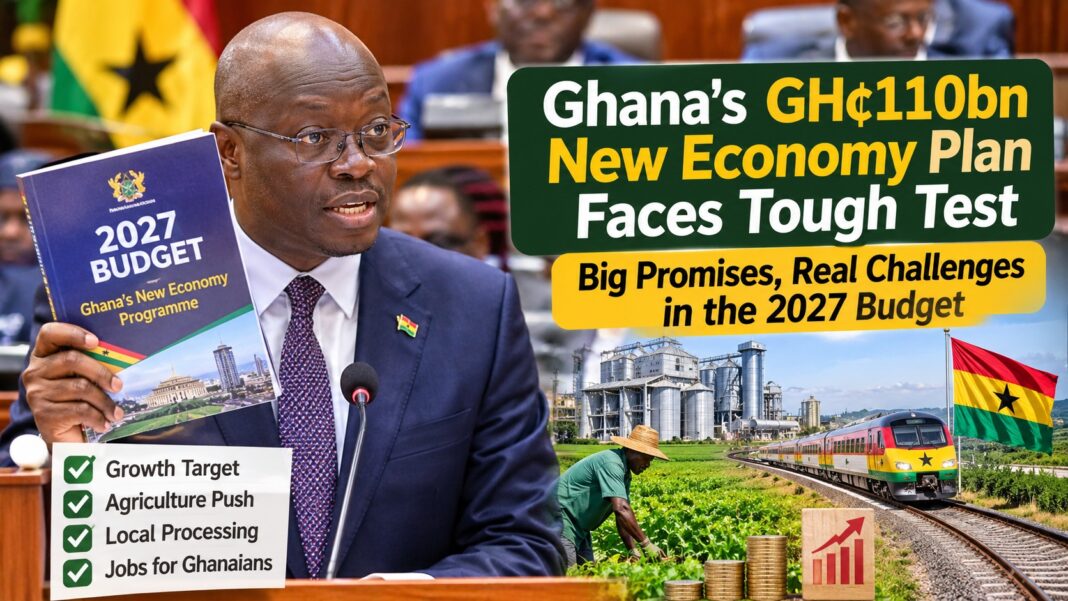

Ghana’s 2027 Budget presents an ambitious attempt to move the country from economic stabilisation towards industrial expansion, domestic production and employment creation. However, a closer examination of the figures, fiscal projections and policy commitments reveals a significant gap between the Government’s transformation ambitions and the economic realities that will determine whether they can be achieved.
At the centre of Finance Minister Dr Cassiel Ato Forson’s November 12 presentation is a US$10 billion investment programme, equivalent to approximately GH¢110 billion, which will run from 2027 to 2030. Dubbed the New Economy Programme, the initiative is expected to finance commercial agriculture, energy infrastructure, critical minerals processing, pharmaceuticals, textiles, technology and other productive sectors.

The Government describes the initiative as a transition from stabilisation to prosperity, arguing that improved macroeconomic conditions have created the fiscal space necessary to invest in production, expand exports and generate employment. Yet, while the economic recovery is supported by measurable improvements in several key indicators, the proposed programme contains targets whose feasibility remains uncertain, particularly when examined against Ghana’s production capacity, infrastructure constraints, financing arrangements and continuing fiscal vulnerabilities.

The central question, therefore, is not whether Ghana needs a productive economic transformation. It undoubtedly does. Rather, it is whether the country possesses the financial resources, institutional capacity and industrial foundations to deliver the promises contained in the budget without undermining the very stability that has taken considerable effort to restore.

Stabilisation Is Real, But Ghana’s Economic Recovery Remains Incomplete
To properly assess the 2027 Budget, it is important to acknowledge that Ghana’s economic circumstances have improved considerably since the crisis that forced the country to seek assistance from the International Monetary Fund in 2022.

On July 27, 2026, the IMF Executive Board completed the sixth and final review of Ghana’s 39 month Extended Credit Facility arrangement, bringing total disbursements under the US$3 billion programme to approximately US$3 billion. Ghana subsequently transitioned into a three year Policy Coordination Instrument, which provides continued IMF monitoring and policy guidance without additional programme financing.
The development represents an important milestone in the country’s economic recovery. Inflation, which reached 54.1 per cent in December 2022, declined substantially, touching 3.2 per cent in March 2026 before edging upwards to 5.5 per cent in October. Economic growth also strengthened, with the economy expanding by 6.2 per cent during the first half of 2026, according to the Ministry of Finance.

These are meaningful improvements. Lower inflation offers households some relief from the rapid increases in the prices of goods and services, while declining interest rates can gradually reduce the cost of borrowing for businesses and individuals. The Bank of Ghana’s reduction of its monetary policy rate from 21.5 per cent in September 2025 to 14 per cent in September 2026 also demonstrates the extent of the monetary easing made possible by improved economic conditions.

However, declining inflation must not be confused with falling prices. When inflation decreases, prices generally continue rising, albeit at a slower rate. Consequently, the reduction in inflation does not automatically restore the purchasing power households lost during the period of exceptionally high price increases.
For ordinary Ghanaians, the real measure of recovery is whether wages can purchase more food, transport, electricity and essential household supplies, rather than simply whether the inflation rate has fallen.
There is also a need to examine the Government’s presentation of the external sector. Although Ghana accumulated approximately US$13.8 billion in gross international reserves at the end of December 2025, the Bank of Ghana’s subsequent figures show that reserves had declined to approximately US$12 billion by September 2026, equivalent to 4.5 months of import cover. The Ministry of Finance also reported reserves of US$12.1 billion in its 2027 Budget assessment.
This means that the country has retained a significant external buffer, but the direction of movement is less reassuring than a general assertion that reserves have improved might suggest. The budget itself now targets a recovery towards at least six months of import cover over the medium term.
The cedi has also experienced renewed depreciation pressures after its substantial appreciation in 2025. The Bank of Ghana’s October investor bulletin reported a year to date depreciation of approximately 6.6 per cent against the US dollar at the end of September 2026.
Consequently, although Ghana has made genuine progress in restoring macroeconomic stability, the recovery remains vulnerable to external payments, import demand, commodity price fluctuations and the country’s ability to sustain foreign exchange inflows.
The US$10 Billion Promise: Where Will the Money Come From?
Perhaps the most consequential announcement in the 2027 Budget is the Government’s commitment to invest approximately US$10 billion over four years in the New Economy Programme.
The initiative translates into an annual investment commitment of approximately US$2.5 billion, with GH¢30 billion allocated for the first year, representing approximately 1.7 per cent of projected GDP in the detailed budget estimates.
The Finance Minister has indicated that the programme will be financed through domestic fiscal resources rather than additional borrowing specifically for the initiative. The proposed financing arrangement involves reducing the primary surplus target from 1.5 per cent of GDP to 0.5 per cent, thereby creating additional room for investment, alongside an anticipated 0.5 per cent of GDP in additional revenue mobilisation.
This is a significant policy shift that deserves greater public scrutiny.
A primary surplus represents the excess of government revenue over expenditure before interest payments on public debt. By reducing the targeted surplus, the Government is effectively choosing to devote a greater proportion of available resources to development expenditure rather than debt reduction.
The argument is that Ghana cannot remain permanently focused on fiscal consolidation without investing in the productive capacity required to expand its economy and generate future revenue.
There is merit in that reasoning. However, the critical question is whether the expected revenue improvements will materialise and whether the Government can maintain fiscal discipline while financing such an ambitious programme.
The distinction between commitment and cash balances is particularly important. Although the budget projects a primary surplus of 0.5 per cent of GDP on a commitment basis in 2027, it simultaneously forecasts a primary deficit of 0.3 per cent on a cash basis. The cash primary balance is also projected to remain negative in 2028 and 2029, reaching approximately zero in 2030.
In practical terms, the Government may record a surplus when expenditure commitments and revenue obligations are accounted for, while actual cash movements continue to reveal a financing shortfall.
This matters because contractors, suppliers, workers and businesses cannot operate on accounting commitments alone. They require actual payments.
The proposed reduction in the primary surplus also raises questions about Ghana’s fiscal framework and the legislative adjustments required to accommodate the revised fiscal anchor. A change in the fiscal target must be accompanied by credible safeguards to prevent the additional spending space from becoming an avenue for renewed expenditure overruns.
Furthermore, the budget projects interest payments of approximately GH¢61 billion in 2027. The medium term expenditure projections indicate that debt servicing will remain a substantial claim on public resources, limiting the amount available for education, healthcare, infrastructure and other essential services.
The New Economy Programme may therefore be financially possible, but its success depends on more than announcing GH¢30 billion in annual allocations. It requires the Government to demonstrate that the money will be released on schedule, directed towards commercially viable projects and protected against waste, procurement irregularities and political interference.
Agriculture: Ambitious Import Substitution, But Can Ghana Produce Enough?
Commercial agriculture is among the most important components of the New Economy Programme, and understandably so. Ghana continues to spend substantial foreign exchange importing food products that could potentially be produced locally.
The Government intends to increase domestic rice production, develop the sugar industry, strengthen agricultural value chains and reduce the country’s dependence on imported food.
One of the most ambitious commitments is the prohibition of commercial rice imports by 2030. The budget argues that the restriction will be supported by expanded domestic production, milling facilities, storage infrastructure, quality assurance and improved distribution networks.
The objective is economically attractive. Reducing rice imports could conserve foreign exchange, create employment across agricultural communities and strengthen the domestic food processing industry.
However, an import prohibition is not itself an agricultural production strategy.
Ghana must first demonstrate that local farmers can consistently produce sufficient quantities of rice at competitive prices and acceptable quality standards. This requires reliable irrigation, mechanisation, affordable fertiliser, improved seeds, access to agricultural credit, adequate storage and efficient transportation.
Without these foundations, an import prohibition could create shortages, increase food prices and disproportionately affect low and middle income households.
The sugar industry presents an equally challenging proposition. The Government intends to achieve self sufficiency in sugar by 2030 through irrigated sugarcane cultivation, commercial estates, organised outgrower schemes and viable processing factories.
However, sugar production requires considerable capital investment, reliable water supplies, extensive agricultural land, industrial processing facilities and a dependable supply of raw materials. Establishing a commercially sustainable sugar industry within approximately four years will therefore require an extraordinary level of coordination and implementation discipline.
For consumers, the consequences of failure could be immediate. If domestic production cannot meet demand, restrictions on imports could increase the cost of rice and sugar, two important commodities in household consumption.
The objective should therefore be to make locally produced food competitive before making imported alternatives inaccessible.
Minerals Processing: Ghana Must Move Beyond Exporting Raw Materials
The Government’s critical minerals agenda is another major component of the proposed transformation.
Ghana intends to process at least 50 per cent of its manganese and bauxite locally by the end of 2028, increasing this to full domestic processing by the end of 2030.
The objective is to retain more economic value within the country rather than exporting raw materials and importing finished products at significantly higher prices.
This is a sensible industrial policy direction, particularly considering Ghana’s mineral resources and the employment opportunities associated with manufacturing and processing.
Nevertheless, establishing an internationally competitive mineral processing industry requires more than access to raw materials.
Bauxite refining into alumina and subsequent aluminium production are energy intensive activities. They require dependable electricity, substantial industrial investment, modern technology, transportation infrastructure and access to international markets.
The proposed Western Corridor Railway, linking Takoradi through Nsuta and Awaso to Nyinahin, is therefore important to the Government’s industrial ambitions.
Without reliable transportation infrastructure, the cost of moving minerals from production areas to processing facilities and export terminals could undermine the commercial viability of the entire initiative.
The Government has also indicated that the railway will be financed through petroleum revenues and mineral royalties rather than additional borrowing. However, the project still requires detailed feasibility studies, engineering designs, environmental assessments and competitive procurement.
The 2027 Budget’s commitment to local mineral processing is therefore strategically important, but the timelines are exceptionally demanding.
Pharmaceuticals and Technology: More Achievable, Provided Investment Is Sustained
The Government’s pharmaceutical manufacturing programme seeks to ensure that between 60 and 80 per cent of Ghana’s essential medicine requirements are manufactured locally by 2030.
The initiative includes pharmaceutical and biomanufacturing hubs in the Eastern and Central Regions, alongside proposed changes to public procurement arrangements that would prioritise locally manufactured medicines where adequate quantities and approved quality standards are satisfied.
This approach could strengthen domestic manufacturing, create skilled employment and reduce the country’s exposure to disruptions in international pharmaceutical supply chains.
However, pharmaceutical production requires stringent regulatory oversight, access to specialised inputs, research capacity, modern manufacturing equipment and compliance with internationally recognised quality standards.
Ghana must also ensure that local manufacturers can produce medicines at competitive prices without compromising safety and effectiveness.
The technology component, including artificial intelligence infrastructure and improvements to digital connectivity, presents another opportunity.
Investments in data infrastructure, advanced computing, telecommunications and digital skills could improve productivity across financial services, education, healthcare, agriculture and public administration.
However, technology investment must extend beyond constructing facilities. Ghana needs trained personnel, reliable electricity, affordable internet access, effective cybersecurity and commercially sustainable applications.
These projects appear more achievable than some of the agricultural and mineral processing targets, provided implementation is supported by credible financing and measurable performance indicators.
The Eight Per Cent Growth Target and the Employment Question
Perhaps one of the most striking ambitions in the 2027 Budget is the Government’s target of approximately 8 per cent economic growth by 2030, accompanied by a reduction in unemployment to below 8 per cent.
These objectives are important because economic growth that does not translate into employment, improved wages and higher household incomes offers limited relief to ordinary citizens.
However, the budget contains an important distinction between its headline ambitions and its detailed medium term projections.
While the New Economy policy section identifies growth of approximately 8 per cent by 2030, the medium term macroeconomic framework separately projects average annual economic growth of at least 5 per cent between 2027 and 2030.
The two figures are not necessarily impossible to reconcile, since an annual growth target for 2030 is different from an average growth target across four years. Nevertheless, the Government needs to explain the assumptions and production increases required to achieve the higher target.
The detailed fiscal projections also show declining oil revenue over the medium term. This makes it particularly important to scrutinise the underlying production assumptions rather than assume that higher growth will automatically follow from the New Economy allocations.
The employment target presents another challenge.
Ghana’s unemployment problem is closely connected to the quality of available jobs, informality, skills mismatches and the limited capacity of the private sector to absorb the growing labour force.
Consequently, creating employment opportunities requires more than expanding government expenditure. It requires competitive industries, accessible financing, stable electricity, predictable regulation and a business environment in which private enterprises can expand.
For young Ghanaians, the real test will be whether the programme creates sustainable employment with reasonable wages, rather than temporary construction opportunities or short term public sector interventions.
What the Budget Means for Ordinary Ghanaians
Beyond the headline figures, the success of the 2027 Budget must ultimately be judged by its impact on household living standards.
For market women, farmers, transport operators, teachers, nurses, artisans and young graduates, economic recovery must translate into tangible improvements in their daily circumstances.
Lower inflation is welcome, but households still face the accumulated consequences of previous price increases. Reduced interest rates are encouraging, but small businesses must be able to obtain loans at affordable rates. A stronger agricultural sector is desirable, but locally produced food must become more affordable and consistently available.
Similarly, investment in energy infrastructure must result in a more dependable electricity supply and fewer financial pressures within the power sector.
The Government’s management of the energy sector is particularly important because the budget acknowledges a substantial energy sector financing burden. Although the Energy Sector Shortfall and Debt Repayment Levy has generated additional revenue, the underlying challenge of ensuring financial sustainability across electricity generation, transmission and distribution remains.
The 2027 Budget also provides for the early redemption of GH¢29 billion in Domestic Debt Exchange Programme bonds due in February 2027, alongside the planned repayment of a restructured Eurobond due in January 2027. The Government expects these transactions to retire more than GH¢36 billion in debt ahead of schedule.
These repayments could strengthen investor confidence and reduce refinancing pressures. Nevertheless, early debt repayment should not be confused with the complete elimination of Ghana’s public debt obligations.
The country must continue balancing debt servicing, development expenditure and the need to protect essential public services.
The Verdict: A Credible Economic Direction, But Delivery Will Determine Its Success
Ghana’s 2027 Budget is built around a legitimate economic objective: converting macroeconomic stabilisation into productive investment, industrial expansion and employment.
The achievements recorded since the height of the economic crisis should not be dismissed. The completion of the IMF programme, lower inflation, improved growth, stronger domestic revenue mobilisation and progress in rebuilding investor confidence provide a foundation upon which further economic transformation can be pursued.
However, the US$10 billion New Economy Programme should be assessed as a financing and implementation commitment, not as an automatic guarantee of economic prosperity.
Some components, particularly improvements in technology infrastructure, gold refining, electricity distribution, metering and the rehabilitation of energy sector finances, offer relatively identifiable pathways towards implementation.
Others, including the prohibition of commercial rice imports, nationwide sugar self sufficiency, extensive bauxite processing and the production of up to 80 per cent of essential medicines locally by 2030, require substantial investment and industrial capacity that cannot be established through budgetary announcements alone.
The Government must also explain the relationship between its revised primary surplus target, the actual availability of cash, the projected growth trajectory and the sustainability of public debt.
Ultimately, the greatest danger would be to mistake the restoration of macroeconomic stability for the completion of economic recovery.
Ghana has made progress, but the cost of living remains a concern, employment opportunities remain inadequate for many young people, businesses continue to face structural constraints and the economy remains exposed to external shocks.
The 2027 Budget therefore represents an important test of the Government’s economic credibility. Its success will not be determined by the size of the investment figure announced in Parliament, but by the factories that become operational, the farms that increase production, the roads and railways that are completed, the businesses that expand and the decent jobs that are created.
For the ordinary Ghanaian, the ultimate question is simple: will the New Economy make life more affordable, create sustainable employment and improve household incomes, or will it remain another ambitious development programme whose promises outpace its implementation?