
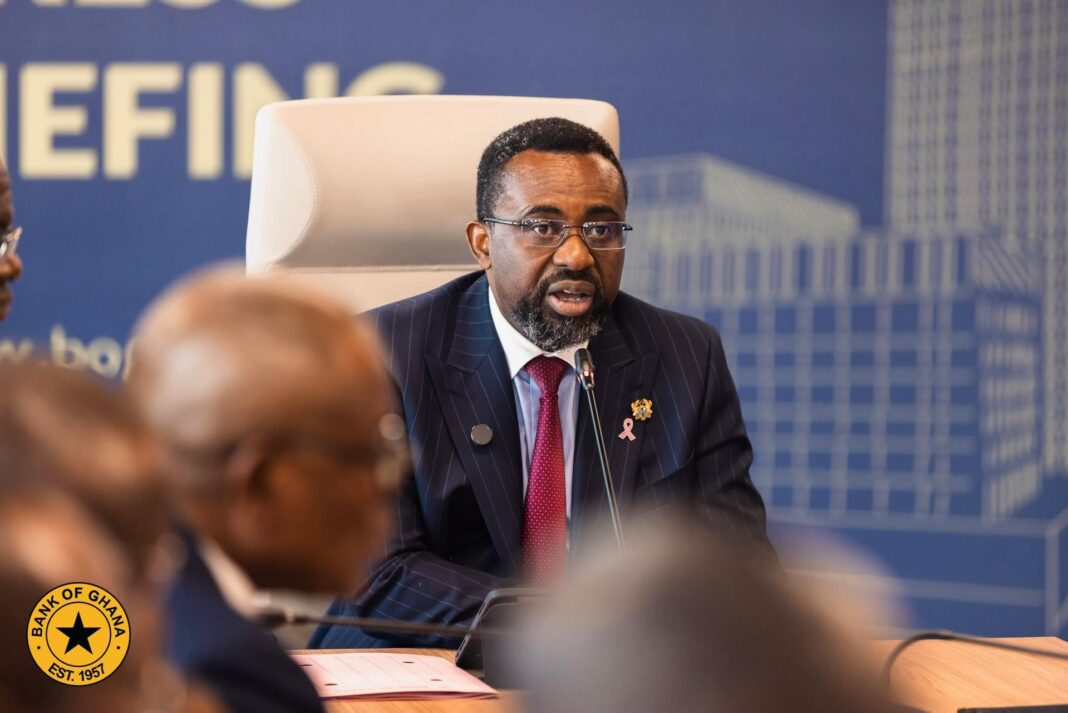

The Bank of Ghana (BoG) has announced plans to closely scrutinise the government’s financing strategy and proposed expenditure under the 2027 Budget to determine their possible consequences for inflation, financial sector liquidity and exchange rate stability.
Governor of the central bank, Dr Johnson Asiama, disclosed that the Monetary Policy Committee (MPC) would pay particular attention to the relationship between government expenditure, domestic borrowing requirements and the country’s broader monetary policy objectives.

Addressing participants at the opening of the 133rd Monetary Policy Committee meeting, Dr Asiama observed that the 2027 Budget comes at a critical stage in Ghana’s economic recovery, as the government increasingly prioritises productive investment and measures intended to stimulate economic expansion.

He explained that the committee would carefully evaluate the magnitude and structure of the projected fiscal surplus, the methods through which government operations would be financed and the potential consequences for overall economic demand.

“The committee will need to carefully assess the size and composition of the fiscal surplus, its financing arrangements, and the likely implications for aggregate demand, for liquidity, for inflation, and for the exchange rate,” Dr Asiama said.
The Governor further indicated that the timing and allocation of public expenditure would be important considerations in determining the availability and movement of liquidity throughout the financial system.

According to him, the committee would also investigate the government’s domestic financing requirements and their potential influence on prevailing monetary conditions to ensure that fiscal activities do not reverse the progress made in restoring economic stability.
Dr Asiama emphasised that effective collaboration between fiscal and monetary authorities would remain indispensable to protecting Ghana’s macroeconomic gains and sustaining a stable economic environment.

“The objective is to ensure that the fiscal and monetary policy frameworks remain coherent and mutually reinforcing in preserving macroeconomic stability,” he added.

The assessment forms part of the central bank’s wider examination of Ghana’s economic performance throughout 2026, alongside emerging vulnerabilities and policy considerations that could influence the direction of monetary policy in 2027.

