
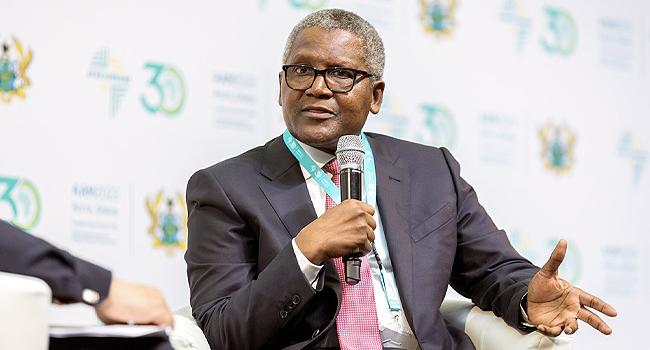

Nigerian industrialist and billionaire businessman Aliko Dangote has called on Ghana to expand its commercial ambitions beyond its domestic economy and capitalise on the enormous business opportunities available across West Africa, highlighting the subregion’s estimated 450 million population as a significant market for local industries and investors.
He maintained that Ghana could considerably improve its economic prospects by attracting capital into productive sectors, strengthening domestic manufacturing and taking advantage of regional trade arrangements to expand the distribution of locally manufactured goods beyond its national borders.

Speaking at the inaugural Invest in Ghana Summit on Monday, November 16, Mr Dangote encouraged Ghanaian business owners and investors to embrace a more expansive commercial strategy by viewing the entire West African region as an extension of their potential customer base.

According to him, Ghana’s economic opportunities should not be assessed exclusively through the size of its domestic population, particularly when membership of the Economic Community of West African States (ECOWAS) provides access to a considerably larger regional marketplace.

“When you are talking about Ghana’s market, it’s not only the population of Ghana. Ghana’s market, I was telling you, is 450 million people’s market,” he said.
Mr Dangote explained that deeper regional integration could enable businesses established in Ghana to increase their production capacity and distribute their products throughout neighbouring countries using existing trade frameworks intended to facilitate commercial exchanges among ECOWAS member states.

He consequently advocated a deliberate national strategy to transform Ghana into an important manufacturing, commercial and distribution centre for the wider West African economy.
Dangote Proposes 1,000km Highway Connecting Ghana, Nigeria and Côte d’Ivoire
Mr Dangote further identified inadequate transportation infrastructure and weak regional connectivity as significant obstacles preventing West African countries from fully exploiting their collective economic potential.

He therefore proposed the development of an approximately 1,000 kilometre highway connecting Nigeria, Ghana and Côte d’Ivoire, arguing that improved road transportation would facilitate the movement of commercial goods, reduce logistical difficulties and strengthen economic relations among the three countries.

The Nigerian business magnate disclosed his intention to hold discussions with Ghana’s President and other regional leaders to secure the necessary political commitment and ensure that the proposed infrastructure project receives the attention it deserves.
“I think we are really going to engage with the President and the other Presidents to make sure that this road is given a priority,” he stated.
The proposed highway is expected to strengthen transportation links between the three economies, improve access to regional markets and create more favourable conditions for businesses involved in cross border trade.
Dangote Warns African Countries Against Excessive Reliance on Imports
Beyond advocating greater regional commerce, Mr Dangote cautioned African governments against excessive dependence on imported merchandise, insisting that lasting economic development would require a substantial shift towards domestic manufacturing and productive investment.
He argued that economies which predominantly purchase finished products from overseas markets without developing competitive local industries risk transferring valuable employment opportunities, industrial investment and economic benefits to foreign manufacturing countries.
“If you are a consumer, you are not a producer; you will never, ever create jobs. You will never, ever create prosperity,” he said.
He explained that importing finished merchandise effectively means that many of the employment opportunities associated with producing those goods are generated outside the importing country.
Conversely, establishing and expanding domestic industries creates employment, stimulates commercial activity, strengthens local enterprises and allows a greater proportion of the economic benefits generated by production to remain within the country.
Citing Ghana’s rice industry, Mr Dangote urged consumers and government authorities to demonstrate stronger support for locally cultivated and processed rice, even where domestic products might initially cost slightly more than imported alternatives.
“Even if today in Ghana you are producing rice at a little bit more expensive than the imported one, it’s okay,” he remarked.
He maintained that purchasing locally manufactured products would help sustain Ghanaian farmers, agricultural processors and businesses operating throughout the domestic production chain, rather than allowing the associated economic gains to flow predominantly to overseas producers.
Dangote Considers Major Investments in Ghana’s Agricultural Industry
Mr Dangote also disclosed his business group’s interest in exploring additional investment opportunities in Ghana, particularly within industries capable of increasing domestic production, generating employment and reducing the country’s dependence on imported agricultural commodities.
Among the sectors identified for possible investment were sugar production, cocoa processing and rice milling, all of which offer opportunities to strengthen Ghana’s agricultural value chain and expand industrial activity.
Regarding sugar production, he revealed that discussions were underway with the Ghanaian government concerning a proposed investment with the potential to generate close to 50,000 employment opportunities.
Should the negotiations produce a final agreement, the project could support job creation across agricultural cultivation, industrial processing and other associated commercial activities.
Mr Dangote additionally indicated his willingness to consider establishing another 500,000 metric tonnes of rice processing capacity in Ghana, subject to reaching an understanding with the government.
Such an investment could strengthen the connection between domestic rice farmers and industrial processors, while expanding Ghana’s capacity to produce processed rice for its growing consumer market.
He nevertheless emphasised that African economies should prioritise developing sufficient domestic productive capacity to satisfy a larger proportion of their consumption requirements before making export expansion their principal economic objective.
According to him, building strong local industries and reducing dependence on imported finished products must remain central to Africa’s pursuit of sustainable economic transformation.

