
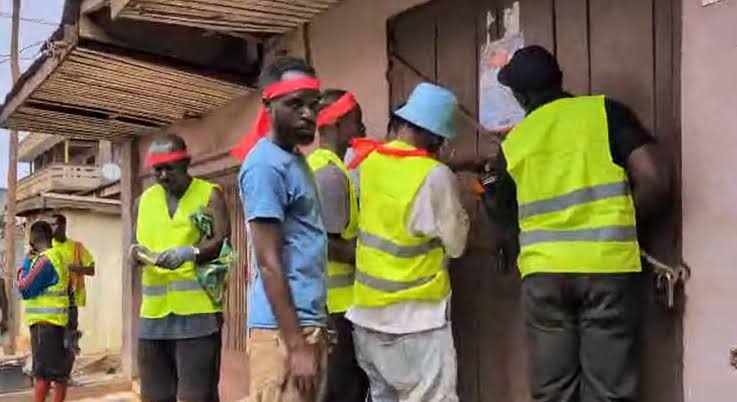

Artisans at Suame Magazine in the Ashanti Region have been instructed to reopen shops operated by Nigerian spare parts dealers following an intervention by security authorities to address escalating disagreements over foreign participation in Ghana’s automotive spare parts market.
The directive came after a meeting involving representatives of the Ghana Union of Traders Association (GUTA), regional security officials and other stakeholders, following the closure of several shops by local artisans on Monday.

The artisans had reportedly locked up the businesses over allegations that some foreign traders were engaging in unfair commercial practices, including undercutting prices and creating unhealthy competition for indigenous operators.

The intervention brought together the Ashanti Regional Police Commander, the Ashanti Regional Coordinator of National Security, Captain Kwame Jabari (Rtd.), executives of GUTA and other security representatives to discuss the dispute and prevent further escalation.

Speaking after the meeting, Captain Jabari disclosed that GUTA had agreed to ensure that the affected businesses were reopened before midday on Tuesday.
He explained that security personnel would first visit Suame Magazine to engage local artisans and other relevant stakeholders before holding separate discussions with Nigerian traders to establish the nature and limits of their permitted commercial activities within the facility.

“We’ll be going to the Magazine to have a stakeholder engagement with them. Then from there, we’ll have another meeting with the Nigerian counterparts on what they can and cannot do at the Magazine. So GUTA has decided on its own to open up the shops that they locked up yesterday before 12 o’clock,” he stated.
The security agencies have consequently assured traders that the statutory provisions governing foreign participation in Ghana’s retail and trading sectors would be upheld, while cautioning local artisans against resorting to self help measures to settle commercial disagreements.

Authorities urged aggrieved traders to submit their complaints through the appropriate institutional and security channels rather than taking unilateral actions that could threaten public order or result in confrontations.

GUTA clarifies identity of man involved in viral confrontation
Meanwhile, Ashanti Regional Chairman of GUTA, Anthony Oppong, has disputed reports surrounding the identity of a man captured being dragged during the confrontation at Suame Magazine in a widely circulated social media video.
Mr Oppong clarified that the individual was Ghanaian and not Nigerian, contrary to descriptions published by some media organisations following the incident.
He further alleged that the individual, together with other Ghanaian nationals, had been engaged by Nigerian traders to disrupt the artisans’ attempts to shut down the affected businesses, resulting in the altercation recorded in the viral footage.
The GUTA regional chairman indicated that the matter would be escalated to the association’s national executives for further deliberations, with the intention of finding a lasting solution to persistent disagreements between indigenous traders and their foreign counterparts.
He maintained that the dispute required broader institutional engagement, particularly regarding the conditions under which foreign nationals participate in commercial activities within Ghana’s trading centres.
GUTA raises concerns over taxes, import duties and alleged counterfeit spare parts
Mr Oppong also questioned disparities in taxation and import duties affecting Ghanaian and Nigerian spare parts dealers, suggesting that differences in their respective financial obligations could explain why certain products offered by foreign traders were comparatively cheaper.
He argued that variations in import costs and tax compliance could place indigenous businesses at a competitive disadvantage, particularly where locally established traders incur higher operational expenses.
Beyond pricing concerns, the GUTA regional chairman accused some foreign operators of participating in the distribution of counterfeit and imitation automotive components, although the allegations have not been independently established.
He called on the relevant regulatory authorities to intensify enforcement of the Ghana Investment Promotion Centre (GIPC) Act, which establishes the legal framework governing foreign investment and participation in commercial activities, including restrictions applicable to certain categories of retail trading.
The renewed calls for enforcement have brought the longstanding debate over foreign participation in Ghana’s retail sector back into focus, particularly within Suame Magazine, one of the country’s most prominent automotive spare parts and mechanical repair centres.
The latest security intervention is intended to ease tensions, restore normal commercial activities and provide an opportunity for structured discussions between Ghanaian artisans and Nigerian traders over their respective business rights and obligations.

