
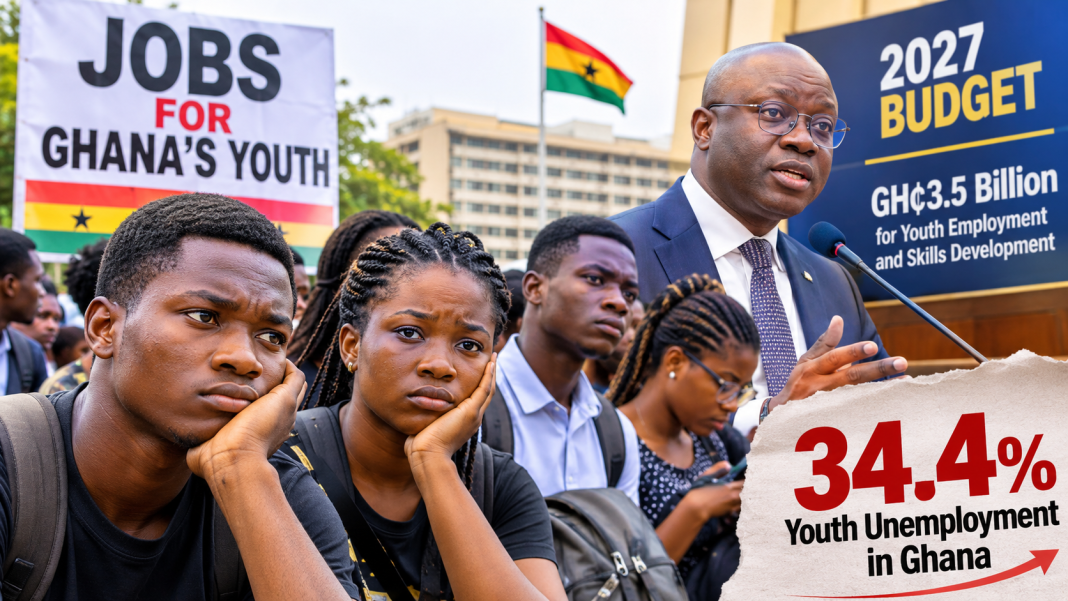

SPECIAL INVESTIGATIVE ANALYSIS | GHANA’S 2027 BUDGET | YOUTH EMPLOYMENT
Ghana’s youth unemployment crisis presents one of the most important tests of the Mahama administration’s economic transformation agenda. While Finance Minister Dr Cassiel Ato Forson continues to champion a proposed US$10 billion New Economy programme, official statistics reveal that a substantial proportion of the country’s young labour force remains without employment, raising questions about whether the government’s ambitious economic plans can deliver opportunities at the scale required.

The contradiction is particularly striking. Ghana is producing graduates, expanding tertiary education and preparing thousands of young people for the world of work, yet the economy is struggling to absorb many of those entering the labour market. For a generation expected to drive the country’s future productivity, the difference between economic growth and actual employment is becoming increasingly consequential.

The problem is not simply that Ghana needs more jobs. It is that the country needs an economy capable of producing sufficient decent, productive and sustainable employment to accommodate its expanding working-age population.

And that is precisely where the government’s New Economy agenda must be subjected to serious scrutiny.

Suggested editorial image: Ghanaian university students attending a career and employment engagement. The image should accompany the story as an illustration of the transition from education into work.
The unemployment figures Ghana cannot ignore
The latest findings from the Ghana Statistical Service’s second edition of its 2026 Productivity, Employment and Growth Report provide a sobering account of the country’s employment situation.

Approximately 34.4 per cent of people aged 15 to 24 who were participating in the labour force were unemployed in the third quarter of 2025. This means that roughly one in every three young people who were either working or actively seeking employment could not find a job. The average for the first three quarters of 2025 was 32.4 per cent.

The situation is particularly troubling in Greater Accra, where unemployment among people aged 15 to 24 reached 49.3 per cent in the third quarter of 2025. Central Region followed with 48.9 per cent, while Western Region recorded 46.8 per cent.
These figures are important because they expose the geographical inequalities underlying Ghana’s employment crisis. The country’s economic capital, which should offer a wider range of employment opportunities, is also experiencing exceptionally high youth unemployment.
The problem extends beyond those actively searching for work. The GSS estimates that approximately two million young people aged 15 to 35 were neither employed, enrolled in education nor participating in training in the third quarter of 2025.
The distinction matters. Unemployment statistics capture people actively looking for work, whereas the NEET measure also identifies young people who have become disconnected from both employment and opportunities to develop their skills.
The education figures are equally revealing. In the third quarter of 2025, unemployment among people whose highest educational qualification was secondary education stood at 36.2 per cent, compared with 14.3 per cent among those with tertiary qualifications.
This does not mean that obtaining a university degree guarantees employment. Rather, it demonstrates the difficulties facing people entering the labour market without further specialised qualifications, while highlighting the importance of technical training, practical experience and access to employment opportunities.
Ghana’s overall unemployment rate has declined from 14.7 per cent in 2023 to 13.7 per cent in 2024 and 12.8 per cent in 2025, using comparable third quarter figures. However, the improvement in the national indicator should not obscure the considerably greater difficulties experienced by younger workers.
The GSS also reports that Ghana’s employed population increased from approximately six million in 1992 to 13.3 million in 2025. Yet, in the third quarter of 2025, 85.9 per cent of employed people were working in the informal sector. Self employment accounted for 61.8 per cent of employment, while paid employees represented just 20.5 per cent.
Consequently, the central question is no longer simply whether Ghana is generating employment. It is whether the opportunities being created offer adequate remuneration, stability, productivity and social protection.
The Ghana Statistical Service’s 2026 report findings provide the latest evidence of this challenge.
Economic growth without sufficient quality jobs
The employment problem becomes even more concerning when considered against the country’s economic performance over the past decade.
In its June 2025 Ghana Economic Update, the World Bank identified a significant disconnect between the expansion of Ghana’s working age population and the economy’s capacity to generate employment.
Between 2012 and 2023, Ghana’s working age population increased by approximately 2.7 million, while net employment expanded by only about 250,000.
The report also established that youth labour force participation among people aged 15 to 29 declined from 62 per cent to 41 per cent over the period.
Although a substantial proportion of this decline reflected more young people remaining in education, the World Bank found that inadequate employment opportunities were also discouraging people from seeking work.
More troublingly, only 13 per cent of Ghanaian workers occupied what the World Bank classified as high quality jobs in 2023. These were formal salaried positions or occupations requiring higher skills.
Between 2012 and 2023, more than three million additional working age people acquired secondary education or higher qualifications, but only approximately 150,000 high quality jobs were created.
This is a particularly important finding for the Mahama administration because it demonstrates that expanding access to education without simultaneously expanding productive employment can intensify competition for the limited number of attractive positions.
The World Bank further observed that low quality jobs paid, on average, approximately half the earnings associated with high quality employment.
In other words, Ghana’s challenge is not simply to get young people working. It is to create an economy in which education, professional qualifications and technical competence translate into meaningful economic advancement.
The World Bank’s ninth Ghana Economic Update provides substantial evidence of this structural weakness.
What exactly has Ato Forson allocated in the 2027 Budget?
The government’s response to the crisis is now taking shape through its 2027 Budget Statement and Economic Policy, presented by Finance Minister Dr Cassiel Ato Forson on November 12, 2026.
The budget places considerable emphasis on the New Economy programme, a proposed US$10 billion investment initiative covering the four year period from 2027 to 2030. Its stated objective is to transform Ghana’s productive capacity, increase domestic manufacturing, expand exports and generate employment.
However, beyond the headline investment announcement, the actual allocations for youth employment deserve closer examination.
According to the budget, the Ministry of Youth Development and Empowerment has received an allocation of GH¢3.5 billion for 2027.
The allocation is broken down as follows.
2027 Ministry of Youth Development and Empowerment allocation
GH¢3.5 billion
Total ministry allocation announced in the 2027 Budget
Youth employment and skills development
GH¢2 billion
National Service Personnel allowances
GH¢1 billion
National Entrepreneurship and Innovation Programme
GH¢170 million
National Youth Authority
GH¢200 million
Percentages are calculated against the GH¢3.5 billion headline allocation. The listed components total GH¢3.37 billion, leaving GH¢130 million not separately itemised in the budget speech.
The most significant component is the GH¢2 billion earmarked for youth employment and skills development programmes. This is the allocation most directly associated with expanding employment opportunities and preparing young people for work.
Another GH¢1 billion is intended for National Service Personnel allowances. Although this is an important commitment to young graduates undertaking national service, it should not automatically be interpreted as funding for one million cedis worth of new employment opportunities. Paying allowances to existing service personnel is different from creating additional permanent jobs.
The National Entrepreneurship and Innovation Programme receives GH¢170 million, while the National Youth Authority is allocated GH¢200 million.
The Ministry of Labour, Jobs and Employment, which is responsible for employment administration and labour related activities, has separately received GH¢156 million.
These figures reveal an important distinction that should inform public discussion: the GH¢3.5 billion frequently presented as the government’s youth investment is not entirely a fund for creating new jobs. A substantial portion supports existing institutional responsibilities and national service allowances.
The additional GH¢1 billion: What does removing the funding cap mean?
Beyond the direct allocation, Dr Forson announced another important intervention that could increase funding for youth employment and apprenticeship initiatives.
Government intends to amend the Earmarked Funds Capping and Realignment Act, 2017, Act 947, to remove the existing funding cap affecting resources earmarked for youth employment programmes.
The Finance Minister says this reform will release an additional GH¢1 billion for youth employment and apprenticeship programmes through uncapped revenue from the Communications Service Tax.
This is potentially significant because it provides an opportunity to strengthen programmes such as the National Apprenticeship Programme, Adwumawura and other employment interventions.
The government has also indicated that it intends to amend and modernise the Youth Employment Act to harmonise the various initiatives.
Nevertheless, there is a difference between announcing additional funding and demonstrating that the money has actually been released, committed and converted into employment opportunities.
The proposed legislative amendment must be completed, the expected revenue must materialise and the relevant institutions must demonstrate their ability to administer the resources effectively.
There is also a need for transparency regarding how the additional GH¢1 billion will be distributed among the different programmes and how many beneficiaries will secure employment after participating.
The public should not be expected to accept the announcement of an additional allocation as proof that the employment crisis is being resolved.
The US$10 billion New Economy: An ambitious industrialisation strategy
The government’s wider response is the New Economy, New Ghana: Jobs and Prosperity Programme, which is expected to receive GH¢30 billion in 2027 alone.
The four year programme is built around eight pillars, including commercial agriculture, energy infrastructure, critical minerals processing, tourism and creative arts, textiles and garments, pharmaceuticals and biomanufacturing, technology and macroeconomic stability.
The underlying argument is that Ghana cannot overcome unemployment through government recruitment and short term youth interventions alone. It must expand the industries capable of employing large numbers of people and encourage private businesses to invest in production.
There is considerable merit in this approach.
Commercial agriculture, for example, could create opportunities for young people in farming, food processing, storage, packaging, transportation and distribution. Rather than limiting employment to primary agricultural production, the government wants to develop interconnected industries that generate economic activity throughout the value chain.
The programme’s agricultural pillar includes an indicative employment potential of 900,000 direct and 1.7 million indirect opportunities under the Feed Ghana framework. However, the programme document makes clear that the costed implementation plan must still validate the sectoral, regional, gender and youth targets.
The proposed US$1 billion investment in textiles and garments also offers an opportunity to expand manufacturing employment, particularly among young people who can acquire technical and industrial skills.
Similarly, the US$1.5 billion critical minerals investment compact is intended to move Ghana beyond exporting raw minerals towards domestic processing and value addition.
The pharmaceutical and biomanufacturing initiative could create technical, scientific, engineering and manufacturing opportunities, while the technology pillar includes a proposed US$300 million investment in digital infrastructure, artificial intelligence and digital skills.
These are sectors with genuine employment potential.
However, the question is whether the government can convert these ambitions into operational businesses, functioning industries and jobs that pay sustainable wages.
The New Economy programme document provides the detailed policy architecture.
Can the proposed investment realistically solve youth unemployment?
Despite the scale of the proposed investment, there are several reasons why the government should be cautious about presenting the New Economy programme as a guaranteed solution to Ghana’s employment crisis.
First, the proposed investment is not exclusively a youth employment fund.
The GH¢30 billion allocated to the New Economy is intended to finance infrastructure, industrial development, agricultural transformation, energy projects and other productive investments. Although these interventions could generate employment, there is no basis for treating the entire amount as money that will directly create jobs for young people.
Second, the government’s strategy depends heavily on private sector participation.
The 2027 Budget explicitly states that private businesses will carry the principal responsibility for investment, innovation, production and sustainable employment, while government provides strategic infrastructure and a favourable investment environment.
This is economically sensible. Government cannot permanently employ every young Ghanaian.
However, private businesses cannot expand their workforce simply because government has announced an industrialisation programme. They require affordable financing, dependable electricity, access to markets, appropriate infrastructure, predictable regulation and sufficient consumer demand.
The World Bank’s 2025 assessment identified substantial obstacles in these areas. More than 55 per cent of businesses cited financing constraints, while 74 per cent experienced frequent electricity outages.
If these difficulties remain unresolved, the industries expected to absorb unemployed young people could struggle to expand at the necessary pace.
Third, the government’s employment strategy must confront the problem of skills mismatch.
It is not sufficient to train thousands of young people in different occupations without establishing whether businesses need those particular skills or whether employment opportunities exist after graduation.
The National Apprenticeship Programme is a potentially valuable intervention. The government has announced a target of 50,000 apprentices for 2027.
Nevertheless, the effectiveness of the programme should be measured by how many participants obtain paid employment, establish viable businesses or secure sustainable contracts after completing their training.
Training numbers are not employment numbers.
A young person who completes an apprenticeship but cannot afford the equipment required to practise the trade has not necessarily escaped unemployment.
Similarly, a graduate of a digital skills programme who cannot access reliable internet, working equipment or paying clients remains economically disadvantaged.
The government’s responsibility must therefore extend beyond training to include equipment, financing, mentorship, business development and actual connections to employers.
The funding question: Is GH¢3.5 billion enough?
Another important consideration is the financial capacity of the Ministry of Youth Development and Empowerment to deliver its objectives.
The Ministry’s 2026 to 2029 Medium Term Development Plan identifies a substantial financing requirement for its proposed programmes.
The document estimates that implementing the plan will require approximately GH¢22.22 billion over four years. However, projected revenue over the same period is estimated at GH¢10.10 billion, leaving a funding gap of approximately GH¢12.12 billion.
This is a significant warning.
The Ministry’s own development framework therefore identifies a financing challenge that cannot be dismissed simply because the 2027 Budget has announced a GH¢3.5 billion allocation.
The government must explain how the funding gap will be addressed, which programmes will receive priority and how the resources will be distributed across the country.
There is also an important question concerning the relationship between the Ministry’s proposed target of reducing youth unemployment to 10 per cent by 2029 and the New Economy programme’s ambition of reducing national unemployment below 8 per cent by 2030.
The latter is a national unemployment target, not a specific commitment to reduce youth unemployment below 8 per cent.
The two targets should not be confused.
The New Economy’s financing and accountability questions
There is another issue deserving attention.
The Finance Minister announced that the US$10 billion New Economy programme would be financed partly through a reduction of one percentage point in the primary surplus target over the programme period and partly through tax reforms and compliance measures expected to generate 0.5 per cent of GDP.
For 2027, the government has earmarked GH¢30 billion, equivalent to approximately 1.5 per cent of GDP.
These financing arrangements require careful monitoring because the success of the programme depends on the government’s ability to mobilise the projected resources without undermining the economic stability it has worked to restore.
Furthermore, the accompanying New Economy policy document contains a financing calculation that deserves clarification. Its table calculates annual investment at 1.5 per cent of GDP between 2027 and 2030, producing a four year total of approximately US$11.72 billion, whereas the budget announcement describes the programme as a US$10 billion initiative.
The government should explain the difference in the financing scope and whether the figures represent different categories of public and catalytic investment.
More importantly, the programme document acknowledges that several important employment baselines and targets will be finalised through a costed implementation plan.
This is where public accountability becomes indispensable.
A programme promising to transform employment conditions must identify how many jobs it expects to create, the industries in which those jobs will emerge, the regions expected to benefit and the proportion that will be available to young people.
It must also distinguish permanent employment from temporary construction opportunities, apprenticeships, informal self employment and indirect economic opportunities.
Without these distinctions, the government could announce impressive employment figures without necessarily demonstrating a corresponding improvement in the lives of unemployed Ghanaians.
What must change if the programme is to succeed?
The first requirement is to establish a direct relationship between education, technical training and actual labour market demand.
Universities, technical institutions and vocational training centres must work more closely with employers to ensure that graduates acquire skills that businesses genuinely require.
The second requirement is to make small and medium sized businesses central to the employment strategy.
Large industrial projects are important, but Ghana cannot depend exclusively on a handful of major companies to absorb its expanding workforce. Small businesses, manufacturers, agricultural processors, technology enterprises and service providers collectively offer significant employment potential.
Affordable credit, reliable electricity, accessible markets and simplified business regulations are essential.
Third, government must strengthen the connection between apprenticeship programmes and employment opportunities. Training should be accompanied by equipment support, access to start up financing and partnerships with established businesses.
Fourth, employment programmes must become more transparent and less vulnerable to political interference. Beneficiary selection should be merit based, opportunities should be publicly advertised and programme performance should be independently assessed.
Finally, the government should publish quarterly employment scorecards showing actual jobs created, wages paid, beneficiaries retained in employment and the number of businesses established through public support.
The New Economy programme already proposes annual Jobs and Prosperity Scorecards, quarterly reporting and an independent evaluation in 2030. These commitments must become practical accountability mechanisms rather than remain policy declarations.
A generation cannot survive on economic projections
Ultimately, the Mahama administration faces a test that goes beyond the impressive figures contained in its economic transformation agenda.
The government has every reason to celebrate improvements in macroeconomic stability, and its ambition to redirect investment towards productive industries deserves serious consideration.
However, economic recovery cannot be considered complete when a significant proportion of young people remain unable to secure employment.
For the unemployed graduate, a declining inflation rate is important, but it does not replace a monthly salary. For the young person who has completed technical training, a billion cedis allocated to an employment programme is meaningless unless it translates into equipment, financing or an opportunity to earn a living.
For the young entrepreneur, the announcement of a new industrial economy means little if access to affordable credit remains difficult and the cost of operating a business continues to undermine profitability.
The government must therefore recognise that the success of its economic transformation agenda will ultimately be judged not by the amount of money announced, but by the number of sustainable opportunities created.
Ghana’s young population represents an extraordinary economic resource. The Ghana Statistical Service estimates that approximately 36.9 per cent of the population is aged between 15 and 35, representing millions of potential workers, entrepreneurs and innovators.
Allowing this generation to remain disconnected from productive economic activity would constitute a serious failure of national development.
The New Economy could provide an important foundation for addressing the crisis. Its agricultural, industrial, technological and manufacturing priorities offer credible pathways towards employment expansion.
But the gap between ambition and implementation remains substantial.
A government that promises a new economic order must demonstrate that the next generation will have a meaningful place within it.
The real measure of Ato Forson’s New Economy will not be the billions allocated in the 2027 Budget. It will be whether a young Ghanaian who is unemployed today can secure decent, sustainable work tomorrow.

