

SOURCE: BBC
COP31 climate talks in Turkey are at risk of collapsing after the EU formally rejected the latest draft agreement – we’re bringing you the latest updates and analysis here

The annual UN summit being held in Antalya has already become the longest-running in history, with negotiations continuing two days after it had been due to end – here’s a timeline of how we got here

The EU and some countries had been pushing to restore a commitment to move away from fossil fuels after producers led by Saudi Arabia called for its removal – the fourth draft still contains no mention of fossil fuels

The draft also acknowledges that the goal set by the 2015 Paris Agreement of keeping the rise in global temperatures below 1.5C is going to be missed – as warming goes beyond this the effects of climate change will ramp up significantly
Should countries be unable to reach consensus, the negotiations could be suspended until next year, which has happened only once before at a COP summit

Edited by Jamie Whitehead and Tinshui Yeung, with Esme Stallard and Justin Rowlatt reporting from the summit in Antalya, Turkey
COP31 President Murat Kurum says there is no agreement on the draft text and the decisions have not been adopted.

We’ll bring you more shortly.

Panama has now joined the EU in rejecting the deal on the table.
It praises the COP meetings but says this agreement doesn’t go far enough.
“Let me start with what [COP] has achieved,” he says. “It gave us the Paris Agreement.”
“Before Paris, the world was heading towards 4C. Current policies point towards 2.8C. That is clear progress. But 2.8C is not safe.”
“Science does not negotiate. The planet cannot continue to wait.”
This speech has received the biggest cheer in the room so far.
“There was a sense of energy and optimism that civil society could still put pressure on negotiators,” climate activist Isabel Ritchotte says, describing how she felt when she arrived in Turkey for her first COP earlier this week.
But now, “it feels pessimistic,” the 25-year-old tells BBC Newsbeat.
“It felt very bleak in the negotiation rooms and outside.
“There’s just a real sense that things aren’t coming together, and it feels like there’s a real risk of there just not being a consensus this year on the draft text.
“Sometimes a bad text is worse than no text at all,” she says.
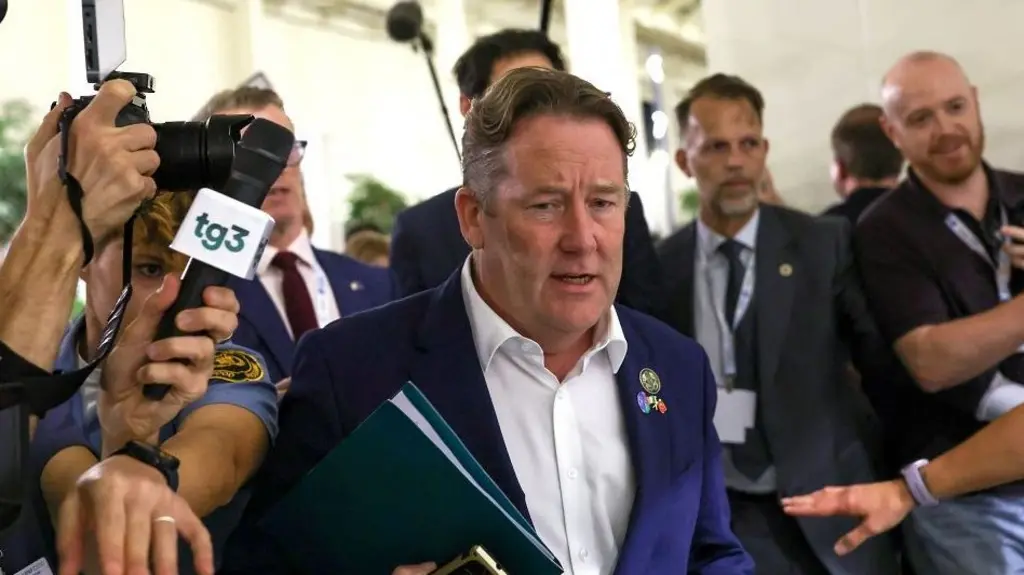
Irish Minister Darragh O’Brien, who is representing the EU here, is standing up and waving to the COP president to get the floor.
He wants to make clear again that the EU “strongly objects” to the deal.
“We are saying that on behalf of our citizens,” he says.
“These decisions go nowhere near the level of ambition needed to tackle climate change. It is unconscionable that we would have a climate pact that makes no mention of fossil fuels.”
More countries have signalled that they want to speak.
The most important climate deal – the Paris Agreement – was signed more than a decade ago.
One of its most important targets is the commitment by countries to “pursue efforts” to keep the rise in global temperatures below 1.5C.
As warming goes beyond 1.5C and gets closer to 2C, the impacts of climate change, including extreme heat, will ramp up significantly.
That goal has been reaffirmed at every COP meeting since.
In the draft of Antalya Pact – as the agreement will officially be known if adopted – countries acknowledge for the first time that the goal will be missed.
The importance of this cannot be overstated. The last time the planet was consistently as warm as it is now was more than 100,000 years ago.
In preparation for this new, warmer world, the text explicitly references “carbon dioxide removal” technologies.
These are used to take greenhouse gases out of the atmosphere. Carbon dioxide can be removed naturally by planting trees, although there are limits to the scale and permanence of this approach.
There are other technological solutions, but they’re controversial because they’re not sufficiently developed.
Irish Minister Darragh O’Brien, speaking on behalf of the EU, says the bloc formally rejects the deal.
He criticises the draft for being published so late in the day.
He said the EU cannot accept a text that doesn’t mention fossil fuels, and called it “greenwashing”.
The statement was met with cheers from NGOs at the back of the room, where I’m sitting.
Climate talks in Antalya have now become the longest in COP history, surpassing the delay in negotiations at COP25 in Madrid.
Negotiations at COP25, held in Madrid in 2019, took an extra two days and nights to reach a compromise between parties.
Before COP25, talks at COP17 in Durban stretched beyond 06:00 local time on the Sunday morning of the conference, according to reports at the time.
As our colleague from the science team has just mentioned, carbon capture, use and storage (CCUS) is one of the issues mentioned in the latest draft deal.
But what is CCUS?
Put simply, it’s a technology that aims to capture carbon dioxide (CO2) emissions and prevent them from entering the atmosphere.
CO2 is the main greenhouse gas contributing to global warming.
Emissions can be captured from industrial processes and power plants, for example.
The captured CO2 can be used in industry or stored underground.
The words “fossil fuels” have become so toxic at these climate conferences.
Whenever they are brought up, there is a huge debate.
Countries like Saudi Arabia, Russia and India have pushed back on including any reference to the words in the text.
Fossil fuels are so central to their economies that they are worried any commitment to phasing them out quickly could be a financial risk.
If you’re watching the live stream at the top of the page, you might be wondering what’s going on.
The COP31 president is currently going through various agenda items.
These are largely procedural, although some nations are still speaking up.
We haven’t yet got to the main agreement, or “cover decision” – where the major drama will happen.
The new draft agreement has just been released as the talks get under way.
It is 12 pages long and runs to nearly 100 paragraphs.
It’ll take me a while to get through it, but these points initially stand out:
There’s still no mention of fossil fuels, a key ask of EU nations
There’s a call for countries to increase the share of energy consumption from electricity to 35% by 2035
The acknowledgement that the world is on track to miss the 1.5C temperature limit has been kept in. This was a key demand of the UK delegation
There are also subtle changes around how much carbon capture, use and storage (CCUS) will be deployed.
France is worried that relying too heavily on this technology – which captures emissions and stores them underground – could give petro-states a licence to continue burning oil and gas at current rates.
Another draft agreement has just been published, according to our reporters at the meeting of the COP31 summit in Turkey.
Murat Kurum, the COP president, has kicked off the meeting.
“We have worked day and night. We have built bridges. Until the very last moment we have sought opportunities to reach consensus.”
At this point, we stand on the threshold of a “historic decision”, he says.
The lead negotiator for the EU delegation, its climate commissioner Wopke Hoekstra, is striding into the room, followed by his entourage.
We know that Germany has said it won’t accept the deal as it stands.
But we’re waiting to see if the whole bloc of EU nations will reject it.
UK Energy Secretary Miatta Fahnbulleh has also taken her seat next to the UK’s negotiators.
We’re now just one hour away from this becoming the longest-running climate talks in history.
As ever with climate conferences, one of the major sticking points is the language around fossil fuels – the main cause of rising global temperatures.
The latest text doesn’t mention “fossil fuels”, but it does contain an indirect reference.
It starts by “recalling the United Arab Emirates Consensus in its entirety”. That’s a nod to COP28 in the United Arab Emirates in 2023, where countries agreed for the first time to “transition away” from fossil fuels in energy systems.
But the first draft of the deal, published on Monday, mentioned “fossil fuel” or “fossil fuels” six times.
By the time the second draft was published on Thursday, all references had gone – to the anger of many countries, particularly the most vulnerable.
So the COP31 presidency will be hoping the latest draft deal acts as a compromise. Whether it’s acceptable to everyone remains to be seen.
Earlier, we brought you a timeline of how we got here
I’ve just asked the president of the COP31 negotiations, Chris Bowen of Australia, whether the talks would collapse.
“Time will tell,” he tells me as he walks by.
9 November: Nearly 200 countries arrive in Turkey for the UN’s COP31 climate summit.
16 November: A first draft of the overarching decision – known officially as the Antalya Accords – circulates. Countries are deadlocked on finance, fossil fuels and adaptation.
19 November: A second draft is published, excluding any explicit references to moving away from fossil fuels.
Australian Chris Bowen, who is leading negotiations, says COP31 would be the first climate summit to acknowledge that the world would fail to hold warming to the 1.5°C limit set out in the Paris Agreement.
20 November: A group of countries led by France and Panama says the deal isn’t good enough. Panama’s environment minister demands that fossil fuels are mentioned in the document. Talks overrun.
22 November: A new draft agreement, published in the early hours, aims to save the talks as negotiators enter their second consecutive day of overtime.
The plenary session is due to begin soon.
Minister Kurum, the Turkish COP31 president, has taken his seat in the room, along with Simon Stiell, head of the UN climate body.
It looks like things are about to start.
I can see the Pacific island negotiators still in a close huddle with the Saudi Arabian negotiators in the middle of the floor.
We’ve just heard from inside the EU delegation that the bloc is meeting now and considering rejecting the agreement altogether.
France is reported to have said: “The text presented to us by the presidency this Sunday morning is even weaker than the previous one.”
And we’ve heard the French negotiator say that the EU worked through the night to reach a compromise, which was “cast aside”.
The last time there was no deal, was in 2000.
The UK delegation have just entered the hall, a sign that we might be approaching the start of this final meeting to pass the text.
But as one person comes in, another leaves. Mohammad Ayoub, a negotiator for the Arab Group, has just hurriedly left while on the phone.
Saudi Arabia is often the unifying nation among the petro-states and has been criticised for delaying talks throughout the two weeks in an attempt to prevent any mention of fossil fuels in the text.
It’s normal for these negotiations to go right down to the wire. But I think we’ve gone well past that point.
With delegates having had just a few hours’ sleep since Friday, I’m not sure how much longer this can go on for.

