
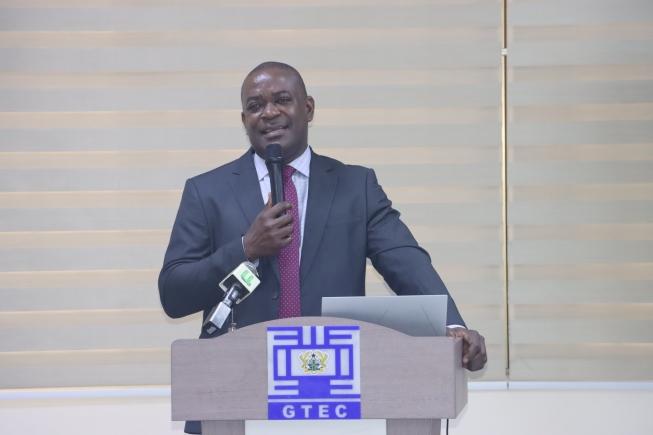

The Ghana Tertiary Education Commission (GTEC) has announced a nationwide suspension of new PhD admissions, pending a comprehensive assessment of doctoral programmes operated by universities and other tertiary institutions across the country.
The decision, according to GTEC Director General, Professor Ahmed Abdulai Jinapor, is intended to strengthen academic standards, address weaknesses in doctoral training and protect the international reputation of qualifications awarded by Ghanaian universities.

Speaking at the 19th Congregation of the University of Mines and Technology (UMaT) in Tarkwa, Professor Jinapor disclosed that the regulatory authority would undertake an extensive review of doctoral programmes to determine whether institutions had the necessary academic resources and administrative capacity to deliver quality postgraduate education.

He explained that the assessment would examine several critical areas, including programme accreditation, PhD enrolment figures, the academic qualifications and expertise of supervisors, research infrastructure, student completion rates and the credibility of thesis examination procedures.

Professor Jinapor emphasised that the exercise was not intended to penalise universities but to ensure that doctoral qualifications obtained in Ghana maintained the academic standing and international recognition expected of a PhD.
“Its purpose is not to punish; it is to protect the credibility of the Ghanaian doctorate, so that a PhD earned in Ghana commands respect at home and abroad,” he stated.

The GTEC Director General also expressed concern about what he described as excessive admissions into certain doctoral programmes, questioning whether institutions enrolling large numbers of candidates possessed sufficient qualified supervisors and research facilities to provide the necessary academic guidance.
He cited the case of an institution that had admitted more than 250 doctoral students, including 52 candidates into a single programme, as an illustration of the enrolment levels that had raised regulatory concerns.

According to him, such admission practices required closer scrutiny to establish whether universities could adequately supervise research, maintain academic rigour and ensure that candidates received the quality of training expected at doctoral level.

Professor Jinapor warned that institutions found to be operating PhD programmes primarily as commercial ventures, without sufficient regard for academic standards, could face suspension of their programmes.
He, however, assured universities that satisfied the required regulatory and academic conditions that their doctoral programmes would be permitted to continue. He specifically cited UMaT as an example of an institution whose programmes had demonstrated the standards GTEC expected.
Explaining the scope of the exercise, he said the Commission had directed universities offering doctoral qualifications to submit comprehensive information about their programmes for regulatory evaluation.
“We have asked all universities that are offering PhD programs to submit to us data of PhD programs that they are running. We’ll evaluate them. Those that are doing well like UMaT, we’ll allow you to. But those that are producing them for the sake of money, we are going to stop it. So in the meantime, GTEC, unfortunately, is putting a freeze on the acceptance of new PhD applications until we are done with this exercise,” he said.
The suspension will remain effective until the nationwide assessment has been completed and GTEC has determined which institutions meet the necessary requirements to operate doctoral programmes.
The exercise places renewed emphasis on the responsibilities of universities to maintain adequate supervisory capacity, credible research environments and rigorous examination procedures as Ghana seeks to strengthen the quality and international standing of its postgraduate education system.

