
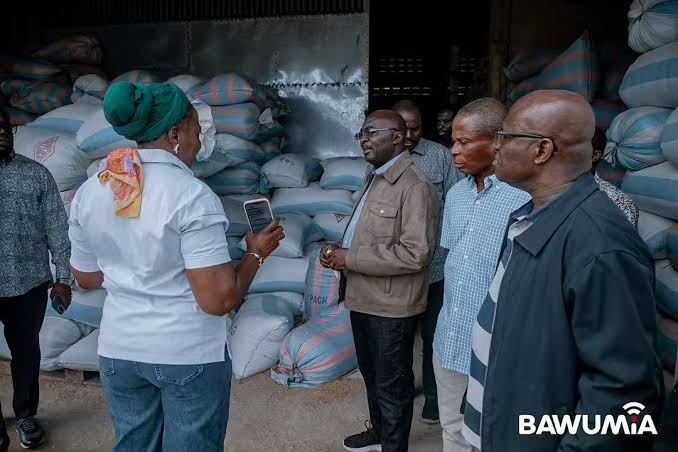

Former Vice President and New Patriotic Party (NPP) flagbearer, Dr Mahamudu Bawumia, has called for a comprehensive overhaul of Ghana’s agricultural policies to safeguard local rice producers against increasing production expenses and competition from cheaper imported rice.
He identified the volume of rice imports as the biggest obstacle confronting domestic producers, arguing that the influx of foreign rice had weakened the competitiveness of locally cultivated varieties and left farmers struggling to find buyers for their produce.

Dr Bawumia made the remarks during an engagement with rice farmers at Asutsuare in the Greater Accra Region on Friday, November 13, 2026, where he highlighted the growing disparity between the cost of producing rice locally and the prices at which imported alternatives were being sold.

Drawing comparisons with Japan’s agricultural policies, the former Vice President argued that Ghana should adopt a more deliberate approach to protecting its domestic rice industry, similar to the Asian country’s treatment of rice production as a national security priority.

He cited Japan’s relatively high domestic rice prices and limited dependence on foreign supplies, contrasting that with Ghana’s substantial reliance on imported rice.
“Rice prices in Japan are almost 50 per cent higher than the world price. We import over 50 per cent of rice. In Japan, it is less than 10 per cent,” he stated.

According to Dr Bawumia, the difference reflected a broader national attitude towards agriculture, insisting that Ghana needed to demonstrate greater commitment to supporting its farmers rather than leaving them vulnerable to external market pressures.
He maintained that imported rice had become more affordable than locally produced varieties, creating an unfavourable trading environment for domestic farmers.

“The imports are too high. The price of the imports is lower than the price of the local production,” he said.

Dr Bawumia attributed much of the price disparity to movements in the exchange rate, explaining that the appreciation of the cedi had substantially reduced the cost of importing rice over the past two years.
He estimated that import costs had declined by approximately 40 per cent during the period, while domestic producers continued to contend with rising operational and production expenses.
“The exchange rate has fallen by 40%. The import cost has come down by 40 per cent. You are hurting the farmers,” he added.
He warned that the situation had created an imbalance in which local farmers were increasing their output but struggling to dispose of their harvest because cheaper foreign rice was competing for the available market.
To address the difficulties, Dr Bawumia proposed a series of interventions aimed at strengthening domestic production, expanding the market for locally grown rice and reducing the country’s dependence on foreign supplies.
He called on the government to make local rice procurement a priority, particularly in public institutions such as schools and prisons, arguing that state purchases could provide farmers with a dependable outlet for their harvests.
He also advocated increased funding and operational support for the National Food Buffer Stock Company to enable it to purchase larger quantities of locally produced rice and absorb some of the surplus currently held by farmers.
According to him, failure to establish a reliable market for domestic producers could trigger widespread unemployment across the agricultural value chain, affecting farmers, mill operators and other workers who depend on the industry.
Dr Bawumia further advocated a deliberate reduction in rice imports, maintaining that Ghana possessed sufficient agricultural potential and arable land to achieve substantial self sufficiency in rice production.
He identified irrigation infrastructure as a critical requirement for expanding cultivation and called for the completion of Phase Two of the Pwalugu Irrigation Project, which he said had experienced a prolonged interruption in construction.
He argued that the absence of progress on the project over the preceding two years had deprived farmers in some areas of the water supply required to sustain agricultural activities.
“We should finish the Phase Two of the Pwalugu Irrigation Project so that you can have water to do the production. The last two years, there has been no work,” he said, adding that farmers in some project areas had been unable to cultivate their land because of the stalled works.
The former Vice President also proposed the restoration of fertiliser subsidies to reduce the financial burden on farmers and make domestic rice production more competitive.
He maintained that Ghana’s ability to feed its population without excessive dependence on foreign supplies should be treated as a national security concern, insisting that agricultural development must receive sustained government attention.
The farmers who interacted with him, meanwhile, described the difficulties they had encountered in disposing of their harvests, revealing that substantial quantities of rice produced over the past two years remained unsold.
Alex Tawiah Amano, a rice farmer and Secretary of the Northern Low Level Branch of the Water Users Association, said producers expected to sell their harvests to generate income, support their families and recover the money invested in cultivation. However, he said farmers had been unable to find buyers for their produce during the previous two farming seasons.
Mr Amano explained that the problem extended beyond Asutsuare, with similar complaints emerging from farmers operating around Akuse, Kpong and other irrigation communities.
He said the absence of bulk purchasers had made it difficult to clear warehouses, stressing that rice production and marketing required buyers capable of purchasing substantial quantities at a time.
Another farmer, Sika Bright, who has more than 30 years of experience in rice cultivation and leads the Shai-Osudoku Rice Farmers Association, said the crisis was affecting more than 3,500 producers under his organisation.
He disclosed that thousands of tonnes of locally harvested rice had accumulated in processing mills and storage facilities, with some stocks already being damaged by weevils because of the prolonged delay in finding buyers.
Mr Bright said he personally had more than 100 tonnes of unsold rice, despite having borrowed from financial institutions to finance his farming activities.
He expressed concern that farmers were facing the prospect of losing both their produce and the money invested in cultivation, particularly as stored rice continued to deteriorate.
A representative of another farmers’ association, comprising 192 members, also complained that 192 hectares of farmland had remained uncultivated since rehabilitation works commenced on the irrigation facility.
He said contractors had abandoned the project site, leaving farmers without the infrastructure needed to resume production, and appealed to the government to intervene by completing the rehabilitation works and establishing a dependable market for locally grown rice.
The farmers consequently called for urgent government intervention to address the accumulation of unsold produce, restore irrigation infrastructure and strengthen demand for Ghanaian rice.
The concerns raised during the engagement have renewed attention on the challenges confronting Ghana’s domestic rice industry, particularly the relationship between import competition, production expenses, irrigation facilities and the availability of reliable markets for local farmers.

