
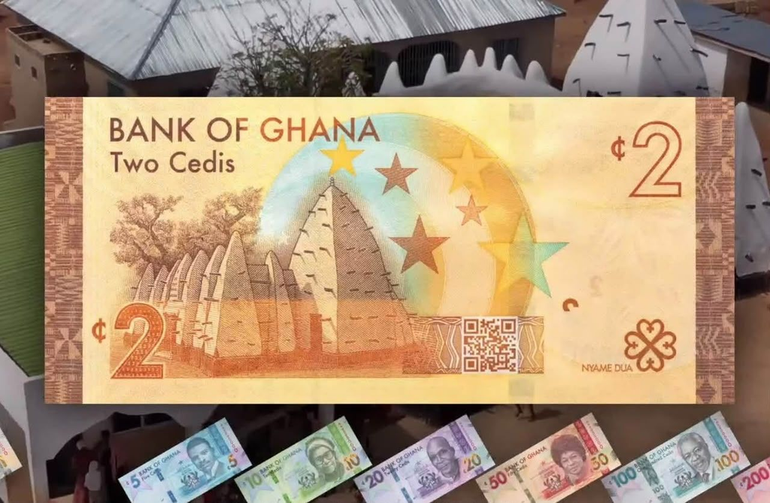

The Alliance of Christian Apologists, Ghana, has called on the Government and the Bank of Ghana (BoG) to remove the Larabanga Mosque from the newly introduced GH¢2 banknote before the Heritage Series currency enters circulation on December 1, 2026, arguing that the historic Islamic monument is inconsistent with the religious tolerance message the denomination is intended to promote.
In a statement released on November 16, 2026, the Christian advocacy organisation acknowledged the mosque’s significance as an important Islamic heritage landmark but questioned the decision to feature it as a national representation of religious freedom, coexistence and diversity.

The Alliance maintained that the historical religious practices associated with the Larabanga community raise questions about the appropriateness of using the monument to communicate a message of religious inclusiveness, particularly given reports that other religious traditions have historically faced restrictions within the community.

Distinguishing between the preservation of religious heritage and the promotion of religious tolerance, the organisation stated that the historical importance of a religious monument should not automatically qualify it as an appropriate representation of peaceful religious coexistence.

“Religious heritage is not the same thing as religious tolerance,” the Alliance declared.
The controversy surrounding the GH¢2 denomination

The GH¢2 banknote forms part of eight denominations introduced under the Bank of Ghana’s Heritage Series, which President John Dramani Mahama officially unveiled at the Bank Square in Accra on Thursday, November 12, 2026.
Designed around the theme of religious freedom, the orange and gold denomination features the late Cardinal Peter Poreku Dery on its front, while the reverse displays the historic Larabanga Mosque in the West Gonja area of the Savannah Region.

Cardinal Dery, who lived between 1918 and 2008, previously served as the Catholic Archbishop of Tamale and became Ghana’s second cardinal in 2006, following the elevation of Cardinal Peter Turkson. His inclusion represents the Christian tradition within the denomination’s religious heritage theme.

The Larabanga Mosque, meanwhile, is a distinctive mud and timber structure constructed in the Sudano Sahelian architectural tradition. Its origins are traditionally traced to 1421, making it widely recognised as one of the oldest surviving mosques in West Africa.
Often described as the “Mecca of West Africa”, the monument holds considerable historical, architectural and religious significance and has previously featured on Ghana’s five cedi banknote during the 1970s.
The denomination also incorporates the Adinkra symbol Nyame Dua, which translates as “tree of God”. The symbol represents divine presence, protection and spiritual direction while acknowledging Ghana’s indigenous spiritual heritage.
Why the Christian organisation objects
The Alliance based its concerns partly on previous media accounts, including a publication by the Daily Graphic, which documented statements from Larabanga community leaders indicating that churches and traditional shrines had historically not been permitted to operate within the community.
According to the reports cited by the organisation, the community’s leadership attributed the restrictions to longstanding customs and religious practices inherited from their ancestors.
The Alliance argued that these reported historical circumstances create an inconsistency between the community’s religious practices and the national message of tolerance supposedly represented by the mosque’s appearance on the new currency.
It questioned how a monument associated with a community where other religious groups have reportedly encountered restrictions could appropriately serve as a national emblem of religious diversity and freedom.
“This creates a fundamental contradiction,” the statement observed, questioning the suitability of presenting the community’s most prominent Islamic monument as a representation of religious tolerance.
The organisation further maintained that national currency carries significance beyond its financial purpose, describing banknotes as expressions of a country’s collective identity, historical experiences and national values.
It warned that featuring the mosque under the banner of religious tolerance could inadvertently confer national recognition on religious exclusivity while communicating an inappropriate message to younger generations.
Alliance urges government to recognise other contributors to national development
Under the heading “Ghana Has Better Stories to Tell”, the organisation urged the government to broaden its considerations when selecting historical personalities, monuments and institutions for national currency.
It argued that Ghana possesses numerous individuals and establishments whose contributions to national progress deserve recognition, particularly in education, teacher training, healthcare, medical advancement, vocational and technical skills development, constitutional governance and democratic institutions.
According to the Alliance, national recognition should extend to Ghanaians and foreign nationals who have made meaningful contributions to the country’s development, rather than being confined to religious landmarks.
“Our national story belongs to all Ghanaians, as well as non Ghanaians who contributed meaningfully to the development of this country,” the statement declared, adding that the country should not celebrate what it described as religiously intolerant and extremist elements.
Three demands presented to government and Bank of Ghana
The Alliance has consequently outlined three principal requests to the government and the central bank ahead of the scheduled introduction of the new currency.
First, it wants the Larabanga Mosque removed from the proposed GH¢2 denomination before the new notes enter circulation in December.
Second, it is demanding a comprehensive reassessment of the standards and considerations governing the selection of historical monuments and prominent personalities for Ghana’s national currency.
Third, it wants authorities to place greater emphasis on individuals and institutions whose contributions have demonstrably advanced education, healthcare, professional skills development, individual freedoms and democratic governance.
The organisation nevertheless emphasised that its intervention should not be interpreted as hostility towards Muslims or an attempt to undermine Islam’s historical contribution to Ghana.
Rather, it described its position as an appeal for historical accuracy, consistency and fairness in determining the national symbols that represent the country.
The Alliance maintained that it would have no objection to the Larabanga Mosque being celebrated exclusively as an important Islamic heritage monument. Its disagreement, however, concerns the decision to associate the structure with religious tolerance and diversity.
“If Larabanga Mosque is presented as an Islamic heritage monument, we have no objection. But if it is presented as a symbol of religious tolerance and diversity, then the historical record demands serious reconsideration,” the statement stressed.
The organisation concluded that Ghana should reconsider the representation of religious monuments on its currency where their historical associations, as it interprets them, appear inconsistent with the national values being promoted.
Larabanga dispute adds to growing controversy surrounding Heritage Series
The Alliance’s objection represents another disagreement to emerge following the unveiling of the Heritage Series, which has attracted considerable public discussion over the selection and removal of historical figures and personalities from Ghana’s redesigned banknotes.
One of the most contentious issues concerns the removal of the Big Six, whose collective portrait previously appeared across the existing banknote denominations.
Under the newly introduced arrangement, Dr Kwame Nkrumah is the only member of the historic group retained, appearing on the GH¢200 denomination.
Minority Leader Alexander Afenyo Markin has criticised the decision, accusing the government of attempting to erase the historical contributions of the remaining five members of the group. He maintained that although their portraits could disappear from the currency, their contributions to Ghana’s independence struggle and national history could never be erased.
Similarly, New Patriotic Party figure Dr Boakye Danquah has argued that each member of the Big Six should have been honoured with an individual banknote.
The GH¢50 denomination has also generated disagreement over the identity of the woman whose portrait appears on the redesigned note.
The denomination is intended to honour Theodosia Salome Okoh, the celebrated designer of Ghana’s national flag. However, her nephew, Professor Eddie Obeng, has alleged that the portrait actually resembles his mother, Dr Letitia Obeng, a renowned scientist and younger sister of Mrs Okoh.
The Bank of Ghana has rejected the suggestion that the wrong personality was featured, explaining that the portrait was developed using several photographs of Mrs Okoh. Nevertheless, the central bank acknowledged that certain adjustments made during the design process resulted in similarities between the two sisters’ appearances.
Alliance’s previous interventions in religious affairs
The latest intervention is consistent with the organisation’s previous involvement in national conversations concerning religious representation, freedom of worship and the relationship between religion and public institutions.
In September 2026, the Alliance opposed calls for Christian mission schools to abandon or alter their religious identities to accommodate Muslim students.
The organisation also advocated equal and impartial enforcement of the law in matters involving religious institutions and practices.
Meanwhile, the Bank of Ghana has maintained that the Heritage Series will operate alongside the existing banknotes, which will retain their status as legal tender. The older denominations are expected to be withdrawn progressively as the redesigned currency becomes more widely available.
The planned December 1 introduction therefore remains the immediate deadline against which the Alliance wants its demand for the removal of the Larabanga Mosque to be considered.

