
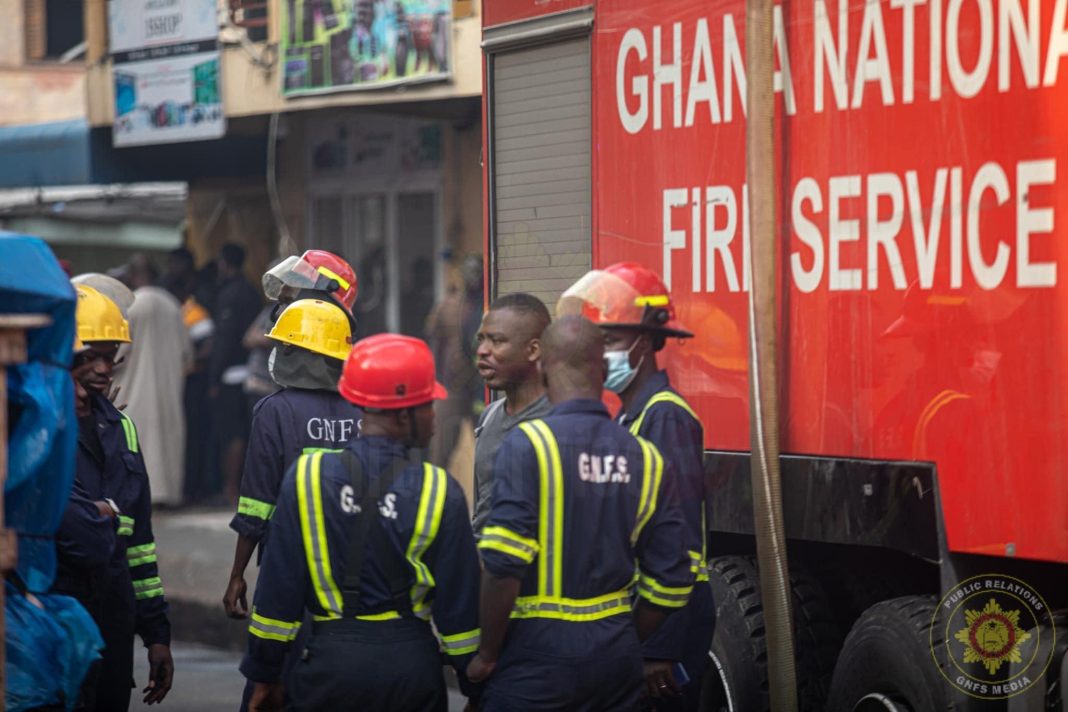

The Ghana National Fire Service (GNFS) has welcomed the four year custodial sentence imposed on a man who assaulted one of its personnel, insisting that the punishment should discourage members of the public from attacking firefighters in the course of responding to emergencies.
The Achimota Circuit Court sentenced 21 year old Sampson Azumah to four years’ imprisonment with hard labour after finding him guilty of unlawfully causing harm to a firefighter who had reported for emergency duty at the residence of actress Yvonne Okoro at Adjiringanor in November 2025.

The conviction followed an incident during which personnel of the Fire Service were reportedly subjected to an assault while attempting to manage an emergency at the actress’s residence.

Commenting on the court’s decision during an interview on JoyNews’ The Pulse on Tuesday, the Service’s Public Relations Officer, Divisional Officer One (DO1) Emmanuel Bonney, said the GNFS would have welcomed a substantially longer custodial sentence but respected the court’s determination.

He maintained that although the Service had hoped for a more severe punishment, the four year sentence represented an important step towards discouraging attacks against emergency responders.
Mr Bonney indicated that the organisation stood by its earlier position on the incident, adding that the ruling should caution individuals against subjecting firefighters to either physical violence or verbal abuse while they are performing their professional responsibilities.

The GNFS spokesperson further explained that hostility towards emergency personnel could obstruct their operations, compromise their effectiveness and potentially endanger lives during critical rescue and firefighting assignments.
He consequently appealed to the public to desist from obstructing firefighting activities, emphasising that individuals who initially attempt to control a fire must allow trained GNFS personnel to assume responsibility once they arrive at the affected location.

According to him, civilians may occasionally be invited to provide limited assistance, particularly where operational requirements demand additional support, such as transporting firefighting hoses across considerable distances. However, he cautioned against independently entering or approaching buildings engulfed by flames.

Mr Bonney explained that fire outbreaks frequently involve unpredictable hazards, including pressurised gas cylinders and other potentially explosive substances, which could cause severe injuries or fatalities when exposed to intense heat.
He stressed that professional firefighters receive specialised training and protective equipment to operate in such dangerous conditions, unlike ordinary members of the public who may lack the necessary protective gear, insurance arrangements and technical knowledge to undertake comparable activities safely.
He specifically referenced proximity suits and other protective clothing provided to firefighters, explaining that such equipment helps personnel withstand hazardous conditions while carrying out emergency response duties.
The GNFS spokesperson also expressed concern about the reluctance of some members of the public to comply with safety instructions issued at emergency locations, noting that such behaviour could expose civilians to unnecessary danger and interfere with rescue operations.
Mr Bonney observed that firefighters routinely establish restricted areas around emergency locations and instruct bystanders to maintain a safe distance. However, he said members of the media generally demonstrate greater willingness to observe such directions than some other members of the public.
He explained that emergency responders sometimes encounter difficulties securing cooperation from individuals who disregard instructions to move away from dangerous areas, despite the risks associated with remaining close to an active fire scene.
The Service therefore reiterated its willingness to seek assistance from civilians whenever operational circumstances require it, while stressing that such support must be provided strictly under the direction of authorised personnel.
Mr Bonney urged residents to cooperate with firefighters, respect safety restrictions and refrain from interfering with emergency operations, emphasising that public compliance remains essential to protecting lives, safeguarding property and enabling emergency responders to discharge their responsibilities effectively.

