
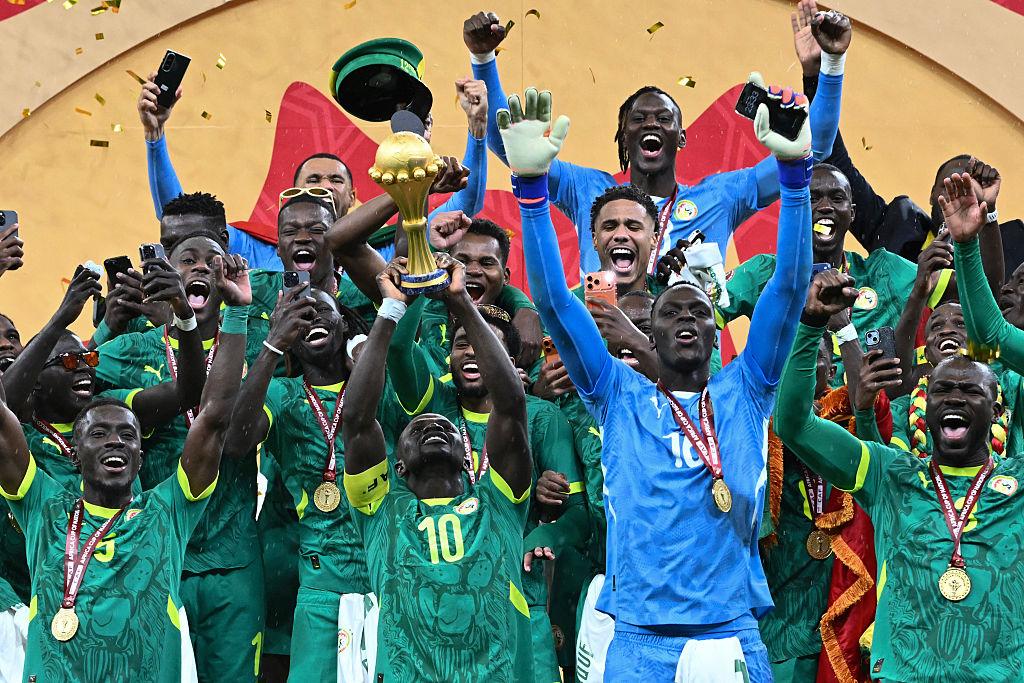

Senegal have officially been restored as champions of the 2025 Africa Cup of Nations (AFCON) after the Court of Arbitration for Sport (CAS) upheld an appeal by the Senegalese Football Federation (FSF), overturning the Confederation of African Football’s (CAF) controversial decision to award the trophy to Morocco.
The unanimous ruling, delivered on Tuesday, November 24, 2026, reinstates Senegal’s original 1-0 victory over Morocco in the dramatic final played in Rabat on January 18, 2026, thereby confirming the Teranga Lions as continental champions for the second time in their history.

The decision reverses a March 17 ruling by CAF’s Appeals Board, which had declared Senegal to have forfeited the final following their players’ temporary departure from the pitch in protest against a penalty awarded to the Moroccan hosts during second half stoppage time.

The dispute originated during a tense closing period of the final, which remained goalless when Congolese referee Jean-Jacques Ngambo Ndala awarded Morocco a penalty after a video assistant referee (VAR) review.

The spot kick followed an incident involving Senegal defender El Hadji Malick Diouf and Moroccan attacking midfielder Brahim Diaz, who had been pulled back inside the penalty area.
Senegal’s players strongly protested the decision, prompting head coach Pape Thiaw to summon his squad towards the touchline before several players and the technical team headed towards the dressing room.

The interruption lasted more than 15 minutes before the Senegalese team eventually returned to the field and play resumed.
Morocco subsequently squandered the opportunity to take the lead when Real Madrid forward Brahim Diaz attempted a Panenka style penalty, only for Senegal goalkeeper Edouard Mendy to comfortably save the effort.

With neither side finding a breakthrough during regulation time, the encounter proceeded into extra time, where midfielder Pape Gueye scored the decisive goal to secure Senegal’s 1-0 triumph.

However, the result became the subject of an extended legal dispute after Morocco’s football federation challenged the outcome before CAF, arguing that Senegal had violated tournament regulations by temporarily abandoning the pitch without the referee’s permission.
CAF’s Disciplinary Board initially rejected Morocco’s protest. Its Appeals Board subsequently overturned that position in March 2026, declared Senegal the losers by forfeiture and awarded Morocco a 3-0 victory.
The Senegalese federation rejected the decision and referred the matter to CAS, football’s highest independent sporting arbitration authority, seeking to have the original result restored.
Following a closed door hearing in Lausanne, Switzerland, on October 8, a three member arbitration panel unanimously ruled in Senegal’s favour.
At the centre of the judgement was the principle known as the field of play doctrine, which generally prevents sporting authorities from overturning decisions made by referees during matches unless there is evidence of arbitrary conduct or bad faith.
In its explanation, CAS maintained that the decision to resume or permanently terminate the encounter rested exclusively with the match official.
The tribunal determined that referee Ndala had exercised his authority when he restarted proceedings after both teams returned to the pitch and indicated their willingness to continue.
The court consequently concluded that the referee’s decision was not arbitrary and that the AFCON regulations governing match forfeiture and abandonment could not be applied in the circumstances.
CAS stated that the CAF Appeals Board’s decision had been set aside and the earlier determination of the Disciplinary Board reinstated, thereby confirming Senegal’s 1-0 victory.
Reacting to the development, the Senegalese Football Federation welcomed the outcome, describing it as a vindication of sporting fairness and the principle that football matches should be decided on the field of play in accordance with the applicable rules.
The federation also published a photograph of the national team celebrating its January triumph, accompanied by the message, “Again and always champions of Africa.”
Morocco’s football federation, however, expressed surprise at the judgement and indicated its intention to pursue further legal options to challenge the outcome.
The Moroccan federation also raised concerns about an alleged telephone conversation between Senegalese federation president Abdoulaye Fall and Ulrich Haas, the German arbitrator nominated by Senegal to serve on the CAS panel.
Fall categorically denied that the alleged conversation had taken place, while the Moroccan federation argued that any unauthorised communication involving an arbitrator and an interested party would raise serious questions about the integrity of the proceedings.
The possibility remains for Morocco to approach Switzerland’s Federal Supreme Court, which has limited authority to set aside CAS awards on recognised legal grounds. Such an application would not automatically overturn the judgement.
Meanwhile, CAF has acknowledged the arbitration ruling and indicated that it respects the decision and will undertake the necessary steps to implement it.
The complete grounds of the arbitration award are expected to be made available unless the parties request confidentiality.

