
Ghana is hosting the sixth edition of the German African Business Summit (GABS 2026), attracting prominent business executives, government officials, investors and industry specialists from Germany and various African countries to discuss emerging commercial opportunities and advance economic collaboration between the two regions.
The three day gathering, taking place from November 23 to 25, 2026, at the Kempinski Hotel Gold Coast City in Accra, is addressing investment prospects across several strategic industries, including energy transition, green hydrogen, digital transformation, artificial intelligence, automotive manufacturing, mobility, mining, trade financing and industrial expansion.

Recognised as Germany’s flagship business conference on the African continent, the summit is designed to strengthen commercial relationships, encourage cross border investments and establish enduring economic partnerships between German enterprises and African economies.

Activities commenced on Monday, November 23, with a welcome reception featuring contributions from several distinguished representatives of government and industry. Among those addressing participants were Heike Bergmann, Senior Vice President for Sales Africa at Voith Hydro and Vice Chair of the Sub Saharan Africa Initiative of German Business (SAFRI); Dr Bärbel Kofler, Parliamentary State Secretary at Germany’s Federal Ministry for Economic Cooperation and Development; Nathanael Liminski, Head of the State Chancellery and Minister for Federal, European and International Affairs and the Media in North Rhine Westphalia; and Ghana’s Minister of Foreign Affairs, Samuel Okudzeto Ablakwa.

The principal conference sessions commenced on Tuesday, November 24, with opening statements from Thomas Schäfer, Chairman of SAFRI; Stefan Rouenhoff, Parliamentary State Secretary at Germany’s Federal Ministry for Economic Affairs and Energy; and Ghana’s Minister of Trade, Agribusiness and Industry, Elizabeth Ofosu Adjare.
The introductory deliberations are intended to establish the foundation for substantive conversations on how governments and private enterprises can identify and exploit emerging commercial prospects in Germany and Africa against the backdrop of evolving international economic conditions.

Ghana and Germany consider new economic opportunities amid global changes
A major feature of the opening day is a high level panel discussion titled *The Future of African German Business Relations in a Changing World: More Opportunities than Challenges*. The conversation examines prospects for expanding trade, industrial development and investment cooperation between the two regions amid intensifying geopolitical rivalry and transformations in international supply networks.

The discussion is expected to feature representatives from the private sector and government, including Kader Olivier Coulibaly, Board Member of DHL Express in Côte d’Ivoire; Agnes Mwagiru of Siemens Healthineers; Amina Mukalazi, Uganda’s Minister of State for Privatisation and Investment; and Martina Engelhardt Kopf, Parliamentary State Secretary at Germany’s Federal Ministry of Agriculture, Food and Regional Identity.

Another significant engagement, titled *Doing Business in Africa: What Does Business Need, and What Can Government Deliver?*, will examine the responsibilities of governments in establishing favourable regulatory conditions, improving the investment climate and supporting private sector expansion.
The session will feature South Africa’s Deputy Minister of Trade, Industry and Competition, John Steenhuisen, alongside Sabine Dall’Omo, Chief Executive Officer of Siemens Sub Saharan Africa and Vice Chair of SAFRI.
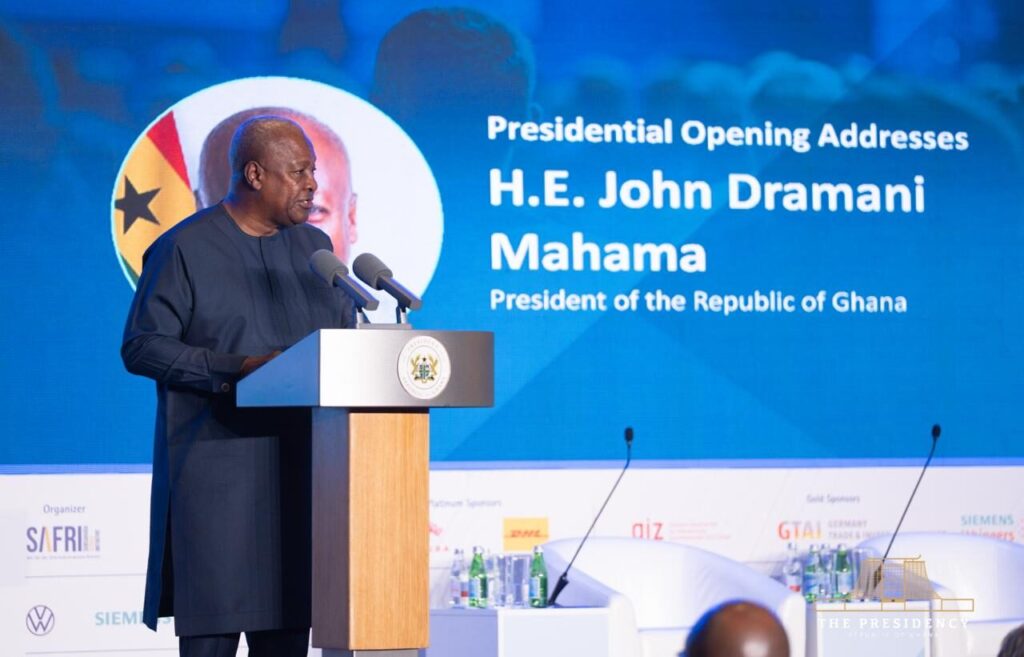
The summit’s presidential opening addresses are scheduled to be delivered by Ghana’s President, John Dramani Mahama, and Germany’s President, Dr Frank Walter Steinmeier, together with SAFRI Chairman Thomas Schäfer.
Startups, artificial intelligence and digital transformation take centre stage
Entrepreneurship, technological advancement and innovation are also receiving considerable attention, with several sessions examining how emerging businesses can penetrate international markets and utilise new technologies to improve productivity and commercial performance.
A fireside conversation, Startups Without Borders: Scaling to a New Continent, will assemble entrepreneurs and senior officials from Ghana and Germany to examine access to investment capital, strategic partnerships, regulatory obstacles and practical approaches to expanding business operations across international markets.
Contributors are expected to include Oluwatosin Abdulsalam of agriBIOME; Samuel B. Opoku, Co Founder and Chief Operating Officer of Kutana Pay; Dr Derrick Edem Akpalu, Co Founder and Chief Executive Officer of Revna Biosciences; and Jana Heinemann, Founder and Chief Executive Officer of IMPARI.
The engagement will be moderated by Anna Sophie Herken, Managing Director of the Deutsche Gesellschaft für Internationale Zusammenarbeit (GIZ), and Meike Neitz, Founder of embassidy.
A separate discussion, titled The AI Moment: Can Africa Seize the Opportunity?, will investigate the growing influence of artificial intelligence, automation and digital technologies on international commerce and industrial production. It will also consider how African countries can position themselves to benefit from developments in digital infrastructure, technical expertise and technology driven industries.
The panel is expected to bring together Prof. Dr Hubertus Bardt, Managing Director of the German Economic Institute; Prof. Brando Okolo of the African Union Development Agency NEPAD; Osman Issah of Smart Africa; Christian Ruckteschler, Chief Operating Officer of AmaliTech; and Martina Vollmer, AI Cybersecurity Strategy Lead at Siemens.
The deliberations are expected to emphasise the importance of expanding digital infrastructure, strengthening technical capabilities and supporting innovation as essential requirements for African economies seeking to remain competitive in an increasingly technology driven global marketplace.
African mineral resources and the drive towards industrial development
The contribution of Africa’s natural resources to industrial expansion and economic transformation constitutes another major area of discussion at the conference.
A panel examining *How Can Africa’s Resources Power the Next Era of Industrial Growth?* will consider practical approaches to increasing domestic processing, mineral beneficiation, manufacturing capacity and the establishment of stronger international supply networks.
Among the anticipated participants are Stefan Rouenhoff, Parliamentary State Secretary at Germany’s Federal Ministry for Economic Affairs and Energy; Stefan Müller, Chief Executive Officer of Bravura Lithium GmbH and DGWA; Amin Amidu Sulemani, Commissioner for Infrastructure, Energy and Digitalisation at the ECOWAS Commission; and Sheila Khama, former Chief Executive Officer of De Beers Botswana and former adviser to the World Bank and African Development Bank on natural resources governance.
The conversation will be complemented by a fireside session titled *Below the Surface: What Does It Take to Develop Mining Projects in Africa?, featuring Dr Augusto Mavuvele, Chief Geologist at Bravura.
His contribution is expected to provide practical perspectives on the technical, financial and operational considerations involved in developing mining ventures and maximising the economic benefits of Africa’s mineral endowments.
Trade financing and investment partnerships dominate second day
The concluding day of the conference, Wednesday, November 25, will place particular emphasis on trade financing, investment regulations, automotive manufacturing and emerging opportunities for commercial cooperation.
A major panel discussion, *Trade Finance, Risk Mitigation and Investment: What Will It Take to Finance and Scale Trust, Trade and Growth Between Germany and Africa?*, will examine the financial instruments, institutional arrangements and commercial partnerships required to facilitate international trade and support large scale industrial investments.
The session is expected to feature representatives of financial institutions, development finance organisations, commercial banks and export credit agencies, including Wola Asase of the Africa Finance Corporation; Eva Miriam Fuchs of DEG; Yewande Giwa of the International Finance Corporation; Ingo Schwutke of Euler Hermes Aktiengesellschaft; and Dirk Besdziek of Commerzbank.
Discussions will centre on strengthening cooperation between private lenders, development finance institutions, export credit organisations and African financial institutions to mobilise investment resources, support commercially viable projects and minimise exposure to financial and operational risks.
Another high level engagement, titled *New African German Partnerships: Are the Rules Fit for Purpose?*, will assess whether existing regulatory and policy arrangements adequately support investment, international trade, access to markets, domestic value creation and the development of reliable supply chains.
Automotive manufacturing and investment prospects across Africa
The automotive sector will also receive dedicated attention as an important component of Germany’s commercial relationship with Africa and the continent’s broader industrialisation ambitions.
A session titled *The German African Automotive Panel: Tackling Growth Barriers, Creating Value will explore opportunities to establish stronger regional automotive production networks, increase trade within Africa and capitalise on the global transition towards electric vehicles and modern mobility solutions.
Expected contributors include Dr Katharina Stasch of Germany’s Federal Ministry for Economic Cooperation and Development; Eugenia Ingabire of the African Continental Free Trade Area (AfCFTA) Secretariat; Jeffrey Oppong Peprah, Chief Executive Officer of Volkswagen Ghana; Lamia Fourati, Chief Strategy Officer of Onetech Group and Vice President of the Tunisian Automotive Association; and Victoria Backhaus Jerling, Chief Executive Officer of the African Association of Automotive Manufacturers.
The deliberations will consider how the implementation of AfCFTA trade arrangements, deeper regional economic integration and emerging transportation technologies could create fresh opportunities for vehicle manufacturers, component suppliers and investors operating across African markets.
A subsequent engagement, titled *Made in Africa, Made by Germany: German Investment on the Rise, will highlight investment opportunities and ongoing commercial projects involving German companies and institutions throughout the continent.
The session will be facilitated by Dr Volker Treier, Member of the Executive Board of the German Chamber of Commerce and Industry, and Simon Madjie, Chief Executive Officer of the Ghana Investment Promotion Centre.
The conference is expected to conclude on Wednesday with closing remarks from Dr Michael Blank, Delegate of German Industry and Commerce in Ghana.
Through the sixth edition of the German African Business Summit, organisers are seeking to stimulate economic expansion, attract productive investments, encourage sustainable commercial partnerships and deepen cooperation between German enterprises and African economies. The gathering also provides an opportunity for Ghana to strengthen its position as a destination for international investment and a potential gateway for businesses seeking to access opportunities across the African continent.