
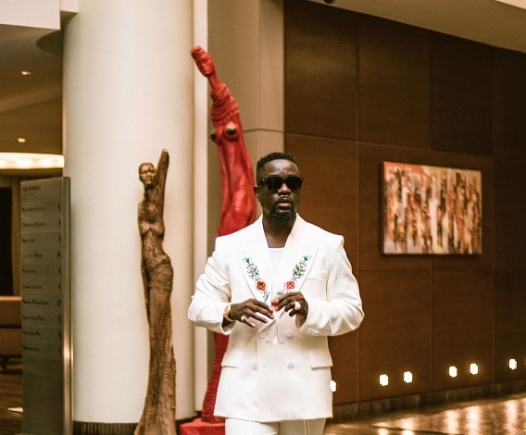

Ghanaian rap star Sarkodie has urged the government to significantly increase funding for the film industry, arguing that cinema and creative storytelling can play a crucial role in promoting Ghana internationally, attracting tourists and stimulating investment.
The award winning musician believes Africa has yet to fully exploit the influence of film and visual storytelling in projecting its cultural identity, changing international perceptions and showcasing the continent’s economic and tourism potential.

In a Facebook post, Sarkodie drew comparisons with Hollywood, highlighting how American film productions have successfully presented the United States as an attractive destination through compelling narratives, memorable visuals and sophisticated creative production.

“How many of you wanted to visit the West so badly because of the Hollywood movies you grew up watching? Almost all of us!” he wrote.

“They successfully sold the world an image of America, making it look like heaven through films, storytelling and visuals.”
He argued that African countries could achieve similar results by investing in their creative industries and producing films that authentically showcase the continent’s history, culture, heritage and development prospects.

“Africa is yet to fully utilize the power of creativity to tell our own stories, reshape perceptions and make the world see our continent as an attractive destination to visit, explore and invest in,” he stated.
Sarkodie Criticises Limited Budgetary Support for Creative Arts
The rapper also expressed concern about what he considers insufficient financial attention to the creative sector, despite its potential to contribute significantly to national development, employment creation and economic growth.

He maintained that while other sectors routinely receive budgetary allocations to support their activities, the creative industry is frequently overlooked despite its capacity to influence public perceptions and promote national identity.

“Every other sector will present a budget and have it approved, yet the creative sector is often overlooked, despite the enormous role it plays in nation building,” he said.
Sarkodie further emphasised the importance of employing experienced professionals in filmmaking, arguing that producing internationally competitive content requires technical expertise, creativity and substantial financial resources.
“Not every photographer or filmmaker can deliver this level of impact. It takes true professionals, and that level of expertise comes at a cost. But it’s an investment worth making,” he added.
He explained that successful filmmaking involves carefully considered artistic and technical decisions, with cinematography, visual composition, storytelling and production quality all contributing to the effectiveness of a film.
Calling for renewed efforts to revitalise Ghana’s film industry, Sarkodie urged the government to recognise cinema as an important medium for communicating its development agenda, promoting Ghanaian culture and strengthening the country’s international image.
“Let’s revive our film industry. It’s time government recognised film as a powerful tool to communicate its vision, tell our stories and sell Ghana and Africa to the world,” he said.
Ghana’s Film Industry Grapples With Structural Challenges
Sarkodie’s appeal comes amid persistent difficulties confronting Ghana’s film industry, including inadequate financing, weak distribution networks, piracy, limited cinema infrastructure and inconsistent production.
Although filmmakers continue to produce content for cinemas, television and digital streaming platforms, industry stakeholders have repeatedly raised concerns about the absence of dependable distribution systems, which makes it difficult for producers to recoup their investments and sustain regular filmmaking activities.
In December 2025, actress and producer Selassie Ibrahim identified inadequate distribution as one of the major impediments to the industry’s expansion, stressing the need for dependable channels through which filmmakers could reach audiences both within Ghana and internationally.
Concerns Over Film Quality and Storytelling
The industry has also faced criticism over production standards, repetitive storylines, weak scripts and shortcomings in technical execution.
Veteran filmmaker Abdul Salam Mumuni, in September 2025, attributed the weakening cinema culture partly to the poor quality of some films released into theatres, arguing that audiences had gradually lost confidence in certain locally produced movies.
Actor and filmmaker Fiifi Coleman has similarly expressed concern about diminishing originality and storytelling standards, pointing to foreign cultural influences and the erosion of effective distribution channels as contributing factors.
Other industry practitioners, including film producer Mawuko Kuadzi, have highlighted insufficient funding, ineffective marketing, piracy and irregular production schedules as persistent obstacles affecting the commercial viability of Ghanaian filmmaking.
Government Introduces Funding Initiatives to Revive Film Industry
The government has announced financial interventions intended to strengthen Ghana’s film industry and support the broader creative arts sector.
In the 2026 Budget Statement presented in November 2025, Finance Minister Cassiel Ato Forson announced GH¢20 million in seed funding for the Film Development Fund, alongside an additional GH¢20 million allocation for the broader Creative Arts Fund.
The National Film Authority subsequently launched the Film Development Fund on May 20, 2026, alongside the inauguration of the Film Development Fund Management Committee and the Film Classification Committee.
The initiative is designed to provide financial assistance for film production, distribution, exhibition, professional training, infrastructure development and other programmes aimed at strengthening the industry’s operational capacity.
The Authority opened applications for the GH¢20 million fund from July 31 to August 31, 2026, with funding categories covering script development, film production, distribution and marketing, cinema infrastructure, training, research and international co productions.
The NFA has also undertaken stakeholder engagement initiatives, including the maiden National Film Dialogue in September 2025, which brought together more than 550 participants to deliberate on investment opportunities, industry collaboration and the future of Ghanaian filmmaking.
Despite these initiatives, questions remain about whether the available funding is sufficient to address the industry’s longstanding challenges, particularly the need for sustainable investment, reliable distribution networks, stronger cinema infrastructure and consistent audience patronage.

