

Ghana has many problems. We have problems delivering quality education, health and social infrastructure. That
means, if we are to dig our way out of the quagmire that we have to begin thinking and ‘doing’ smart. By ‘doing
smart’, I mean the things that can, very quickly, move us out of the quagmire, of set us on a path to social progress.
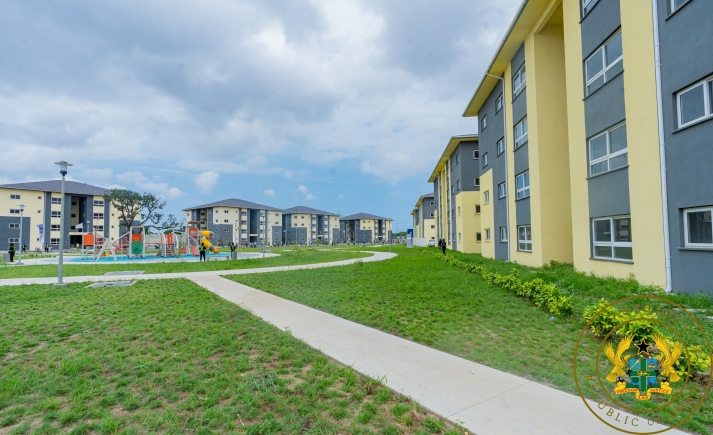
Recently, the President of Ghana, Nana Addo Dankwa Akufo-Addo, commissioned (is that the correct word) three
hundred and twenty flats for the use of the Ghana Police Service. The buildings, a form of barracks but on a grander
scale, has been hailed by many Ghanaians as a great achievement.
Speaking at the occasion, Mr Kojo Oppong Nkrumah, Minister for Works and Housing, said the government had
provided 1,000 homes to security services since 2017.
Now, at the last count, I believe that the Ghana Police Service has a manpower staffing of over thirty thousand
officers. Assuming I am right, it means that the accommodation would only be for one thousand officers. So that
even if the government has found accommodation for a thousand men and women, it still has to find twenty-nine
thousand such accommodation for the remaining officers.
Without doubt, that is likely to take Ghana decades of very hard work, and trillions of cedis spent, before we can
achieve that feat.
Do not forget, that apart from the Ghana Police Service, we also have Immigration Service, Police, Prisons, Fire
Service, doctors, judges, teachers and many other classes of public sector servants. Using current methods, I can
comfortably wager that Ghana will never be able to achieve the target of finding comfortable accommodation for all
these classes of employees. So that I can state, that directly procuring the housing of these people, will never lead to
the solution of the problem. The direct procurement is also an avenue for some people to steal, on a grand scale.
So how do we address the problem of housing? It is where and why I suggest that we find the ‘smart’ and easy
solutions.
One such solution, is just to give public sector employees rent allowance, so that they just go out there to find their
own accommodation with the rest of us.
It is my case, that overnight, this would spur growth in the real estate sector, and solve the entire problem of finding
suitable accommodation for all public sector workers, instead of a few thousand every year.
The biggest problem that would arise, of course, is a significant increase in the public sector wage bill. The solution
to this, is that it is high time Ghana cut down non-essential staff and agencies on the public wage bill, so that we can
comfortably take care of those who are essential to our wellbeing. To start on that, we have to target certain state
agencies and ministries, of which there are plenty.
At the last count, Ghana has nearly forty ministries and over two hundred (over three hundred, more like) agencies.
These, in their turn, are staffed by hundreds of thousands of personnel, mostly engaged in activity that are not
necessary, or, more likely, doing nothing at all apart from ensuring that the rest of us believe that they are social
necessities.
In this write-up, I would look at one of such agencies; the National Disaster Management Organization (NADMO).
In my opinion, this agencies should be scrapped, and the resources we labour on it directed elsewhere.
Why, you would ask.
Well, let us begin with NADMO. NADMO was initially an agency called the National Mobilization Program,
formed by junta leader Jerry John Rawlings in the 1980s. The National Mobilization Program had an ill-defined
policy objective, but was principally intended to be used to ‘mobilize’ Ghanaians to support the economic effort to
bring Ghana to its feet. It was also where Rawlings could comfortably and conscientiously dump revolutionary
cadres who had become disenchanted with his so-called revolution and assure them a comfortable government
stipend at the end of every month.
Eventually, when a few social disasters arose, it was converted to fight ‘disaster’, hence NADMO arose. Initially, as
stated, it was peopled by cadres of the revolution, and used to distribute all manner of things to the populace,
particularly during elections. This is something the organization is still doing, albeit they become a bit more visible
when there are obvious disasters. In between, they push paper, waste petrol at the government expense, and yes, it is
still peopled by political party officers, who would never be able to secure public employment under normal
circumstances. It used to be largely peopled by NDC party harks. Now, it is peopled by NPP party officers at various
levels. All taking your money but doing virtually nothing useful.
Their mandate can also be comfortably absorbed by the Ghana Police Service, and the Department of Social
Welfare, which makes that agency really redundant, though, each year, it remains the funnel by which billions of tax
cedis are directed to unemployable party men and women.
It is my case that if we do a critical study, we would identify many such agencies, which we can weed out.
Additionally, even within those agencies that are relevant, we have many ways of cutting out or cutting back to
improve efficiency and save funds, which can be directed more efficiently elsewhere.
(This article was published under the column Periscope Depth in the Daily Searchlight on 29 th July, 2024. Read
Periscope Depth in print in the Daily Searchlight).


