
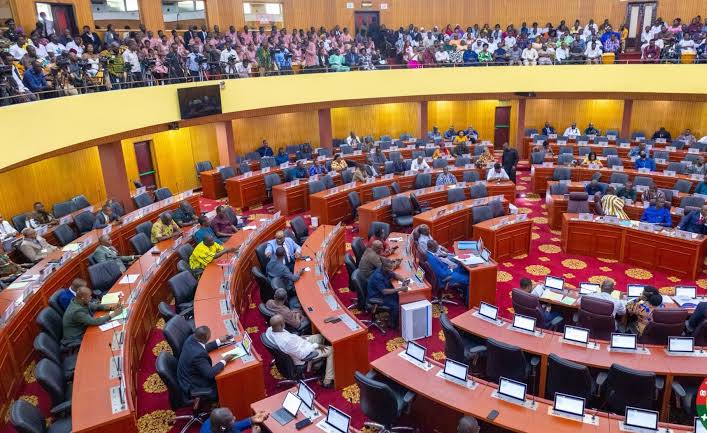

Parliament has withdrawn its previous approval of the Human Sexual Rights and Family Values Bill 2025 after uncovering discrepancies between decisions adopted by the House and the version of the legislation prepared following its third reading.
The decision was announced by Speaker of Parliament, Alban Sumana Bagbin, on Tuesday, November 10, 2026, after the Legislation Drafting Department identified inconsistencies during its examination of the bill.

Mr Bagbin explained that the discrepancies could not simply be amended by parliamentary drafters because they concerned substantive decisions previously taken by legislators. Consequently, the corrections required Parliament to revisit the matter and formally reconsider its earlier resolutions.

Addressing members of the House, the Speaker said the Legislation Drafting Department was responsible for translating parliamentary decisions into the appropriate legislative language after proceedings. He explained that the department undertook a process known as tracking to ensure that the final version of a bill accurately reflected the decisions reached by Parliament.

According to him, while the department could independently rectify minor grammatical and technical errors, it lacked the authority to alter decisions adopted by the House without obtaining parliamentary approval.
Mr Bagbin emphasised that any inconsistencies involving decisions made by legislators had to be referred back to Parliament for the necessary reconsideration and correction.

He subsequently informed members that the legislation had been returned to the House to enable them to rescind their previous resolution and address the discrepancies before undertaking the remaining parliamentary procedures.
The Speaker then put the matter to a vote, with members voting in favour of reversing Parliament’s earlier decision concerning the bill.

Declaring the outcome, Mr Bagbin stated that the Ayes had prevailed and formally announced that Parliament had rescinded the resolution adopted on Friday, May 29, 2026, in relation to the third reading of the Human Sexual Rights and Family Values Bill 2025.

The legislation is expected to be brought before the House again for further examination, with another passage anticipated after the identified inconsistencies have been resolved and the requisite parliamentary procedures completed.
The controversy surrounding the legislation dates back to Friday, May 29, 2026, when Parliament approved the bill despite strong resistance from the Minority Caucus, whose members had threatened to withdraw their support for the proposed legislation.
The bill was originally introduced to the Ninth Parliament on Thursday, July 24, 2025, by the Member of Parliament for Assin South, Reverend John Ntim Fordjour, representing the other lawmakers sponsoring the proposed legislation.
The sponsors include Samuel Nartey George, Emmanuel Kwasi Bedzrah, Helen Adwoa Ntoso, Nurudeen Muhammed Mummuni, Vincent Ekow Assafuah, Alhassan Tampuli Sulemana, Rita Naa Odoley Sowah, Abdul Karibu Tiah Mahama and Anthony Mmieh.
Following its introduction, Speaker Bagbin referred the proposed legislation to Parliament’s Committee on Constitutional and Legal Affairs for examination and the submission of a report to the House.
However, disagreements emerged before its eventual approval, with the Minority Caucus raising objections to an amendment it alleged had been introduced without undergoing consideration by the relevant parliamentary committee.
The Minority accused the Majority of incorporating an exemption provision that had not formed part of the original proposals examined by the Committee on Constitutional and Legal Affairs. The disputed provision reportedly sought to exempt particular groups of professionals, individuals and institutions whom the Minority described as perpetrators of LGBTQ+ activities.
The disagreement intensified as the Minority threatened to withdraw the legislation rather than support its passage in the form presented to Parliament.
Following the bill’s approval, Mr Bagbin disclosed that he was surprised by the decision, particularly because Parliament had completed the legislative process while he was away attending to official engagements.
In an explanation delivered on Monday, June 1, 2026, the Speaker said he had instructed members to begin considering the legislation before his departure, but had not anticipated that they would complete all the remaining stages required for its passage in his absence.
He maintained that his expectation was for Parliament to commence deliberations and continue the examination of the proposed law upon his return.
Mr Bagbin expressed astonishment upon learning that the House had proceeded beyond the initial consideration stage and approved the bill.
He explained that the circumstances surrounding its passage were unexpected because his instructions to members had been limited to commencing consideration of the proposed legislation.
The Speaker further indicated that he had anticipated a longer parliamentary process, considering the complexity of the bill and the extensive deliberations required before members could reach a final decision.
He also recalled that the sitting took place on a Friday, when several legislators were eager to return to their constituencies, making him believe that the House would not complete the entire legislative exercise that day.
However, he said he subsequently learnt through media reports that Parliament had approved the legislation and later watched television coverage of the proceedings.
The latest decision to rescind the third reading approval therefore represents another significant development in the prolonged parliamentary process surrounding the controversial legislation.

