
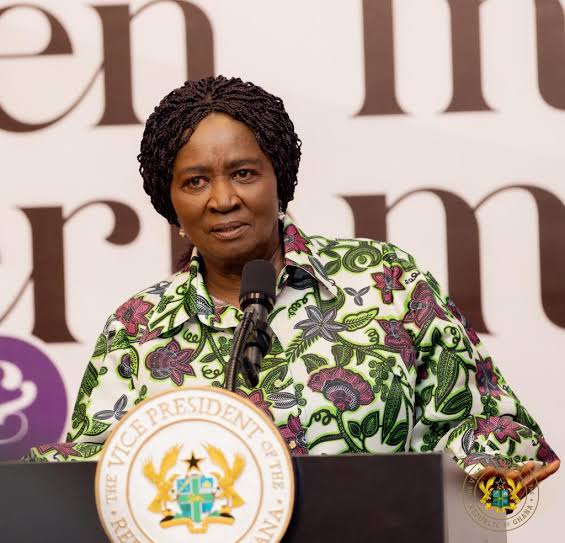

Vice President Professor Jane Naana Opoku-Agyemang has denounced sexual exploitation in workplaces and educational institutions, declaring that no employment opportunity or academic achievement should require individuals to sacrifice their dignity in exchange for professional or educational advancement.
She cautioned individuals occupying positions of authority against abusing their influence over recruitment, promotion and academic progression by pressuring subordinates or students to provide sexual favours.

Speaking at a Sex for Jobs Conference organised by the Ark Foundation, the Vice President described such conduct as a serious abuse of entrusted power that compromises human dignity, weakens public confidence in institutions and prevents individuals from achieving their full potential.

“No job or academic qualification should come at the price or the cost of anyone’s dignity, and no person entrusted with authority has the right to demand that dignity,” she stated.

Professor Opoku-Agyemang acknowledged the government’s responsibility to establish appropriate legislative and policy measures to prevent sexual harassment and exploitation but emphasised that the existence of laws and institutional guidelines would achieve little without proper enforcement.
She observed that government representatives could not supervise every workplace, classroom or recruitment interview to ensure acceptable conduct, making it necessary for individual institutions to assume responsibility for preventing and addressing misconduct.

“Policies can only go so far without implementation,” she cautioned, urging organisations to confront wrongdoing decisively, even when doing so might prove uncomfortable or inconvenient.
The Vice President also highlighted several government initiatives designed to improve the prevention of and institutional response to sexual harassment and gender based violence.

Among the interventions she identified was the introduction of the revised National Gender Policy by the Ministry of Gender, Children and Social Protection, which seeks to reinforce institutional mechanisms for addressing gender based violence.

She further referenced the Ministry’s partnership with the ECOWAS Gender Development Centre to equip stakeholders across the judicial, healthcare and social welfare sectors with the necessary skills to prevent and respond effectively to sexual harassment and gender based violence.
Professor Opoku-Agyemang disclosed that government had additionally undertaken to establish dedicated centres and shelters to provide assistance and protection for victims and survivors of abuse.
Within the educational sector, she pointed to measures introduced by the Ministry of Education and the Ghana Education Service to facilitate the reporting, investigation and punishment of sexual harassment in schools.
She also noted that national guidelines had been developed to assist tertiary educational institutions in formulating and enforcing internal policies to address such misconduct.
However, the Vice President insisted that institutional commitments must translate into tangible outcomes, particularly by ensuring that individuals subjected to sexual exploitation can report abuses and obtain justice without jeopardising their livelihoods or academic futures.
She therefore advocated the establishment of independent, secure and confidential complaint mechanisms, especially in circumstances where persons accused of misconduct exercise substantial control over the employment, promotion or educational prospects of those making allegations.
According to her, such reporting arrangements must provide adequate protection against intimidation, threats, victimisation and any form of retaliation that could deprive complainants of professional or academic opportunities.
She also called for allegations to be examined without unnecessary delays through impartial, comprehensive and transparent investigations, with appropriate disciplinary measures taken against individuals found responsible.
Professor Opoku-Agyemang maintained that institutions must demonstrate genuine commitment to accountability by providing adequate resources for protective mechanisms, treating complaints with the seriousness they deserve and ensuring that survivors receive appropriate assistance.
She emphasised that the campaign against sexual harassment and exploitation was not exclusively a government responsibility but required the active participation of employers, schools, universities, public institutions, private organisations and members of the wider society.
The Vice President urged stakeholders to work collectively towards creating an environment in which practices commonly described as “sex for jobs” and “sex for grades” would no longer be tolerated as unavoidable features of professional and academic life, but recognised and challenged as unacceptable abuses of authority.
“Behind every account of sexual harassment or exploitation, there is a human being whose ambitions, confidence and sense of security may have been profoundly shaken,” she said.
She stressed that institutions owed victims and survivors an obligation to handle their complaints responsibly, safeguard their privacy, preserve their dignity and ensure that individuals who misuse positions of authority are held accountable.
Professor Opoku-Agyemang expressed optimism that the conference would strengthen collective determination to eliminate exploitative practices and improve safety within workplaces and educational establishments.
She reiterated that every professional environment, public organisation and academic institution must provide individuals with the freedom to pursue their aspirations without intimidation, sexual harassment or exploitation.

