
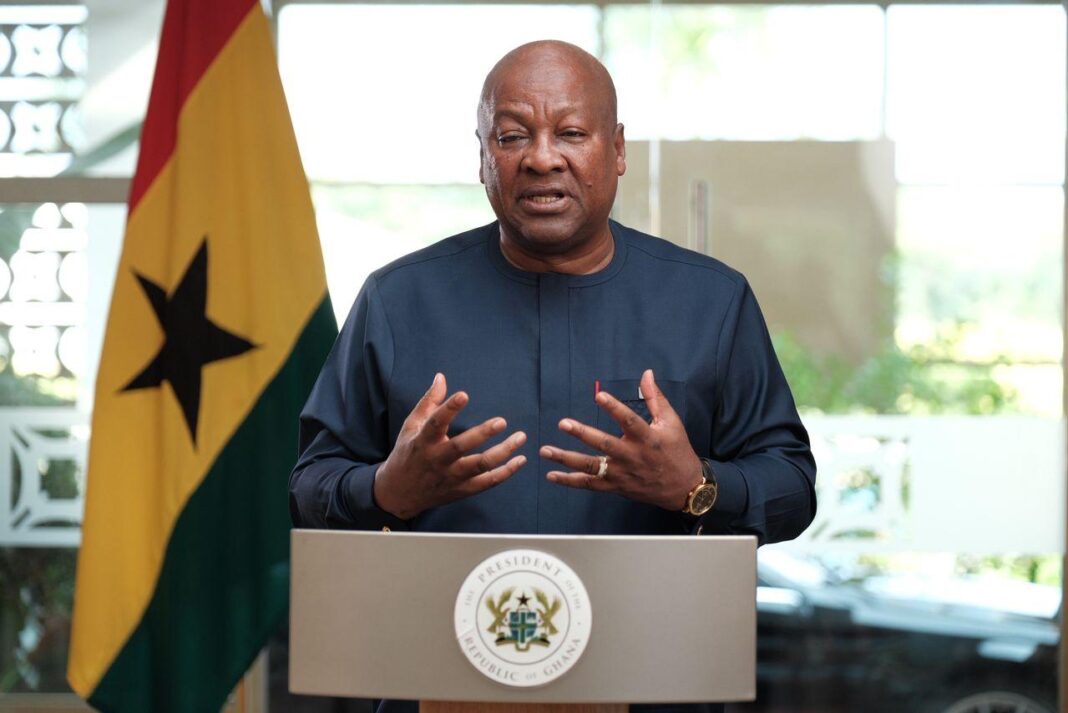

President John Dramani Mahama has reaffirmed his administration’s determination to preserve the Achimota Forest Reserve, declaring that Ghana’s most significant remaining urban forest will not be surrendered to private interests at the expense of environmental protection, national heritage and the wellbeing of future generations.
The President stated that the Achimota Forest remains a vital ecological resource and an indispensable green space within the Greater Accra Region, stressing that its protection is a national responsibility rather than a matter of private commercial opportunity.

Addressing a high level delegation from the Greater Accra Regional House of Chiefs, Members of Parliament from the region and government officials at the Jubilee House on Tuesday, July 21, President Mahama announced that Cabinet had approved the revocation of Executive Instrument 144, as amended, in a move aimed at restoring the forest reserve to its original protected status.

“The Achimota Forest Reserve remains Accra’s largest remaining urban forest, and must not be sacrificed for private development. It must be protected as an environmental asset, a green buffer, and a national heritage for present and future generations,” President Mahama stated.

The decision marks a significant intervention in one of Ghana’s most debated land management controversies, with the Achimota Forest Reserve having faced years of public concern over issues of encroachment, ownership disputes and proposed developments within an environmentally sensitive area.
Environmental advocates have long described the forest as a crucial ecological shield for Accra, providing climate regulation, biodiversity protection, improved air quality and a natural buffer against the effects of rapid urbanisation. The President’s announcement therefore places the preservation of the reserve at the centre of government’s broader environmental protection agenda.

Beyond the Achimota Forest issue, President Mahama also announced a comprehensive reform programme aimed at transforming Ghana’s land administration system, which has historically faced challenges including multiple sales of lands, documentation delays, ownership disputes and allegations of corruption.
According to the President, the government intends to strengthen the capacity of the Lands Commission while accelerating the digitisation of land records to create a more transparent, efficient and accountable system.

He explained that modernising land administration would reduce conflicts, improve access to reliable land information and protect both traditional authorities who hold significant land interests and the broader public interest of the state.

“Land administration must serve the public interest and protect both traditional landowners and the interests of the state,” President Mahama said.
The proposed reforms are expected to introduce stronger safeguards within Ghana’s land management framework by reducing opportunities for fraudulent transactions, improving record keeping and ensuring that legitimate landowners and investors can access reliable documentation through a more efficient process.
President Mahama further indicated that government would continue discussions with the Greater Accra Regional House of Chiefs, the Lands Commission, the Ministry of Lands and Natural Resources and other relevant stakeholders to resolve outstanding disputes relating to compensation, ownership claims, state acquisitions and the lawful utilisation of public lands.
The engagement with traditional authorities and state institutions reflects government’s recognition that land governance in Ghana requires cooperation between customary landowners, government agencies, local communities and private sector actors.
The Achimota Forest controversy has become one of Ghana’s most prominent examples of the challenges surrounding urban expansion, environmental preservation and competing land interests. As Accra continues to experience rapid population growth and increasing pressure on available land, the protection of remaining green spaces has become a major national policy concern.
Government officials maintain that the restoration of the forest’s protected status and the wider land administration reforms will strengthen confidence in Ghana’s management of natural resources and public assets.
The President’s announcement also signals a broader policy direction in which environmental conservation is being positioned alongside economic development rather than treated as an obstacle to investment.
The future of Achimota Forest is therefore expected to remain a significant national issue, with the implementation of the revocation of Executive Instrument 144 and the success of the proposed land reforms likely to determine whether Ghana can effectively balance urban development, environmental sustainability and responsible land governance.
For many observers, the protection of the reserve represents more than the preservation of a forest. It represents a test of Ghana’s commitment to safeguarding public resources, respecting environmental obligations and ensuring that national assets remain protected for generations yet unborn.

