
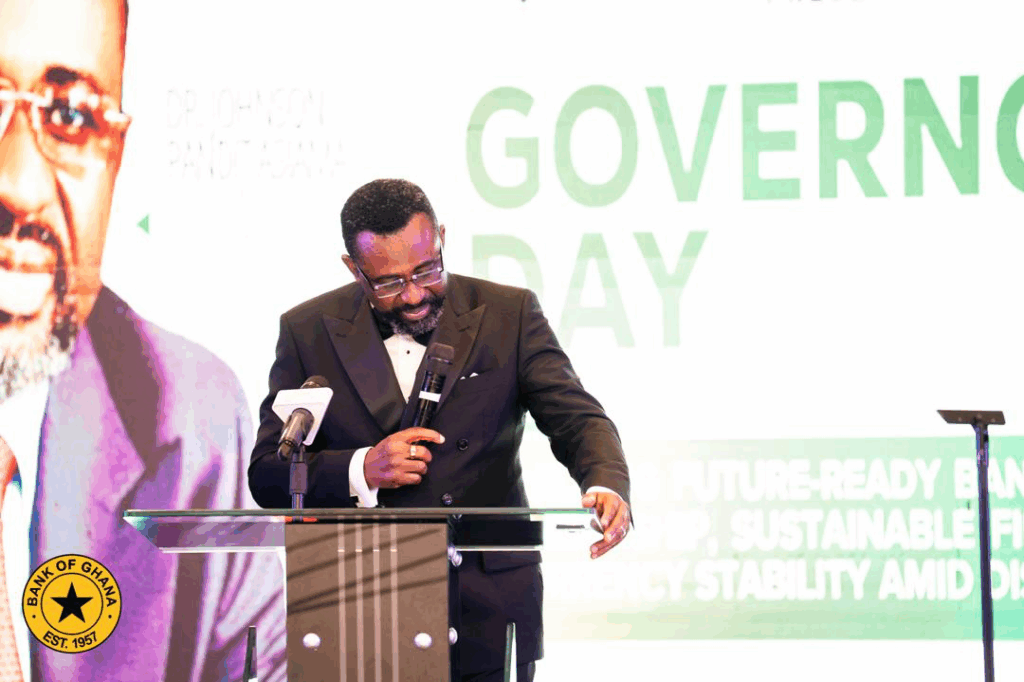

The Governor of the Bank of Ghana, Dr Johnson Asiama, has outlined a clear and forward-looking agenda aimed at strengthening the health of Ghana’s banking sector, announcing a target to reduce the industry’s Non-Performing Loan (NPL) ratio to 10 per cent by the end of 2026. This represents a significant improvement from the 19.5 per cent level recorded in October 2025 and forms part of a broader strategy to safeguard asset quality as the economy gradually transitions into a lower-interest-rate environment.
Dr Asiama made these remarks while delivering a keynote address at the Governor’s Day Annual Bankers’ Dinner organised by the Chartered Institute of Bankers. In his address, he emphasised that as borrowing costs begin to ease, the responsibility on banks to manage credit risk becomes even more critical. Lower interest rates, he noted, should not lead to complacency, but rather provide room for carefully structured loan restructuring that supports viable businesses without undermining prudential standards.

According to the Governor, Ghana is approaching a turning point in its economic recovery. While the immediate task in recent years had been restoring stability, the challenge now is how to productively deploy that stability. He described 2025 as a year in which confidence was painstakingly rebuilt, after a period marked by uncertainty, weak market signals, and limited policy traction. In contrast, 2026, he argued, must be the year in which that restored confidence is put to work—deliberately, responsibly, and in a manner that strengthens the competitiveness of the Ghanaian economy.

Within this context, Dr Asiama urged commercial banks to play a more assertive role in supporting Ghana’s export-led growth ambitions. He called on financial institutions to deepen their engagement in export financing by strengthening dedicated export desks, expanding support for agro-processing and non-traditional exports, and positioning themselves to take advantage of opportunities created by the African Continental Free Trade Area (AfCFTA). He stressed that banks should not merely observe Ghana’s export agenda from the sidelines, but actively help shape it by financing export-oriented enterprises, managing trade-related risks, and supporting firms seeking to move from domestic markets into regional and global value chains.

The Governor noted that when banks nurture exporters, the benefits are mutual. Increased export activity broadens the country’s foreign exchange base, improves external balances, and enhances macroeconomic resilience, while simultaneously strengthening banks’ balance sheets. Every processed good sold abroad and every export contract secured, he said, reinforces both the real economy and the financial institutions that support it.
Reflecting on the journey through 2025, Dr Asiama described the year as one defined by difficult but necessary policy decisions whose impact extended far beyond their immediate moment. When he assumed office earlier in the year, the central challenge was not a shortage of ideas or tools, but a deep erosion of confidence—confidence in policy direction, coordination, and consistency. This uncertainty, he recalled, shaped market behaviour and constrained the effectiveness of even well-intended interventions.

He explained that a series of reforms implemented during the year helped to restore order and discipline across the monetary and financial system. Inflation, which stood above 23 per cent at the beginning of 2025, declined steadily into single-digit territory by November, reaching levels last seen in 2019. Over the same period, the cedi recorded a cumulative appreciation of more than 20 per cent, reflecting improved fundamentals rather than speculative activity. This sustained disinflation, he added, provided the credibility needed for the Monetary Policy Committee to reduce the policy rate by a cumulative 1,000 basis points over the course of the year.
The Governor also addressed the condition of the banking sector in the aftermath of the Domestic Debt Exchange Programme. He acknowledged that banks entered 2025 under considerable strain, with capital adequacy pressures still evident. At the end of 2024, eleven banks were operating below the required prudential capital threshold. By November 2025, that number had fallen to five, following recapitalisation efforts, stronger supervisory oversight, and an improving macroeconomic environment.

Looking ahead, Dr Asiama disclosed that the central bank is laying the groundwork for the next phase of financial sector development, aimed at ensuring long-term resilience and sustainable expansion. A key pillar of this agenda is the completion of the National Payment Systems Strategy for 2025–2029, which sets out a coordinated roadmap for enhanced interoperability, stronger cybersecurity, instant payments, and broader modernisation of financial infrastructure.

Taken together, the Governor’s remarks underscored a shift in Ghana’s financial narrative—from a period of crisis management and stabilisation to one of careful consolidation and purposeful growth. With improved macroeconomic conditions, declining inflation, and a strengthening banking system, Dr Asiama challenged banks to lower credit risk, finance exports, and translate renewed confidence into tangible economic gains for Ghana.

