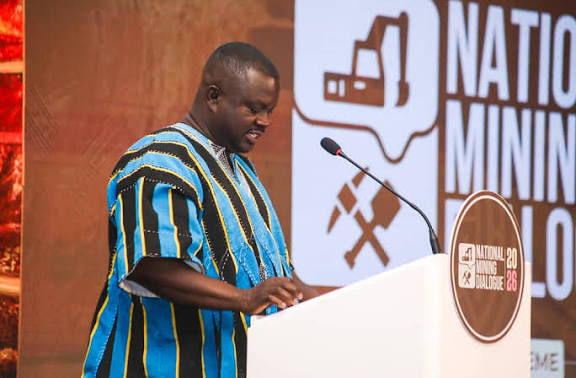
President of the Ghana Journalists Association (GJA), Albert Kwabena Dwumfour, has called for a collective effort by journalists, media owners, government, businesses and citizens to secure the future of journalism and preserve public trust in the media.
According to him, the future of Ghanaian journalism cannot be guaranteed by the GJA alone but requires all stakeholders to recognise their respective responsibilities towards building a free, credible and sustainable media industry.
Mr. Dwumfour made the call at the GJA @77 Anniversary Symposium, held to commemorate 77 years of the Association’s service to journalism and Ghana’s democratic development.
Speaking on the theme, “GJA @ 77: Building on Our Legacy, Advancing Ethical Journalism and Shaping the Future of Digital Media,” he said the anniversary offered an opportunity not only to celebrate the Association’s achievements but also to confront the challenges confronting the profession.
Media freedom and responsibility
Mr. Dwumfour reaffirmed the GJA’s commitment to defending press freedom and creating an environment in which journalists could investigate, question, scrutinise and report on matters of public interest without fear or intimidation.
He, however, stressed that press freedom must be accompanied by professional responsibility.
He said the credibility of the media depended on journalists adhering to principles of accuracy, fairness, balance, independence, accountability and respect for the dignity and rights of others.
The GJA President said the Association would therefore continue to defend journalists whose legitimate work was threatened while simultaneously promoting higher ethical standards within the profession.
He identified political polarisation, misinformation, disinformation, economic pressures, threats to media sustainability and attacks on journalists, particularly through digital platforms, as some of the major challenges confronting the media.
Journalism must remain trusted
Mr. Dwumfour said technological advancement had fundamentally changed journalism, but the core responsibilities of journalists remained unchanged.
He noted that artificial intelligence and other emerging technologies could assist journalists with research, transcription, translation and data analysis, but could not replace the human qualities required for responsible journalism.
“Journalism still requires curiosity, judgement, courage and conscience,” he said.
He explained that journalists must continue to verify information, scrutinise documents, seek responses from all relevant parties and identify inconsistencies, regardless of how advanced newsroom technologies became.
He consequently urged journalists to measure their success by the accuracy and credibility of their work rather than simply by audience numbers, social media followers or the speed at which stories were published.
Welfare of journalists
The GJA President also highlighted the need to improve the welfare and professional security of journalists.
He argued that the country could not expect excellent journalism from professionals operating under persistent insecurity and poor conditions.
He also warned that journalism could struggle to attract and retain talented young people if the profession continued to be regarded as a career without sufficient dignity and security.
“Media owners and managers have a responsibility here, but so do we as an Association,” he said.
He called for a more sustainable media ecosystem in which media organisations could invest in their journalists and provide the conditions necessary for quality journalism.
A responsibility to the next generation
Reflecting on the GJA’s 77-year history, Mr. Dwumfour paid tribute to former leaders whose sacrifices and contributions had helped establish the Association as an important voice for journalists.
He said the current leadership regarded itself as custodians of the institution rather than its owners.
“Our duty is to strengthen what we inherited and leave an even stronger Association for those who will come after us,” he said.
He challenged stakeholders to look beyond immediate concerns and consider what the GJA and Ghanaian journalism should become by the time the Association reaches its centenary.
The GJA, he said, must prepare for a future in which journalism, broadcasting and digital media would be fundamentally different from what exists today.
He said the most important question was whether the public would continue to trust journalists, stressing that the answer would depend on the choices made by the industry today.
Renewing the GJA
Mr. Dwumfour said the Association would continue to strengthen professional development, intensify advocacy for journalist safety and press freedom, promote ethical and public-interest journalism, support innovation and digital transformation, and deepen collaboration with government, civil society, development partners and the private sector.
He also expressed appreciation to institutions and partners that had supported the GJA through training programmes, advocacy initiatives, safety interventions, professional development activities and other programmes.
Concluding his address, Mr. Dwumfour said the 77th anniversary should not be viewed as the end of an era but as the beginning of another phase of renewal.
“At 77, therefore, our message is simple: the GJA is not retiring. We are renewing,” he said.
He reaffirmed the Association’s commitment to press freedom, ethical journalism, journalist safety, innovation and Ghana’s national development.
Professional Standards
The President of the Ghana Journalists Association, Albert Kwabena Dwumfour, has called on media practitioners to uphold the highest standards of professionalism, insisting that the credibility of journalism cannot be effectively defended when journalists themselves disregard the principles that sustain public confidence in the profession.
Mr Dwumfour made the appeal on Wednesday, August 19, 2026, when he addressed the Ghana Journalists Association’s 77th anniversary symposium and lecture, where he emphasised that journalists must regard professional integrity as an essential obligation accompanying the freedoms and protections associated with their work.
www.ghanareaders.com
He explained that members of the profession should be able to depend on the association for training, professional guidance and institutional support whenever legitimate journalistic duties are threatened. Nevertheless, he stressed that such protection must be matched by a corresponding commitment from journalists to preserve the ethical principles upon which the reputation of the profession rests.
According to the GJA President, the association would find it difficult to defend journalism’s standing if practitioners failed to demonstrate the discipline, accuracy and responsibility expected of them.
Mr Dwumfour also used the anniversary commemoration to reflect on the responsibility entrusted to the leadership of the association, describing its executives as custodians of an institution that has been built over several decades through sacrifice, advocacy and sustained professional dedication.
He maintained that the responsibility of present leaders was not simply to manage the association during their respective periods in office, but also to consolidate its achievements and strengthen its institutional foundation for succeeding generations.
The GJA President further recalled the association’s longstanding contribution to Ghana’s media environment, particularly its advocacy for conditions that allow journalists to perform their duties without intimidation, coercion or inappropriate interference.
He reaffirmed the association’s position that an independent press remains indispensable to democratic governance, public accountability and the protection of citizens’ right to reliable information.
Mr Dwumfour said the GJA had over the years collaborated with successive administrations, public institutions, civil society organisations, development partners and media establishments in efforts to advance journalism and reinforce professional standards across the country.
He pointed to training initiatives, professional workshops, conferences and engagements with key stakeholders as some of the measures through which the association has sought to strengthen the knowledge, competence and effectiveness of journalists.
He also recalled the GJA’s repeated interventions whenever media practitioners had faced attacks or threats to their safety and freedom, noting that the association had engaged appropriate authorities in response to such incidents.
Mr Dwumfour maintained that the association’s continued advocacy on behalf of journalists had formed part of its broader commitment to protecting press freedom and creating an environment in which media practitioners could carry out their constitutional responsibilities without fear.
He nevertheless emphasised that defending press freedom could not be separated from the obligation of journalists to exercise professional restraint, verify information carefully and uphold the ethical principles governing the profession.
The GJA President therefore urged journalists to understand that the future strength of Ghana’s media sector would depend not only on the ability of the association to defend its members, but also on the willingness of practitioners to conduct themselves in ways that preserve public confidence.
He said credibility remained one of the most important assets of journalism and warned that the profession’s relevance would inevitably be weakened whenever accuracy, integrity and professional responsibility were compromised.
His remarks form part of a broader message delivered at the GJA’s 77th anniversary events, during which he also urged journalists to place accuracy and verification ahead of the pressure to publish information quickly. He said journalists should be prepared to delay publication where necessary until facts had been properly established.
Mr Dwumfour further noted that emerging technologies, including artificial intelligence, were transforming the manner in which information was gathered, processed and distributed, but cautioned that technological advancement must not displace the ethical judgment and human responsibility required in credible journalism.
He maintained that journalists must continue to demonstrate curiosity, sound judgment, courage and conscience while using technological tools to support rather than undermine professional practice.
The GJA President’s message ultimately placed professional responsibility at the centre of the association’s anniversary reflections, stressing that the protection of press freedom and the preservation of journalism’s credibility must advance together if the profession is to retain the confidence of the Ghanaian public.