
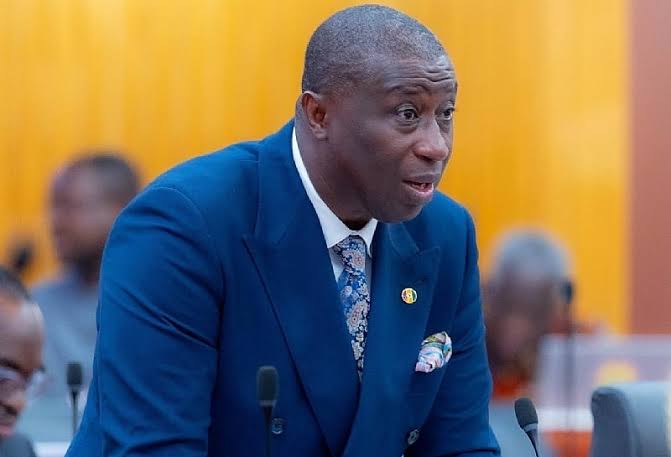

Okaikwei Central Member of Parliament Patrick Yaw Boamah has questioned the government’s commitment to strengthening Ghanaian businesses, arguing that the 2027 Budget’s emphasis on private sector development lacks sufficient practical measures to support local entrepreneurs and stimulate job creation.
Contributing to the second day of parliamentary debate on the budget, the lawmaker urged the government to demonstrate how its economic policies would translate into tangible assistance for indigenous businesses, particularly those seeking to expand operations, create employment and contribute to national development.

Mr Boamah maintained that Ghana’s economic transformation must largely depend on the capacity of domestic entrepreneurs to grow their businesses, insisting that foreign investors alone could not drive the country’s development.

He questioned whether the budget adequately addressed the concerns of business owners who were seeking meaningful government interventions to improve their operations and competitiveness.

“The question is, did the budget of 2027 answer the question that a lot of Ghanaian business people are asking with regards to supporting their businesses? Because Mr. Speaker, no foreigner will develop this country for us. We have to develop this country ourselves,” he said.
The MP argued that although references to private sector development and employment creation featured prominently in the budget, the government had failed to outline sufficient concrete initiatives to empower local businesses.

Drawing comparisons with Nigeria, Mr Boamah cited the government’s support for industrialist Aliko Dangote, arguing that deliberate state backing had contributed to the expansion of his business empire across the African continent, including Ghana.
He also referenced Ghanaian entrepreneurs and investors such as Dr Tettey Assah of Manet, the Adu family of Devtraco and Kevin Otry in the upstream petroleum industry, suggesting that local business leaders could benefit from targeted government assistance, fiscal incentives and policy support.

Mr Boamah called for a more deliberate approach to supporting the business community, insisting that government commitments must be accompanied by financial and policy interventions capable of delivering measurable results.

He said strengthening domestic enterprises was essential to expanding employment opportunities, particularly for the country’s growing youth population.
MP questions suspension of sitting allowances for SOE boards
Mr Boamah also expressed reservations about a Ministry of Finance directive instructing more than 164 state owned enterprises and statutory institutions to discontinue monthly sitting allowances for their board members.
He disclosed that a letter dated October 12, 2026, and signed by a Deputy Finance Minister on behalf of the Finance Minister, had been circulated to the affected institutions, raising concerns about the implications for their administrative and corporate governance responsibilities.
The lawmaker argued that the organisations required regular board meetings to facilitate effective supervision, strategic decision making and institutional growth, warning that the suspension of allowances could have implications for their operations.
“These are state companies, these are statutory institutions that require regular board meetings to help grow those companies. But this is a directive by the Minister of Finance asking for board allowance not to be paid. And this is a very serious matter that must be looked into by the House,” he said.
He urged Parliament to investigate the directive and assess its implications for the governance and management of state owned enterprises.
Boamah questions GH¢100 million provision for judgment debts
The Okaikwei Central legislator also demanded clarification from the Finance Minister regarding the GH¢100 million earmarked for judgment debt payments in the 2027 Budget, particularly the provision contained on page 195 of Appendix 4A.
Mr Boamah claimed that the Ghana Revenue Authority was facing a judgment debt exceeding GH¢680 million in connection with Safari Tech, questioning whether the budgeted amount was sufficient to address the outstanding liability.
“As I speak to you, GRA is saddled with a judgment debt of over 680 million Ghana Cedis from Safari Tech,” he stated.
He further criticised a proposed amendment to the State Proceedings Act, which he argued could limit the ability of creditors to attach monies held in the Contingency Fund or Consolidated Fund when pursuing the enforcement of judgments against the government.
According to him, public institutions must honour contractual commitments and comply with their legal obligations to prevent disputes from escalating into costly litigation and judgment debts.
“The government must respect the contracts that they enter into. State institutions must respect contracts to prevent the occurrence of judgment debts,” he said.
He cited outstanding financial obligations involving Ghana Water Company, Abengoa and Tullow Oil Ghana as additional examples of contractual and financial liabilities that required attention.
MP demands parliamentary oversight of GH¢30 billion New Economy allocation
Mr Boamah also called for stronger parliamentary scrutiny of the proposed GH¢30 billion allocation for the government’s New Economy programme, questioning the absence of specific ministries or institutions directly responsible for administering the funds.
Referring to page 189 of the 2027 Budget, he said the allocation had been classified as capital expenditure without being assigned to identifiable ministries, raising concerns about accountability and transparency in its implementation.
“There’s no ministry called New Economy,” he said, arguing that the arrangement differed from the previous budget, in which allocations were channelled directly to the relevant ministries.
The MP cited proposed allocations of GH¢3 billion for agriculture, GH¢2.2 billion for mining and GH¢1 billion for telecommunications, questioning why the amounts had not been directly assigned to the ministries responsible for those sectors.
He warned that placing the funding under the Ministry of Finance could undermine Parliament’s ability to effectively monitor expenditure and determine whether the resources were being utilised for their intended purposes.
“We as a House must have the power or the oversight to check whether those monies were sent to the ministries and whether they were properly utilized,” he said.
Mr Boamah cautioned against granting the Finance Minister excessive discretion over the management and distribution of the funds over the next four years, insisting that resources earmarked for agriculture, mining, telecommunications and other sectors should be channelled through the appropriate ministries to strengthen accountability.
His contribution has added to the ongoing parliamentary scrutiny of the 2027 Budget, with concerns emerging over local business support, public sector governance, contractual liabilities and transparency in the implementation of the government’s flagship economic programme.

