
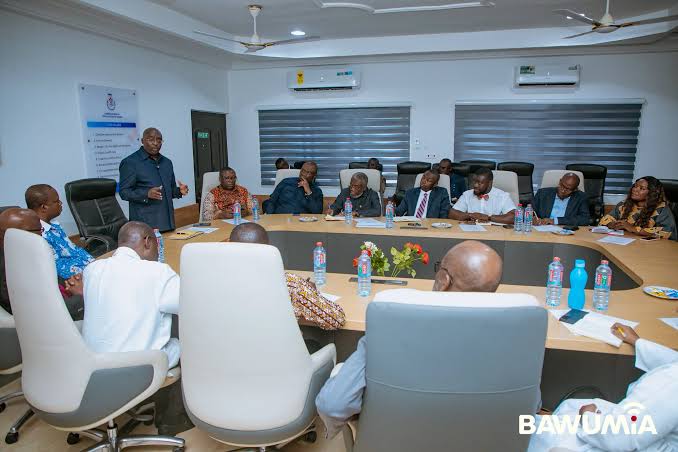

Former Vice President and New Patriotic Party (NPP) presidential candidate Dr Mahamudu Bawumia has proposed an amendment to the Ghana Health Service and Teaching Hospitals Act, 1996 (Act 525), to formally institutionalise the participation of the Christian Health Association of Ghana (CHAG) in the country’s healthcare delivery framework.
The proposal follows an engagement between Dr Bawumia and the leadership of CHAG, during which discussions centred on the association’s contribution to national healthcare provision, the challenges confronting faith-based medical institutions and the need to establish a more sustainable partnership between government and religious healthcare providers.

Dr Bawumia argued that the existing arrangement, which relies substantially on Memoranda of Understanding (MoUs) to regulate aspects of cooperation between government and CHAG, should be strengthened through a more comprehensive legislative framework.

He maintained that amending Act 525 would provide a more formal institutional foundation for CHAG’s participation in the national healthcare system, recognising its substantial contribution to service delivery, particularly in rural and underserved communities.

The former Vice President highlighted the scale of the association’s operations, explaining that its 42 health facilities account for approximately six per cent of Ghana’s healthcare infrastructure but provide between 30 and 40 per cent of healthcare services.
He observed that CHAG facilities play an especially important role in districts where access to public healthcare infrastructure remains limited, providing essential medical services to economically disadvantaged households and vulnerable populations.

The figures underscore the importance of faith-based healthcare institutions in complementing government efforts to expand access to medical services, particularly in communities where attracting and retaining healthcare professionals remains a persistent challenge.
CHAG itself describes its contribution as particularly significant at the outpatient level. According to information published by the association, its network accounts for approximately 7.5 per cent of Ghana’s health infrastructure while delivering about 30 per cent of outpatient department services nationally. It also says it serves approximately eight million people annually.

The distinction is important because the figures presented by Dr Bawumia refer to broader healthcare service delivery, whereas CHAG’s published 30 per cent figure specifically concerns outpatient services.

Established in 1967, CHAG emerged from the collaboration of faith-based healthcare providers and missionary institutions seeking to support government efforts to extend medical services to communities that were inadequately served by conventional healthcare infrastructure.
Over the decades, the association has developed into an important component of Ghana’s pluralistic healthcare delivery system, operating facilities that provide primary healthcare, maternal and child health services, specialist treatment and other essential medical interventions.
Its contribution extends beyond the provision of medical consultations, with some facilities offering specialised services, including renal transplantation, orthopaedic treatment, magnetic resonance imaging and computerised tomography.
The legislative dimension of Dr Bawumia’s proposal is particularly significant because Act 525, enacted in 1996, established the Ghana Health Service as an autonomous public agency responsible for implementing approved national health policies and expanding access to healthcare.
Section 3 of the legislation identifies increasing access to improved healthcare services as one of the principal objectives of the Ghana Health Service. It also empowers the Service to provide healthcare directly or contract recognised healthcare providers to deliver services on its behalf.
This provision is particularly relevant to the proposed reform because the existing legislation already recognises the possibility of engaging non-governmental healthcare providers in service delivery.
Consequently, the central question is not simply whether CHAG can participate in national healthcare provision, but whether its longstanding relationship with government should be given a more clearly defined statutory framework, including institutional representation, financing arrangements, operational responsibilities and accountability mechanisms.
A successful amendment could potentially provide greater predictability in the relationship between government and faith-based healthcare providers, particularly regarding resource allocation, infrastructure development, service delivery obligations and the provision of medical equipment.
However, the proposal would require further legislative clarification to establish precisely what additional rights, responsibilities and institutional guarantees CHAG would receive beyond the arrangements already permitted under existing law.
Beyond the proposed amendment, discussions also addressed the need to introduce additional incentives for healthcare professionals serving in rural and underserved communities.
The issue is particularly important given the persistent geographical inequalities in healthcare access, with specialist medical professionals and essential health infrastructure often concentrated in major urban centres.
Providing additional incentives could help encourage medical practitioners, nurses and other healthcare professionals to accept postings in remote communities and remain there for longer periods.
The meeting also considered the removal of import duties on medical equipment as a possible intervention to facilitate the retooling of CHAG facilities.
Such a measure could reduce the financial burden associated with acquiring sophisticated diagnostic and treatment equipment, potentially enabling healthcare institutions to improve the quality and range of services available to patients.
Nevertheless, any proposed duty exemptions would require careful consideration of the applicable customs and tax framework, including the categories of equipment that would qualify and the potential implications for government revenue.
Dr Bawumia also connected the discussions to his broader position on government collaboration with religious organisations in the education sector.
Reiterating a commitment contained in the NPP’s 2024 manifesto, he maintained that faith-based organisations should be allowed to participate more substantially in managing mission schools.
His position reflects the longstanding involvement of religious institutions in Ghana’s educational development, particularly through the establishment and management of schools that have contributed significantly to the country’s educational infrastructure.
The former Vice President indicated that his engagements with CHAG formed part of broader consultations aimed at developing practical policy proposals to address the challenges confronting faith-based institutions and improve healthcare delivery.
He added that his team would continue consultations with stakeholders before developing more concrete proposals.

