
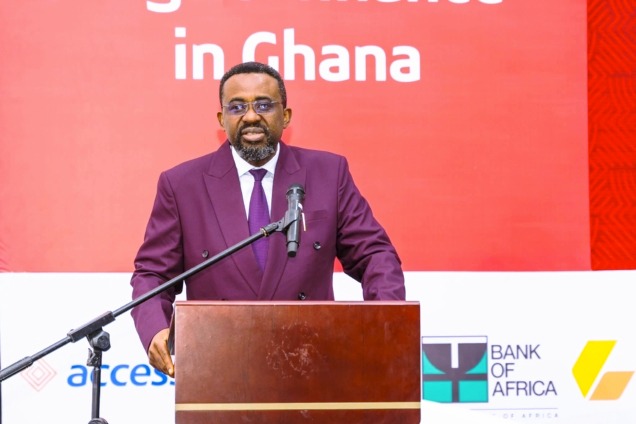

The Governor of the Bank of Ghana, Dr Johnson Pandit Asiama, has called on African decision makers and corporate executives to assume a decisive and proactive position in determining the trajectory of international finance, rather than continuing as mere observers within the system.
Addressing participants at the 3i Africa Summit in Accra, he indicated that the continent stands at a pivotal moment, where intentional strategy and collective alignment will ultimately define its relevance and influence within the transforming global financial architecture.

He framed the matter in clear terms, posing a direct challenge to stakeholders by questioning whether Africa will simply embrace the forthcoming evolution of financial systems or whether it will actively contribute to designing and directing that transformation.

Dr Asiama pointed to the continent’s measurable advancement in broadening financial accessibility, explaining that the rapid spread of digital financial platforms, particularly mobile money services alongside branchless banking structures, has established a dependable base for continued advancement. He noted that nearly half of the adult population within Sub Saharan Africa now possesses access to digital financial accounts, reflecting consistent gains in inclusion across the region.

Despite this progress, he warned that the emphasis must now progress beyond mere accessibility towards tangible outcomes, insisting that inclusion must generate measurable economic benefit and scalable value. In his view, access alone is insufficient unless it translates into meaningful growth, productivity, and improved livelihoods.
The Governor further explained that the forthcoming stage of digital financial development across Africa will be determined by the continent’s capacity to interlink financial infrastructures, align regulatory frameworks, and cultivate confidence across national boundaries. He stressed that the central issue has shifted away from constructing systems towards ensuring their effective integration and interoperability.

He also highlighted the necessity of robust collaboration, continuous capital commitment, and coherent policy direction as essential drivers of this transformation. According to him, these foundational elements must not only be articulated in theory but must also be executed efficiently through durable partnerships and sustained financial backing.
In addition, Dr Asiama emphasised that Africa’s digital financial environment must transition towards a more advanced and stable phase, anchored in accountability, openness, and healthy competition. He clarified that a resilient financial system cannot be evaluated solely by the volume of transactions or activity, but rather by the strength of its governance, the clarity of its operations, and its ability to remain competitive on a global scale.

He concluded by asserting that although Africa has achieved notable milestones, it now faces a rare and significant opportunity to shape the future direction of global finance. However, this prospect will only be realised if the continent elevates its ambition from simple engagement to authoritative leadership, making it clear that participation alone is no longer sufficient, and that leadership must now define Africa’s role.


