
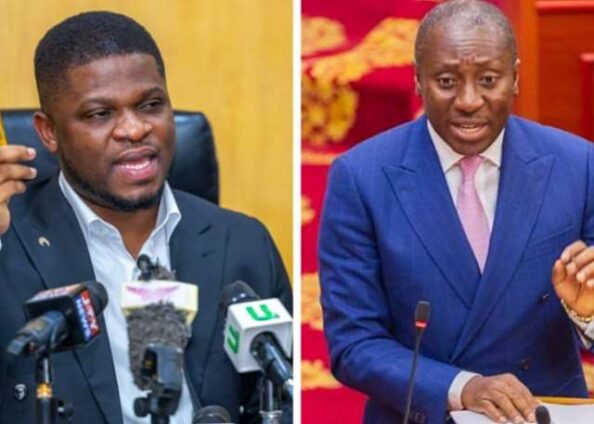

The Minority in Parliament has intensified its challenge to Ghana Gold Board Chief Executive Officer Sammy Gyamfi, maintaining that his response to allegations surrounding the Domestic Gold Purchase Programme has failed to resolve concerns about the reported financial losses and has instead reinforced the need for parliamentary scrutiny.
In a statement issued on Wednesday, August 19, 2026, Minority Leader Alexander Afenyo Markin contended that Mr Gyamfi had not disputed the reported US$1.7 billion loss associated with the programme in 2025, but had instead concentrated his defence on whether GoldBod should bear responsibility for the financial setback.


Mr Afenyo Markin said that distinction did not eliminate the need for accountability because the funds involved belonged to the state and therefore required a clear explanation regardless of which public institution carried the loss on its balance sheet.

“First, the loss is admitted. The Chief Executive does not dispute the IMF’s finding that there is a loss of US$1.7 billion, which is 22 billion Ghana cedis, under the Domestic Gold Purchase Programme in 2025,” the Minority Leader stated.

He added that the central issue was not simply which government institution recorded the loss, but whether public resources had been properly managed and whether those responsible for the programme could adequately account for its financial consequences.
“This is public money, whichever State balance sheet it sits on,” he said.

Mr Afenyo Markin subsequently questioned Mr Gyamfi’s assertion that GoldBod achieved an operational surplus of GH¢907 million in 2025.
According to the Minority Leader, information provided by the GoldBod chief executive indicated that the institution accounted for approximately GH¢133 billion in advances connected to the Domestic Gold Purchase Programme while receiving an assay charge of 0.258 per cent and a service charge of 0.5 per cent.


He argued that applying those charges to the reported advances suggested that GoldBod generated roughly GH¢1 billion in fees through its involvement in the programme.

Mr Afenyo Markin therefore questioned why the GH¢907 million operational surplus was being presented as evidence of GoldBod’s financial performance when, in his assessment, the institution’s fee income from the programme exceeded the surplus being highlighted.
“The plain implication of his own numbers is that the operational surplus he is celebrating is smaller than the fee income he collected from a programme that lost the state 22 billion Ghana Cedis,” he said.
He further maintained that once the agency fees were excluded from the calculation, GoldBod would have little or no operational surplus to present as an achievement.
“Strip out the agency fees and there is no operational surplus to speak of,” Mr Afenyo Markin added.
The Minority Leader said Mr Gyamfi’s response had not satisfactorily answered that particular financial question and maintained that GoldBod must provide a clearer account of the relationship between the fees it earned and the broader financial outcome of the gold purchasing programme.
He also accused the GoldBod management of adopting an inconsistent position when discussing the programme’s successes and shortcomings.
According to Mr Afenyo Markin, GoldBod and its supporters have associated the expansion of domestic gold purchases with several positive economic developments, including an alleged 41 per cent appreciation of the Ghanaian cedi, an increase in international reserves from approximately US$8.9 billion to US$13 billion and a decline in inflation.
He argued that an institution that associates itself with the benefits generated by a programme should also be prepared to answer questions concerning the costs and losses connected to the same initiative.
“An institution that claims authorship of the benefits cannot describe itself as a passive agent when the costs are counted,” he said.
The Minority Leader also raised questions about the financing structure supporting GoldBod and the wider domestic gold purchasing framework.
He pointed to reported changes in responsibility for the implementation of the Ghana Agriculture and Natural Resources Platform, known as GANRAP, saying the arrangement had reportedly shifted from the Bank of Ghana to the Ministry of Finance in July 2026 while GoldBod was expected to secure financing independently from August.
Mr Afenyo Markin described the reported changes as evidence of uncertainty surrounding the programme’s funding architecture.
“Three funding arrangements in six months is not a settled model. We view this with curious eyes,” he said.
Beyond the financial questions, the Minority Leader also criticised the language Mr Gyamfi used in his earlier response to the allegations.
He specifically objected to the GoldBod chief executive’s description of the Minority’s narrative as a “brothel”, arguing that such language was inappropriate for an official involved in accounting for public resources.
“Finally, a word on tone. The Chief Executive’s reference to a brothel does not belong in a statement issued by a Public Officer accounting for public funds,” Mr Afenyo Markin said.
He maintained that the central demand from the Minority was for financial information and documentary evidence rather than personal exchanges.
“Ghanaians asked for figures. They were given insults. The figures are still outstanding,” he added.
The latest confrontation follows Mr Gyamfi’s earlier challenge to Mr Afenyo Markin to use Parliament’s oversight mechanisms to invite him before the Public Accounts Committee, where he said he was prepared to explain GoldBod’s operations and contest claims that the institution was responsible for the losses associated with the Domestic Gold Purchase Programme.
Mr Gyamfi has maintained that the reported losses should not automatically be attributed to GoldBod and has called for the matter to be settled through an evidence based parliamentary inquiry rather than competing statements in the media.
Mr Afenyo Markin, however, has indicated that the Minority intends to proceed with parliamentary action when the House resumes, with the objective of compelling GoldBod’s management to provide a comprehensive account of the financial implications of the Domestic Gold Purchase Programme.
The disagreement has consequently developed into a wider dispute over the interpretation of the International Monetary Fund’s findings, the financial performance of GoldBod and the institutional responsibility for losses linked to Ghana’s domestic gold purchasing arrangements.
At the centre of the controversy is the IMF’s Sixth Country Report, No. 26/213, issued in August 2026, which contains assessments of the Domestic Gold Purchase Programme and the financial consequences associated with its operations.
The competing interpretations of that report have become a major point of contention, with the Minority arguing that the reported loss demands direct accountability while Mr Gyamfi maintains that GoldBod should not be held responsible for losses incurred by another state institution.
The dispute is therefore expected to move beyond public exchanges as Parliament prepares to resume proceedings, potentially providing a formal platform for both sides to present documents, financial records and other evidence concerning the programme.
Until such scrutiny takes place, the disagreement between the Minority and GoldBod management is likely to remain focused on one central question: whether the financial losses associated with the Domestic Gold Purchase Programme should be attributed to GoldBod, the Bank of Ghana or the broader structure through which the programme was implemented.

