
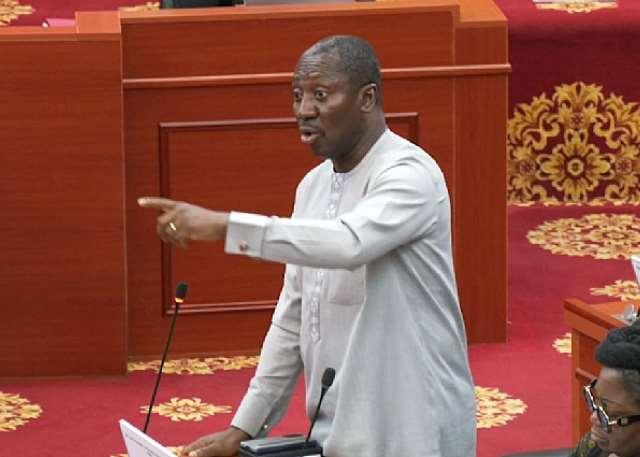

Minority Leader in Parliament, Alexander Afenyo Markin, has defended the opposition New Patriotic Party’s scrutiny of the Ghana Gold Board, insisting that the concerns raised over the financial consequences of the institution’s operations are rooted in policy and institutional shortcomings rather than partisan politics.
Speaking on Eyewitness News on Tuesday, August 18, Mr Afenyo Markin argued that the Minority’s reservations regarding the financial implications of GoldBod’s gold purchasing programme were informed by issues previously identified by the International Monetary Fund.

He maintained that the IMF’s assessment of Ghana’s gold purchasing arrangements is already within the public domain and therefore should not be dismissed as an opposition political narrative. According to him, the substance of the concerns deserves serious consideration regardless of the political affiliation of those raising them.

The Effutu Member of Parliament consequently appealed to the government to concentrate on the substantive issues surrounding GoldBod instead of responding to criticism through personal attacks or questioning the intentions of opposition figures.

Mr Afenyo Markin said the debate should not be reduced to disagreements between individual politicians, arguing that the fundamental question concerns the financial consequences of policies implemented through the state owned gold purchasing institution.
He maintained that the principal concern was whether GoldBod’s operational and purchasing policies had contributed to substantial financial losses for the state. According to the Minority Leader, the alleged loss amounted to approximately US$1.7 billion, which he equated to about GH¢22 billion.

Mr Afenyo Markin characterised the matter as an institutional efficiency and policy question, arguing that the government should be prepared to account for the financial implications of the programme rather than treating the criticism as a personal attack against GoldBod officials.
His comments have emerged amid an increasingly contentious dispute over the financial performance of GoldBod and the interpretation of its 2025 financial results.

The Institute of Fiscal Policy Governance has challenged the Minority’s assertion that GoldBod suffered losses of approximately US$1.7 billion, maintaining that the figure does not correspond with the institution’s audited financial statements.

The institute argues that GoldBod’s audited accounts present a substantially different assessment of its financial position, thereby disputing the basis upon which the alleged US$1.7 billion loss has been calculated.
The disagreement has consequently shifted attention towards the interpretation of GoldBod’s financial records and the broader economic consequences of the government’s gold purchasing strategy.
GoldBod has previously maintained that its audited financial statements do not support claims that the institution suffered a GH¢22 billion loss. Chief Executive Officer Sammy Gyamfi has stated that the organisation recorded an operational surplus of approximately GH¢907 million and an overall surplus of about GH¢5.4 billion for the period under consideration.
The conflicting assessments have intensified the political and economic debate over Ghana’s gold purchasing programme, particularly concerning the cost of financing gold purchases, the management of the resulting assets and the broader implications for public finances.
For Mr Afenyo Markin, however, the controversy should be assessed primarily through the lens of institutional performance and policy effectiveness. He insists that the critical question is whether the implementation of GoldBod’s mandate has strengthened Ghana’s financial position or instead exposed the state to significant losses.
The Minority Leader’s latest intervention therefore reinforces the opposition’s determination to keep GoldBod’s financial operations under scrutiny while challenging the government to provide clear explanations regarding the institution’s performance and the financial outcomes associated with its gold purchasing policy.
At the centre of the dispute remains a fundamental disagreement over the figures themselves, with the Minority maintaining that the programme has resulted in losses of about US$1.7 billion, while GoldBod and the Institute of Fiscal Policy Governance point to audited financial information that they say contradicts that assessment.
The competing interpretations are expected to sustain further public debate over GoldBod’s accounts, the government’s gold purchasing strategy and the extent to which the programme has affected Ghana’s public finances.

