
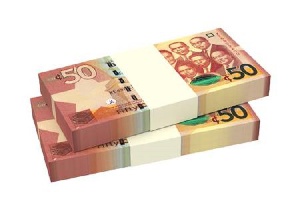

The Cedi was created as the principal medium of exchange for the land of Ghana by its first black Prime Minister and later President, Dr. Kwame Nkrumah, who later adopted nom de guerre ‘Osagyefo’ for himself.
The Cedi was created in July 1965 to replace the Ghanaian pounds, shillings and pence. Since its creation fifty-nine years ago, the Cedi’s value has faced a downward trend, and has never seen any appreciation in value against its fellow trading currencies.

Over the decades, many governments and administrations of the central bank have tried to use fiscal and monetary policies to try to stem the slide of the Cedi. However, all these efforts have failed.

The most extensive effort was in July 2007, when the Cedi was ‘redenominated’ to bring its value on a par with currencies such as the United States dollar. However, since then, predictably, the historical trend to the downward has remained the norm.

Against the background above, it can be stated on authority that the latest effort by the Bank of Ghana to clamp down on foreign exchange dealers, would meet exactly the same fate as the previous efforts. It too, shall fail, with a certainty, and the same panache.
The Cedi has been plagued with the plague of constantly sliding in value, because of a problem all of us know, but have consistently refused to address. You see, Osagyefo Dr. Kwame Nkrumah instituted the Cedi against the backdrop of a problem that had existed for three hundred years before he arrived, and has outlived him. The problem was/is that the Ghanaian, and before then the people of the Gold Coast, had been indoctrinated by the colonizers to use only finished products manufactured by the colonizers. Today, we euphemistically say that the Ghanaian economy is an import-driven economy.

That is to say, that everything we use, from toothpicks to heavy machinery, is imported from outside the nation. Secondly, we have been placed as an agrarian producer of specific global needs on the world economic calendar, and there are real, entrenched powers on the global platform who ensure that this position on the global calendar remains the same.
Worsening the problem is the fact that we have decided, as a people, that we would not engage in value addition. Value addition is where we add value to what we produce, before exporting same. Ghana primarily produces cocoa, timber, diamonds, bauxite and few more. This is exactly where the world wants us, and nowhere else. We do not add value or process any of these primary exports, and the prices for what we produce are determined by others other than ourselves. And those who buy our products from us, are capitalists who would do anything and everything to maintain their profits.

You should add the fact that we also do not determine the prices of the goods we import. So we are at a place, where we do not control the prices of what we export, and also do not determine the prices of what we import. Thus our currency, the medium of exchange that serves the two situations, would continually face a dismal fate.

That is the real problem of the Cedi, and until and unless we deal with that issue, our currency would continually face dismal prospects. In other words, we have to take control of one end of the spectrum, that is, either the imports, or the exports. Otherwise, or currency would continue to slide, with its manifest and catastrophic effects.
WHAT CAN WE DO?
First, increase local production of all manner of goods. A few years ago, I was campaigning and thought that giving my constituents handkerchiefs would be a nice thing to do. I have a tailoring outfit, and decided that I would sew the gifts. Then all manner of technical challenges started popping up, and in spite of the best of efforts, I never overcame the challenges. We do not produce handkerchiefs in Ghana.
Another example. Several years ago, I visited Dr. Edward Mahama at his clinic, and he was complaining about a piece of medical equipment called a pap swab. The doctors use it to conduct a pap smear, to check for virginal cancer. It is just a piece of wood, fashioned in a funny way. I ignorantly boasted that I would supply him with the device. It is a piece of wood, but we do not have the machinery to craft them into the fineness required. So we export timber at so hundreds of dollars a ton, and it comes back as medical equipment at so many hundreds of thousands of dollars a ton, because of a few pieces of machinery. In effect, we have to change that much more Cedis into dollars to import finished products made from our own raw products.
So the solution, is in increasing local production of all manner of goods.
CREATING MORE FINISHED PRODUCTS
Second, is in processing our local products into finished products. Wherever you are reading this, all that you need to do, is cast a cursory look at all the things around you, that you use or have bought, and you would realize, that almost all of them, is imported. That means, that you have created jobs elsewhere, and you have created a stronger currency in another country. If we want to save the Cedi, this has to stop.
PATRONAGE
The third thing, is patronage. We must buy the things we produce here.
Again, this is a major stumbling block to the stability of the Cedi (or Ghana Cedi, as Bawumia will have us call it) in that we are constantly selling the Cedi to buy other foreign currencies to feed our love of everything imported.
As I stated earlier, everything we use in this country is imported. We would buy imports, even when there are local substitutes. This is a habit that we must make a conscious effort to stop.
Therefore, to ensure the viability of our increased production efforts, we must back it up with patronage. Ghana has a population of about thirty million people. On a global scale, this is just a drop in the ocean. But for any business start-up, this is a major market share. If we decide to direct our purchasing power to only home-grown efforts, it would lead to the creation of many viable companies, which would lead to job creation on a large level, which would also lead to a more sustainable currency.
MORE EXPORTS
Fourth, we should work towards creating a larger market share of exports, and the solution would lie in ingenuity. Ghana has a greater percentage of the worldwide cocoa market, and we should look to secure and improve on this advantage.
Again, we should look at creating more exportable goods and services that would bring in more foreign exchange to bolster the Cedi.
I believe, that when these things are done, the Cedi would fare much better.
HARD WORK
Of course, the above proposals would involve hard, back-breaking work, which all of us strive diligently to avoid, and therein lies the problem. It is why we are behaving like ostriches and have tried to find a solution to the Cedi’s ailment in fiscal policy, when we know, and have known for decades, that that is not where the solution lies.

