
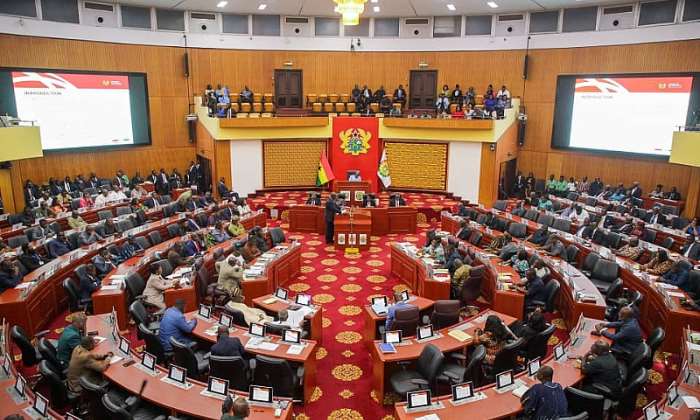

The Government has proposed more than GH¢5 billion in funding for Parliament, the Judiciary and the Ghana Audit Service for the 2027 financial year, with Parliament and the Judiciary facing substantial reductions in their original budgetary requests amid concerns over the country’s constrained fiscal position.
The proposed allocations, announced by Speaker of Parliament Alban Bagbin during proceedings in the House on Tuesday, November 24, 2026, were contained in a presidential communication outlining the government’s recommended expenditure provisions for the three constitutional institutions.

The figures indicate that Parliament and the Parliamentary Service have been earmarked GH¢2,283,561,480, while the Judiciary and Judicial Service are expected to receive GH¢1,426,188,719.02. The Ghana Audit Service has been allocated a recommended GH¢1,315,963,661.

The proposed funding arrangements are intended to finance the operational and administrative responsibilities of the three institutions throughout the 2027 fiscal year, consistent with the constitutional framework governing public expenditure and the financial independence of designated state institutions.

Judiciary faces GH¢143 million reduction in proposed funding
The Judiciary and Judicial Service had initially requested GH¢1,569,553,531.20 to finance their activities during the 2027 financial year.

However, the government’s proposed provision stands at GH¢1,426,188,719.02, leaving a funding deficit of approximately GH¢143.36 million against the institution’s original submission.
Presenting the recommendation to Parliament, Mr Bagbin explained that the reduction reflected the government’s assessment of available financial resources and the limitations confronting the national budget.

“In view of the limited fiscal space, the government recommends a total allocation of 1,426,188,719 Ghana cedis and 2 pesewas for the Judiciary and the Judicial Service for the 2027 financial year,” he stated.

The proposed expenditure is expected to finance the administration of justice, the maintenance of court operations and the broader institutional responsibilities of the Judiciary and Judicial Service.
The reduction nevertheless leaves the institution with less funding than it considered necessary to meet its projected expenditure requirements for the year.
Parliament’s allocation reduced by approximately GH¢670 million
Parliament and the Parliamentary Service have also encountered a significant adjustment to their proposed 2027 budget, following the government’s decision to recommend GH¢2,283,561,480 instead of the GH¢2,953,139,666 originally requested.
The difference amounts to approximately GH¢669.58 million, representing a substantial reduction in the financial provision initially submitted by the legislature.
According to the Speaker, the government’s proposed allocation reflects adjustments to several expenditure categories, including capital investments, the procurement of goods and services, as well as employee compensation.
Mr Bagbin indicated that the reductions could affect Parliament’s capacity to expand its technical workforce and engage additional professionals whose expertise would strengthen the institution’s legislative and administrative functions.
He explained that the proposed adjustments had affected plans to recruit specialised personnel and obtain consultancy services in areas where Parliament required additional technical support.
“The request to also add additional experts and technical hands have also been affected in the compensation of employees. And so we may not be able to ask for some consultancies and some technical people to support us in some of the areas that we need to be strengthened to do our work,” he told the House.
The Speaker’s remarks suggest that the reduced financial provision could constrain Parliament’s plans to improve its institutional capacity, particularly in areas requiring specialised professional knowledge and technical assistance.
The recommended amount is expected to sustain parliamentary proceedings, legislative activities and the administrative operations of the Parliamentary Service throughout the coming financial year.
Audit Service receives full budgetary request
In contrast to Parliament and the Judiciary, the Ghana Audit Service has received a government recommendation that fully accommodates its submitted financial requirements for 2027.
The institution has been earmarked GH¢1,315,963,661, covering its expenditure on employee remuneration, goods and services, and capital investments.
Announcing the allocation, Mr Bagbin confirmed that the proposed amount adequately addresses the Audit Service’s original budgetary submission across the three principal expenditure classifications.
“This allocation fully meets the Audit Service request for compensation for employees, goods and services, and capital expenditure,” he announced.
The funding is expected to strengthen the institution’s capacity to examine public accounts, scrutinise government expenditure and promote transparency, financial discipline and accountability in the utilisation of public resources.
The full accommodation of its request contrasts with the reductions imposed on the financial proposals submitted by Parliament and the Judiciary.
Parliamentary committees to scrutinise proposed allocations
Following the presentation of the presidential recommendations, Speaker Bagbin referred Parliament’s financial estimates to the Committee on Parliament, alongside the leadership of the Budget Committee and the Finance Committee, for examination and subsequent reporting to the House.
The Ghana Audit Service’s estimates were similarly referred to the Finance Committee and the Public Accounts Committee for consideration.
The committees are expected to assess the proposed expenditure provisions, examine the financial implications and submit their findings to Parliament to facilitate further deliberations and the eventual approval process.
The referrals form part of Parliament’s budgetary scrutiny responsibilities, through which the proposed allocations will undergo legislative examination before the financial provisions are finalised.
The recommendations were communicated through a presidential letter dated October 19, 2026, following the submission of Parliament and the Parliamentary Service’s annual financial estimates for the 2027 fiscal year.
2027 Budget prioritises spending restraint and economic transformation
The proposed allocations come against the background of the government’s broader fiscal programme outlined in the 2027 Budget, which Finance Minister Dr Cassiel Ato Forson presented to Parliament on November 12, 2026.
Among the major policy commitments announced in the budget is the government’s intention to introduce no additional taxes while pursuing its proposed US$10 billion New Economy agenda.
The administration has positioned the initiative as a central component of its economic transformation strategy, even as it seeks to manage public expenditure within the limits of available financial resources.
The funding recommendations for Parliament, the Judiciary and the Ghana Audit Service therefore highlight the competing demands confronting the 2027 national budget, particularly the need to finance essential constitutional institutions while maintaining fiscal discipline.
Although the three institutions have collectively been recommended more than GH¢5 billion, the reductions affecting Parliament and the Judiciary raise questions about the extent to which their original operational and institutional development priorities can be accommodated within the government’s proposed expenditure framework.

