
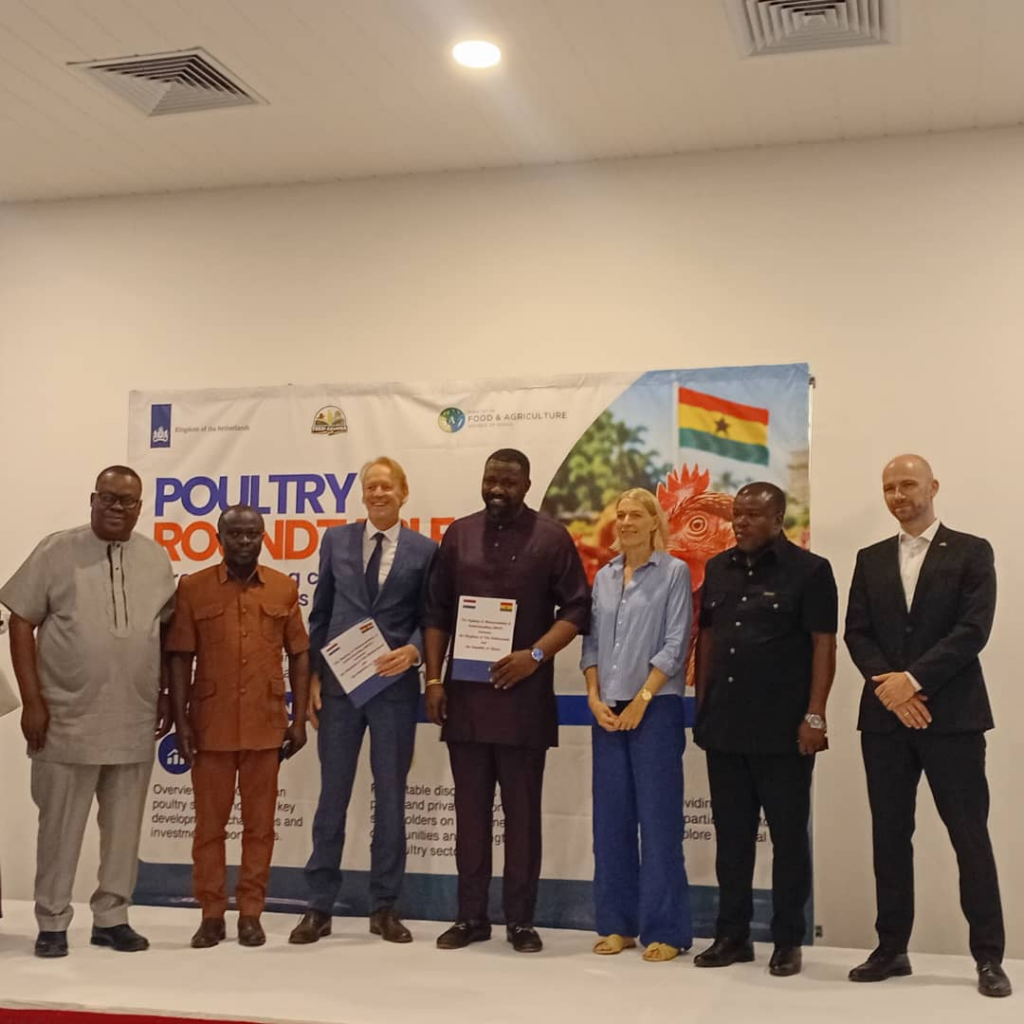

Deputy Minister of Food and Agriculture John Dumelo has reaffirmed the government’s commitment to strengthening Ghana’s poultry industry, pledging to address persistent challenges undermining local production and making domestically raised chicken increasingly expensive for consumers.
Speaking on behalf of the government at a poultry roundtable discussion with the Netherlands in Accra on Monday, October 26, 2026, Mr Dumelo said information gathered on the industry underscored the urgent need for decisive action, improved coordination and stronger partnerships to unlock the sector’s potential.

“We are taking the poultry sector very seriously,” he emphasised, signalling the government’s determination to improve local production and address obstacles confronting poultry farmers.

He expressed particular concern about the high prices of locally produced chicken, pointing to the involvement of multiple intermediaries along the supply chain as one of the factors driving up costs between farms and retail markets.

According to Mr Dumelo, poultry that farmers sell for approximately GH¢80 can eventually cost consumers about GH¢200 by the time it passes through the distribution network. He argued that this substantial price difference deserved closer examination, particularly as Ghana seeks to make locally produced chicken more affordable and competitive.
The Deputy Minister’s comments highlighted a major challenge confronting the domestic poultry industry, where high consumer prices can undermine demand for locally raised birds and strengthen the appeal of imported alternatives.

The engagement also resulted in the signing of a memorandum of understanding between Mr Dumelo and the Netherlands Ambassador to Ghana, Hans Akerboom, to deepen bilateral cooperation and support the development of Ghana’s poultry industry.
The agreement is expected to promote improvements in domestic production through technical assistance, the exchange of expertise and knowledge, and investment opportunities. The partnership could help strengthen local production capacity while supporting efforts to address structural weaknesses within the poultry value chain.

Ghana’s renewed focus on poultry production comes against the backdrop of its substantial dependence on imported chicken. The Netherlands Ambassador has previously highlighted the country’s reliance on foreign supplies, with an estimated 80 per cent of poultry consumption met through imports, underscoring the need to expand domestic production.

As part of its response, the government introduced the Nkoko Nkitinkiti initiative under the Feed Ghana Programme, which was launched in November 2025. The initiative seeks to encourage household poultry farming, strengthen food security, create employment opportunities and reduce the country’s dependence on imported chicken.
The programme is designed to distribute millions of birds and chicks while extending support to household poultry keepers, small and medium scale farmers, and larger commercial producers. By broadening participation in poultry farming, the government hopes to increase domestic supplies and establish a stronger foundation for the industry’s long term growth.
In July 2026, Feed Ghana Coordinator Bright Demordzi disclosed that approximately 2.5 million birds had already been distributed under the initiative, indicating progress towards expanding Ghana’s poultry production base.
Mr Demordzi also said the programme was targeting a 50 per cent reduction in poultry imports over the medium term. Achieving that objective would require sustained investment, improved productivity, stronger distribution systems and measures to make locally raised chicken more affordable for consumers.
The latest agreement with the Netherlands therefore represents another step in the government’s broader effort to revitalise the poultry industry. However, the extent to which the partnership and existing interventions can reduce prices, improve farmers’ earnings and narrow Ghana’s dependence on imported poultry will depend on how effectively the commitments are translated into practical results.

