
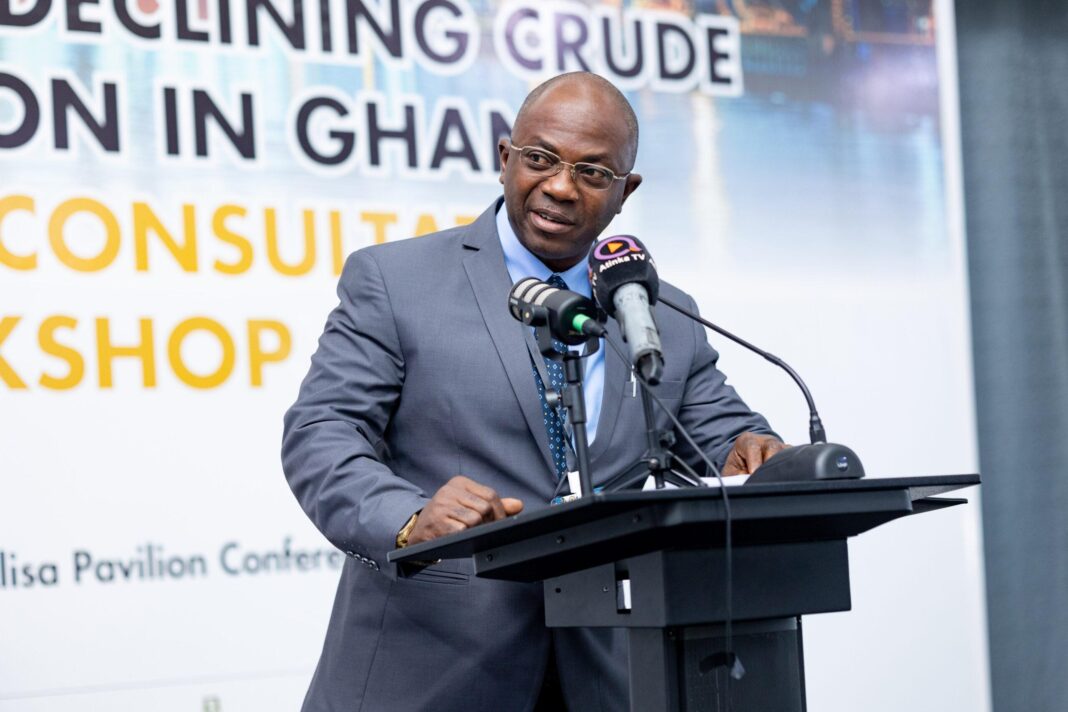

The Public Interest and Accountability Committee (PIAC) has called for improved access to government expenditure information, warning that delays in obtaining details about petroleum revenue allocations are constraining its ability to assess how the funds are being utilised.
Presenting its 2026 semi annual report in Accra, PIAC Chairman Richard Ellimah disclosed that the Committee was still awaiting information from the Ministry of Finance concerning the use of the Annual Budget Funding Amount (ABFA), which channels petroleum revenues towards government expenditure.

Mr Ellimah explained that the Committee had formally requested the relevant information but had yet to receive a response from the Ministry. He stressed that access to the data was essential for a comprehensive assessment of public spending financed through petroleum revenues.

He identified infrastructure development as a particularly important area of scrutiny, citing projects under the government’s Big Push Agenda, including the proposed Accra to Kumasi Expressway.

According to the PIAC Chairman, the allocation of a substantial share of the ABFA to the Big Push programme could also require the Committee to reconsider its approach to inspecting projects financed through petroleum revenues.
“We are hoping very much that the Ministry of Finance will give us the data so we can understand what is going on,” he said.

“It is something new for us because it is going to change the way we also do our project inspections.”
Mr Ellimah also raised concerns about compliance with the legal requirements governing the disclosure of information to PIAC, calling for stronger enforcement of the relevant provisions.

He observed that throughout the Committee’s 15 years of operation, he was not aware of any prosecution arising from a failure to comply with the Petroleum Revenue Management Act (PRMA).

The Chairman disclosed that PIAC intended to consult the Attorney General for guidance on addressing persistent compliance challenges. He explained that the Committee lacked the independent authority to initiate legal proceedings to enforce its recommendations or compel compliance with the legislation.
“These are clearly legal infractions,” he said, adding that advice from the Attorney General would help the Committee determine the appropriate steps to take.
Established under Section 51 of the Petroleum Revenue Management Act, PIAC is mandated to promote transparency and accountability in the collection, allocation and utilisation of Ghana’s petroleum revenues.
Its responsibilities include monitoring adherence to the law and providing independent information to the public to encourage informed national debate while supporting Parliament’s oversight of petroleum revenue management.
PIAC Executive Secretary Isaac Dwamena, meanwhile, drew attention to the timelines prescribed for institutions responding to the Committee’s requests for information.
He explained that Regulation 25 of the Petroleum Revenue Management Regulations requires institutions asked to provide information for PIAC’s annual and semi annual reports to submit the requested material within 15 days of receiving the request.
Despite the outstanding information from the Ministry of Finance, the Committee’s latest report examined developments in petroleum revenue collection, crude oil production, expenditure and the administration of the country’s petroleum funds during the first six months of 2026.
The report disclosed that petroleum revenue receipts climbed to US$561.4 million during the period, compared with US$370.3 million recorded in the corresponding half of 2025.
The improvement was attributed largely to higher crude oil prices on the international market and increased receipts from corporate income taxes.
Ghana’s average realised crude oil price reached US$92.80 per barrel, exceeding the benchmark price of US$76 per barrel used in the country’s petroleum revenue projections.
However, PIAC cautioned that the stronger revenue performance was driven substantially by favourable crude oil prices rather than a corresponding increase in petroleum production.
The Committee’s findings therefore underscored the exposure of Ghana’s petroleum revenues to volatility in international oil prices, reinforcing the importance of prudent fiscal planning, transparent expenditure reporting and effective oversight of the country’s petroleum resources.

