
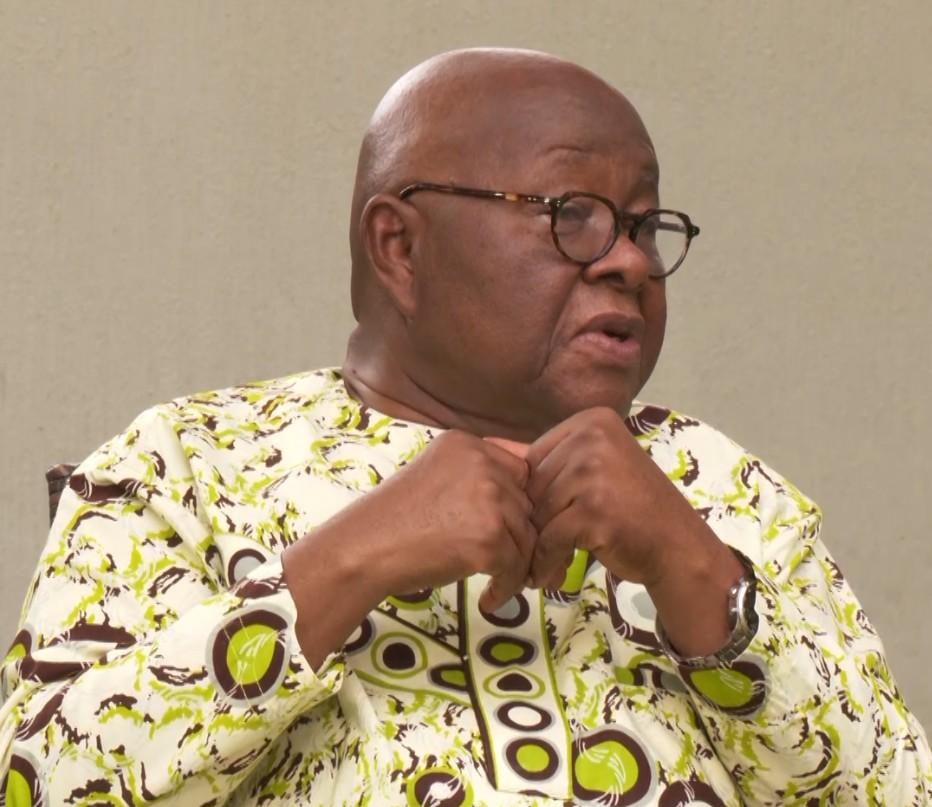

Former Speaker of Parliament, Professor Aaron Mike Oquaye, has thrown his support behind the call by newly elected New Patriotic Party First Vice Chairman, Kojo Fosu Boadu, popularly known as Kojo Bamba, for stronger measures to protect the party’s votes, while making it clear that he does not advocate the restoration of political vigilante groups.
Professor Oquaye’s comments have injected fresh intensity into an already sensitive debate within the NPP over electoral security, political intimidation and the responsibility of the state to safeguard political parties and their supporters during elections.

Speaking on Joy FM’s Super Morning Show on Monday, October 5, Professor Oquaye said Mr Bamba’s concerns about protecting the party were legitimate, particularly in view of incidents which he said had occurred during previous elections. He nevertheless maintained that the answer should not be the creation of a parallel security structure within the party.

Professor Oquaye was responding to questions about his support for Mr Boadu, whose election as First Vice Chairman has revived public discussion about his previous association with the Delta Force, a pro NPP vigilante organisation that attracted considerable controversy following the party’s return to power in 2017.

Mr Bamba secured 3,116 votes to emerge first among 13 contestants competing for the three vice chairmanship positions in the NPP’s national executive elections. His victory has subsequently brought renewed attention to his political history and, in particular, questions about how the party intends to protect its electoral interests ahead of future elections.
Professor Oquaye, however, insisted that his support for Mr Bamba’s position should not be interpreted as an endorsement of party vigilante groups.

Asked directly whether he supported the establishment of a parallel security arrangement within the NPP to protect ballot boxes instead of relying on the Ghana Police Service, the former Speaker responded firmly that he did not.
“I don’t support it at all,” he said.

He nevertheless argued that the concern surrounding electoral protection could not simply be dismissed, particularly if political parties and ordinary citizens developed the perception that state security institutions were failing to provide adequate protection.

Using a strongly worded analogy, Professor Oquaye suggested that people could resort to protecting themselves if they believed the state had failed in its responsibility to protect them.
His argument was subsequently linked to what he described as political intimidation, with the former Speaker calling on the NDC to desist from conduct that he believes could heighten political tensions.
“That is why the NDC must stop this intimidation,” he said.
Professor Oquaye also appealed to civil society organisations, religious leaders and other influential groups to speak out before the political atmosphere becomes more difficult to manage.
He cautioned that when citizens become convinced that the state cannot protect them, they may begin searching for alternative forms of protection, a development he suggested could have serious implications for Ghana’s democratic stability.
“Because if the state will not protect you, you will protect yourself,” he said.
Despite those remarks, Professor Oquaye stopped short of advocating the return of party based security groups. Instead, he maintained that the NPP’s concerns should be understood against the backdrop of incidents which he said had raised serious questions about the safety of political actors and electoral materials.
“Reality is honesty. Our people are seriously worried,” he said.
He also referred to comments he attributed to President John Dramani Mahama concerning the historical association between the NDC and political violence. Professor Oquaye said the comments were made in the context of a warning against violence and used them to illustrate what he described as the longstanding sensitivity surrounding political intimidation in Ghana.
The former Speaker further explained that his own approach to electoral security had historically been to place responsibility in the hands of the national security institutions rather than political party security groups.
He recalled that while he was leading an NPP internal electoral team during a presidential contest, he invited the Inspector General of Police to participate in the process and took the exercise to Police Headquarters.
According to Professor Oquaye, the arrangement enabled the police to assume responsibility for security and allowed the party’s internal election to proceed without the involvement of party security personnel.
He said the experience convinced him that political parties should rely on the police to maintain order and protect electoral processes rather than establish their own security structures.
Professor Oquaye further noted that the current Inspector General of Police had also engaged the NPP ahead of its recent internal elections and assured the party leadership that the police would take responsibility for security.
“In fact, in the last one, the present IGP did the party good service by even coming to chat with us and assure that police will be in charge,” he said.
He maintained that the NPP remained committed to peaceful elections but cautioned against a situation in which one political organisation or group was perceived to possess an exclusive capacity to deploy force or intimidation.
“You know, so we love the peace,” Professor Oquaye said, while stressing that no political organisation should assume it possesses a monopoly over the ability to resist intimidation.
He said the NPP had its own supporters and members who could respond if confronted with force, but immediately connected that position to a broader appeal for an end to what he described as political machismo.
“The NPP has men. Therefore, let us take machoism out of this politics,” he said.
The former Speaker’s comments come against the backdrop of renewed discussion over the role of party security groups following the election of Mr Bamba, who previously led the Delta Force.
The Delta Force became the subject of national controversy in March 2017 when members of the group forcibly entered the Ashanti Regional Coordinating Council and removed the then Regional Security Coordinator from his office. The incident generated widespread condemnation and intensified calls for political parties to dismantle vigilante structures.
Professor Oquaye recalled that the NPP itself had taken steps during the administration of former President John Agyekum Kufuor to dismantle party security structures.
He said the party, despite being in government at the time, dissolved its security groups and subsequently supported legislation designed to prohibit political vigilantism.
“During President Kufuor’s time, the NPP, though it was in power, banned its security people, party security. They dissolved; we dissolved them. And the vigilante law was brought to Parliament,” he said.
Professor Oquaye said the decision was subsequently followed by an agreement that national security institutions, particularly the Ghana Police Service, should assume responsibility for protecting elections.
“We said in future elections we must rely on the national police,” he said.
He explained that this principle also informed recommendations from a committee he chaired concerning security arrangements for the NPP’s internal elections.
However, Professor Oquaye said developments during the 2024 general election had generated fresh anxiety within the party.
He referred to allegations of ballot boxes being seized and destroyed, voting processes being disrupted and violence occurring at some electoral locations.
“Seizure of ballot boxes, burning of ballot boxes, and so on and so forth,” he said.
He also pointed to disturbances surrounding the Ablekuma Central electoral process and subsequent re voting in certain constituencies as developments that, in his view, should not be ignored when considering the future security of Ghanaian elections.
Professor Oquaye argued that the NPP could not simply assume that similar incidents would never occur again.
“They were able to take advantage of their own wrong. They think the world did not see. We think NPP did not see. So we will also protect ourselves,” he said.
When the discussion returned to the election of Mr Bamba and his previous association with the Delta Force, Professor Oquaye again avoided explicitly endorsing the restoration of party vigilante structures.
Instead, he urged the public and political parties to examine what occurred during the previous election and to address the underlying concerns through lawful and institutional means.
His intervention therefore places two positions side by side. On one hand, Professor Oquaye insists that the NPP must have confidence that its ballots, members and electoral interests will receive adequate protection. On the other hand, he expressly rejects the establishment of a parallel security system operated by the party.
The former Speaker’s comments have consequently added another dimension to the growing debate surrounding Mr Bamba’s emergence as First Vice Chairman and the implications of his previous association with the Delta Force.
The discussion is likely to remain significant as Ghana’s political parties prepare for future electoral contests, particularly with questions continuing to surround the ability of state security institutions to guarantee peaceful elections and protect electoral materials without creating conditions that encourage political groups to take security into their own hands.

