
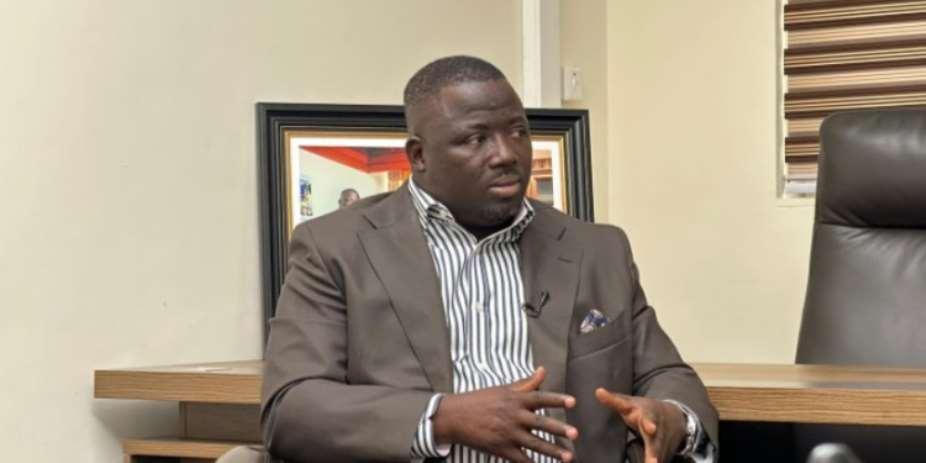

The Deputy General Secretary of the National Democratic Congress, Mustapha Foyo Gbande, has made a startling admission that he personally instructed the Economic and Organised Crime Office to arrest the Member of Parliament for Manhyia South, Nana Agyei Baffour Awuah, in a development that is likely to intensify the political controversy surrounding the legislator’s recent confrontation with the state’s investigative authorities.
In an unusually forthright disclosure, Mr Gbande acknowledged that he met the leadership of EOCO and explicitly told the agency’s boss to take the Manhyia South legislator into custody. His admission is particularly striking because it places a senior official of the governing NDC directly at the centre of a matter involving the arrest, detention and subsequent prosecution of an opposition Member of Parliament.

“I told him to arrest him. I wouldn’t lie about it,” Mr Gbande stated during an interview on JoyNews, leaving little ambiguity about his account of what transpired.

The NDC executive, however, rejected suggestions that his intervention was motivated by Mr Baffour Awuah’s position as counsel for senior nursing officer Salomey Awiti Baffoe, whose own legal circumstances have featured prominently in the wider dispute. Mr Gbande maintained that his position was instead informed by what he regarded as the conduct of the Manhyia South MP in relation to invitations from a state investigative institution.

He subsequently reinforced the admission during an appearance on JoyNews Pulse, where he argued that his intervention was made from what he described as a security perspective. According to him, permitting individuals to disregard invitations from law enforcement authorities and then publicly challenge those institutions to arrest them could gradually weaken the authority of the state.
“I met the EOCO boss; I told him to arrest the guy. Let the whole world come to an end. Arrest him,” he declared.

The extraordinary nature of the statement has immediately raised the political temperature surrounding the case because the admission came from a prominent official of the governing party while the person whose arrest he said he demanded is a sitting legislator belonging to the opposition New Patriotic Party. Mr Gbande nonetheless insisted that political affiliation should have no bearing on whether a person responds to a lawful investigative process.
He argued that anybody summoned by a law enforcement institution in connection with an alleged offence should cooperate with investigators irrespective of political status or public office. In his view, no elected representative or political operative should regard himself as being beyond the reach of Ghanaian law.

Mr Gbande also turned the argument towards his own position, stressing that his political office did not make him superior to the laws of the Republic.

“Never should I sit anywhere and say that because I am a deputy general secretary of a party, I am bigger than the laws of Ghana,” he said.
He maintained that Mr Baffour Awuah should simply have responded to EOCO’s invitation, provided whatever statement investigators required and departed, rather than convening a press conference to challenge the manner in which the agency was attempting to secure his attendance.
The NDC executive further rejected the suggestion that an investigative institution must first publicly advertise its intention before carrying out an arrest. He argued that there was no requirement for a law enforcement agency to approach media organisations and announce that it intended to arrest a particular individual.
“There’s no law that says that when a law enforcement agency is doing its work, it should come to media houses and tell them that I’m going to arrest somebody,” he said.
Mr Gbande consequently maintained that if investigators believed that Mr Baffour Awuah had committed an offence, EOCO was entitled to investigate the matter and take whatever lawful steps were necessary.
The controversy surrounding the Manhyia South MP dates back to September 23, 2026, when EOCO officers attempted to take him into custody at the Accra High Court. The agency subsequently explained that the operation formed part of an investigation and followed invitations issued to the legislator earlier in February. EOCO said it had made efforts to secure his attendance and eventually abandoned the attempted arrest after assessing that continuing the operation could create a threat to public safety.
Mr Baffour Awuah disputed EOCO’s account of the incident. He questioned the manner in which the officer approached him and said the officer initially failed to provide identification, documentary proof of authority or an arrest warrant. He also maintained that he was prepared to travel to EOCO himself but became suspicious when the officer insisted that he use the agency’s vehicle.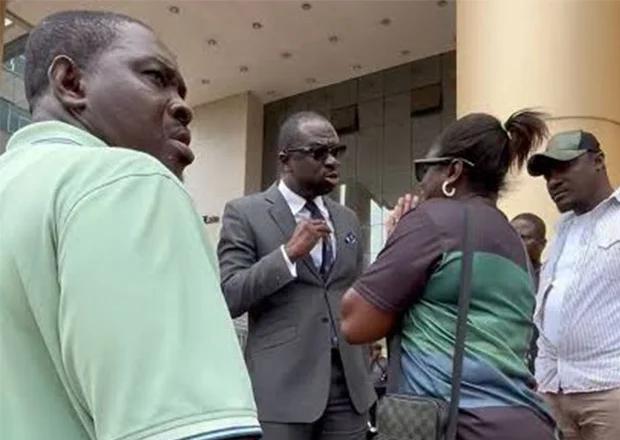
The dispute subsequently moved to the courts. On September 30, the High Court issued a warrant authorising EOCO to arrest Mr Baffour Awuah and also permitted investigators to search for and seize documents considered relevant to the investigation. The court directed that the warrant be executed through the Speaker of Parliament.
EOCO told the court that its investigation concerned alleged unauthorised financial transactions involving SIC Life Savings and Loans. The investigation includes allegations relating to criminal conspiracy, financial loss, money laundering, tax matters and other suspected offences. The allegations remain matters for investigation and judicial determination, and Mr Baffour Awuah has not been convicted of any offence.
The MP eventually reported himself to EOCO on October 1, accompanied by his lawyers. He was subsequently placed under arrest and questioned as investigators proceeded with the case and executed search warrants at his residence and office.
The proceedings subsequently culminated in the High Court granting Mr Baffour Awuah GH¢10 million bail with two sureties on October 3. The court determined that he was not a flight risk but directed him to remain available to investigators while the investigation continues. He is expected to return to court on October 26 and November 2, 2026.
His lawyers have strongly contested aspects of the allegations, particularly the prosecution’s characterisation of a GH¢9.85 million transaction as the dissipation of public funds. The defence has maintained that the transaction arose from legal work undertaken by the MP’s former law firm in connection with efforts to recover funds owed to SIC Life Savings and Loans, and that the eventual settlement followed prolonged litigation.
Mr Baffour Awuah has also publicly maintained his innocence. Following his release from EOCO custody after satisfying his bail conditions, he said he remained confident that the allegations against him would not withstand scrutiny in court and challenged the prosecution to prove its case through the proper judicial process.
Against this already charged background, Mr Gbande’s admission that he personally told the EOCO boss to arrest the opposition MP is likely to generate renewed questions about the relationship between political actors and independent state investigative institutions. His emphatic declaration that he told EOCO to “arrest him” has transformed what was already a contentious dispute over an attempted arrest into an even more politically sensitive national conversation about the limits of political influence, the independence of law enforcement bodies and the treatment of opposition lawmakers.

