
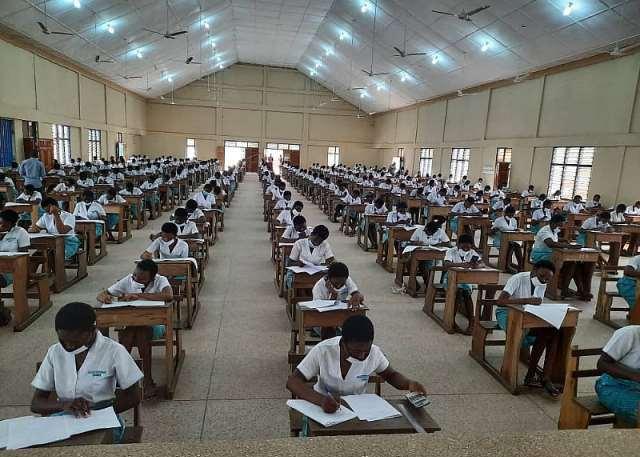

The West African Examinations Council has raised serious concerns over the declining performance of Ghanaian candidates in English Language, attributing the latest deterioration partly to weak reading habits, persistent grammatical deficiencies and the increasing influence of informal language commonly used on social media.
The warning follows the release of the provisional results of the 2026 West African Senior School Certificate Examination, which show that English Language has continued to experience a sustained decline in candidate performance over the past four years.

According to figures released by WAEC, the proportion of candidates who obtained grades A1 to C6 in English Language has fallen from 73.11 percent in 2023 to 69.42 percent in 2024, 69 percent in 2025 and 62.40 percent in 2026. The latest figure represents a significant decline of more than six percentage points within a single year.

John Kapi, Head of Public Affairs at the WAEC Ghana National Office, said the overall performance of candidates in the 2026 examination was better in several areas compared with the previous year, but English Language stood out as the major exception.

He explained that the Chief Examiner’s report had identified a number of recurring weaknesses in candidates’ written work, including poor grammatical control, weak expression, concord errors, spelling difficulties, inadequate comprehension and weaknesses in summary writing.
Mr Kapi said the problem extends beyond examination preparation and reflects a broader decline in students’ engagement with reading. According to him, regular reading plays an important role in developing vocabulary, strengthening sentence construction and improving the ability of students to understand and analyse written material.

The concern is particularly evident in candidates’ responses to questions based on prescribed literary works. WAEC says some students demonstrated inadequate familiarity with the texts they were expected to study, making it difficult for them to interpret passages and provide meaningful analysis.
The examination body has also expressed concern about the increasing appearance of informal expressions associated with social media and digital communication in examination scripts.

Mr Kapi explained that expressions commonly encountered on platforms such as WhatsApp and in text messaging are increasingly finding their way into formal examination writing. However, he stressed that WAEC had not conducted a study establishing a direct causal relationship between social media use and the decline in English performance.

The concern therefore centres on the transfer of informal writing habits into situations where candidates are expected to demonstrate proficiency in standard English. WAEC believes that students need to distinguish more clearly between the language appropriate for casual digital communication and the formal language required in academic and professional settings.
The latest figures have consequently renewed calls for schools, teachers and parents to strengthen efforts aimed at restoring a stronger reading culture among young people. WAEC has also called for improvements in teacher preparation as part of the broader response to the persistent weaknesses identified in English Language.
While English Language recorded a significant decline, the performance of candidates in Core Mathematics improved considerably compared with the previous year. WAEC reported that 60.75 percent of candidates obtained grades A1 to C6 in the subject in 2026, compared with 48.73 percent in 2025.
Mr Kapi said candidates demonstrated particular strengths in areas including arithmetic progression, coordinate geometry and business mathematics. Nevertheless, difficulties remained in translating word problems into appropriate mathematical statements and solving certain categories of problems.
The 2026 results show that 62.40 percent of candidates obtained A1 to C6 in English Language, compared with 60.75 percent in Core Mathematics. Integrated Science recorded 62.08 percent, while Social Studies emerged as the strongest performing core subject with 78.04 percent.
The contrast between English Language and the other core subjects has placed renewed attention on the quality of literacy development within Ghana’s education system. Although fluctuations in examination performance can occur from one year to another, the continuous decline recorded in English over four consecutive years presents a more persistent concern.
For an education system in which English serves as the principal language of instruction, examination and formal communication, weaknesses in reading, comprehension, grammar and written expression can extend beyond the WASSCE itself and affect students’ preparedness for tertiary education and the workplace.
The latest results therefore provide WAEC, education authorities, schools and families with a clear indication that improving English proficiency requires more than examination preparation. A sustained emphasis on reading, effective language instruction, familiarity with literary texts and disciplined use of formal English may be necessary to reverse the downward trend.

