
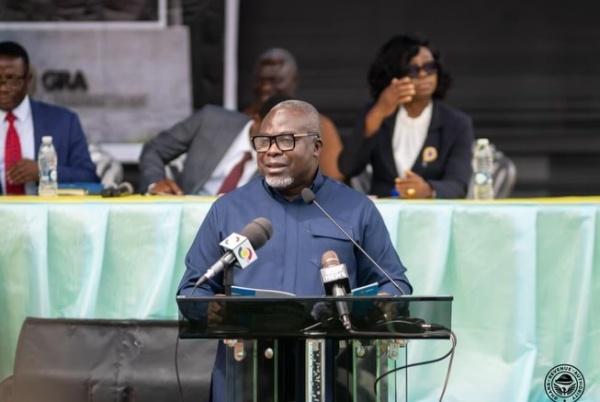

The Ghana Revenue Authority has unveiled an ambitious plan to raise GH¢310 billion in tax revenue by 2028, representing a doubling of the GH¢155 billion collected in 2024, as the government intensifies efforts to strengthen tax compliance and curb revenue losses without imposing additional tax rates.
The target was announced on Wednesday, August 19, 2026, during the Annual Tax Conference in Accra, where government officials, tax specialists, business representatives and other stakeholders examined measures aimed at improving domestic revenue mobilisation and strengthening Ghana’s tax administration system.

Speaking at the gathering, Commissioner General of the Ghana Revenue Authority, Anthony Kwasi Sarpong, said the authority had established a medium term revenue mobilisation strategy designed to expand the domestic tax base, improve compliance and generate sufficient resources to finance public expenditure while reducing the government’s reliance on borrowing.

He described the objective as ambitious but achievable, stressing that the authority had already established a structured pathway for increasing tax receipts over the coming years.

“We set ourselves an ambitious target to ensure that we can mobilise revenue for the state. So we are on a decisive trajectory to double the tax revenue we raised in 2024, which was GH¢155 billion, to GH¢310 billion by 2028,” Mr Sarpong said.
According to the GRA Commissioner General, the authority has mapped out annual revenue milestones that will progressively lead to the 2028 target.

He explained that tax collections increased to GH¢182 billion in 2025, while the authority is projecting GH¢225 billion in 2026 as part of the next stage of its revenue mobilisation programme.
The GRA expects collections to rise further to approximately GH¢260 billion in 2027 before reaching the ultimate target of GH¢310 billion in 2028.

“The pathway, Your Excellency, is clear, and we are on course. In 2025, Your Excellency, we achieved GH¢182 billion. In 2026, we are focusing strongly to move to GH¢225 billion. In 2027, we look to be in the region of GH¢260 billion, and ultimately in 2028, GH¢310 billion,” he added.

The proposed increase is expected to come primarily from improving the effectiveness of the existing tax system rather than introducing additional tax rates.
The authority intends to concentrate on bringing more economic activities and taxpayers into the formal tax system, while simultaneously ensuring that existing taxpayers meet their statutory obligations.
Broadening the tax base is therefore expected to remain a major component of the strategy, particularly as the government seeks to increase domestic revenue without placing additional pressure on compliant businesses and individuals through higher tax rates.
The GRA also plans to intensify efforts to identify tax leakages and strengthen mechanisms for detecting under declarations, non compliance and other practices that reduce the amount of revenue accruing to the state.
Technology is expected to play an increasingly important role in that process, with the authority seeking to expand the use of digital systems and data driven tools to improve taxpayer identification, monitoring, assessment and collection.
The strategy is also intended to improve the efficiency of interactions between the revenue authority and taxpayers while making it easier for individuals and businesses to fulfil their tax obligations.
The focus on domestic revenue mobilisation comes as Ghana continues to pursue measures aimed at strengthening its fiscal position and reducing dependence on borrowed resources to finance government programmes and public investment.
Higher internally generated revenue would provide the government with greater fiscal space to fund essential services and development initiatives while supporting efforts to maintain fiscal discipline.
The GRA’s projected increase from GH¢155 billion in 2024 to GH¢310 billion in 2028 would require sustained growth in collections over the period, making improved compliance, effective enforcement and the reduction of revenue leakages central to the success of the strategy.
Mr Sarpong’s announcement therefore signals a renewed emphasis on extracting greater value from Ghana’s existing tax system, with the authority seeking to ensure that increased revenue comes from a wider and more compliant taxpayer base rather than simply from raising tax rates.
The strategy places the GRA at the centre of government’s broader efforts to strengthen domestic resource mobilisation, improve fiscal sustainability and create a more reliable stream of revenue for financing national development.
If achieved, the GH¢310 billion target would represent a significant expansion in Ghana’s domestic tax collection capacity and mark a major shift towards generating more public resources internally while reducing the country’s dependence on borrowing.

