
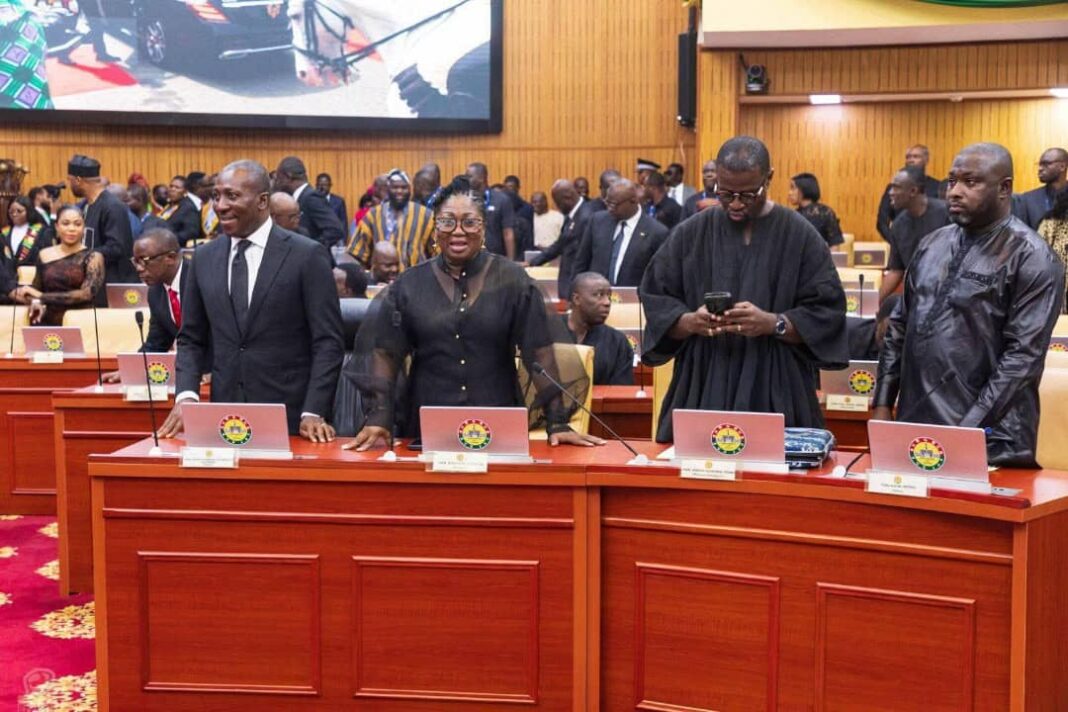

The Minority Caucus in Parliament has intensified its opposition to the conviction and 20 year prison sentence imposed on New Patriotic Party Ashanti Regional Chairman Bernard Antwi Boasiako, popularly known as Chairman Wontumi, demanding equal enforcement of Ghana’s anti illegal mining laws while urging the Court of Appeal to undertake a rigorous examination of the legal and constitutional issues arising from the trial.
The opposition lawmakers staged a symbolic protest at Parliament House by appearing in black attire, a move they described as an expression of solidarity with Chairman Wontumi and a demonstration of their deep concerns over what they believe are troubling aspects of the judgment delivered by the Accra High Court.

The coordinated action by the Minority came shortly after the court convicted Chairman Wontumi and Akonta Mining Company Limited in a case involving alleged breaches of the Minerals and Mining Act, 2006, Act 703. The court subsequently sentenced Mr Antwi Boasiako to 20 years imprisonment with hard labour and imposed a financial penalty after finding him guilty of offences connected to mining activities conducted without the required regulatory approval.

However, the Minority has rejected the verdict, insisting that while Ghana’s fight against illegal mining, popularly known as galamsey, must continue with determination, the enforcement of the law must be consistent, transparent and free from political influence.

Addressing journalists in Parliament, Deputy Minority Leader and Member of Parliament for Dormaa East, Patricia Appiagyei, argued that selective enforcement of anti illegal mining laws could undermine confidence in Ghana’s democratic institutions and create perceptions that the law is applied differently depending on political affiliation.
She called on the Attorney General’s Office to provide a comprehensive record of illegal mining prosecutions and enforcement actions undertaken by the state across the political divide, arguing that transparency would help strengthen public trust and demonstrate that the fight against environmental destruction is being pursued fairly.

“Public trust in institutions that must outlive any single administration is corroded. We therefore call on the Attorney General to publish the state’s enforcement record on illegal mining across the political spectrum,” Mrs Appiagyei stated.
The Minority’s concerns extend beyond allegations of selective prosecution and focus heavily on the legal reasoning applied during the trial. The caucus has called on the Court of Appeal to closely examine what it describes as critical procedural and constitutional questions, including the absence of Chairman Wontumi’s lead counsel during the delivery of judgment, the refusal of the trial court to refer constitutional questions to the Supreme Court and the decision to pierce the corporate veil of Akonta Mining Company Limited.

According to the Minority, the trial court acted improperly by treating Chairman Wontumi and Akonta Mining as one entity despite the separate legal personality recognised under company law. Mrs Appiagyei argued that a company incorporated under Ghanaian law possesses its own independent legal identity and that the distinction between a corporation and its directors or shareholders cannot be ignored without satisfying strict legal requirements.

“The judgment convicted Wontumi and the company separately on separate counts, using reasoning that treated them as one and the same. A court cannot dissolve a company to convict the man,” she stated.
The Minority has also challenged the trial court’s decision not to refer constitutional questions surrounding Section 99 subsection 2 paragraph b of the Minerals and Mining Act to the Supreme Court. The caucus maintains that the constitutional implications of the provision required interpretation by Ghana’s highest court rather than determination solely by the High Court.
Mrs Appiagyei further urged the judiciary to revisit the legal standard governing constitutional referrals, drawing attention to the Supreme Court’s decision in the case involving former North Tongu Member of Parliament Samuel Okudzeto Ablakwa and private legal practitioner Justice Srem Sai, commonly referred to as the Zanator case.
She argued that the appellate courts must reaffirm the proper threshold for constitutional referral and ensure that lower courts do not assume authority reserved for the Supreme Court when substantial constitutional questions arise.
“We call on the Court of Appeal to scrutinise the denial of counsel, the refusal to refer and the veil piercing with equal and unflinching rigor,” she stated.
The Minority’s position has been reinforced by the broader stance of the New Patriotic Party, which has described the conviction as a miscarriage of justice and announced plans to challenge the ruling through the appellate process. The party maintains that Chairman Wontumi lawfully acquired his mining concession and argues that the prosecution failed to prove beyond reasonable doubt that he unlawfully assigned, transferred or dealt with mineral rights contrary to the law.
The NPP has expressed confidence that the Court of Appeal will overturn the conviction after reviewing what it considers serious errors in the trial court’s interpretation of evidence and legal principles.
The controversy has generated intense national debate, attracting reactions from political parties, legal professionals, civil society organisations and environmental campaigners. Supporters of the judgment have welcomed the decision as evidence that Ghana’s anti galamsey campaign is capable of holding influential individuals accountable, regardless of political status.
They argue that illegal mining has caused severe environmental damage, polluted water bodies and threatened the country’s natural resources, making firm enforcement of mining regulations necessary for national survival.
However, the Minority insists that accountability must be achieved through equal application of the law and strict adherence to constitutional safeguards. The caucus maintains that the fight against illegal mining cannot succeed if citizens lose confidence in the fairness and neutrality of state institutions.
The Attorney General’s Office has previously maintained that mining related prosecutions are based on evidence available to the state and are not influenced by political considerations. Government prosecutors have insisted that individuals accused of violating mining regulations are treated according to the facts presented before the courts.
As the appeal process begins, the Chairman Wontumi case has moved beyond a single criminal conviction into a wider national debate about constitutional interpretation, judicial authority, corporate responsibility and the future direction of Ghana’s fight against illegal mining.
The eventual decision of the appellate courts could establish significant legal precedents on how constitutional questions are referred, when corporate identity may be disregarded and the extent to which individuals connected to mining companies can personally bear criminal responsibility. For that reason, the case is expected to remain one of the most closely watched legal and political matters in Ghana’s recent history.
SOURCE: Myjoyonline

