
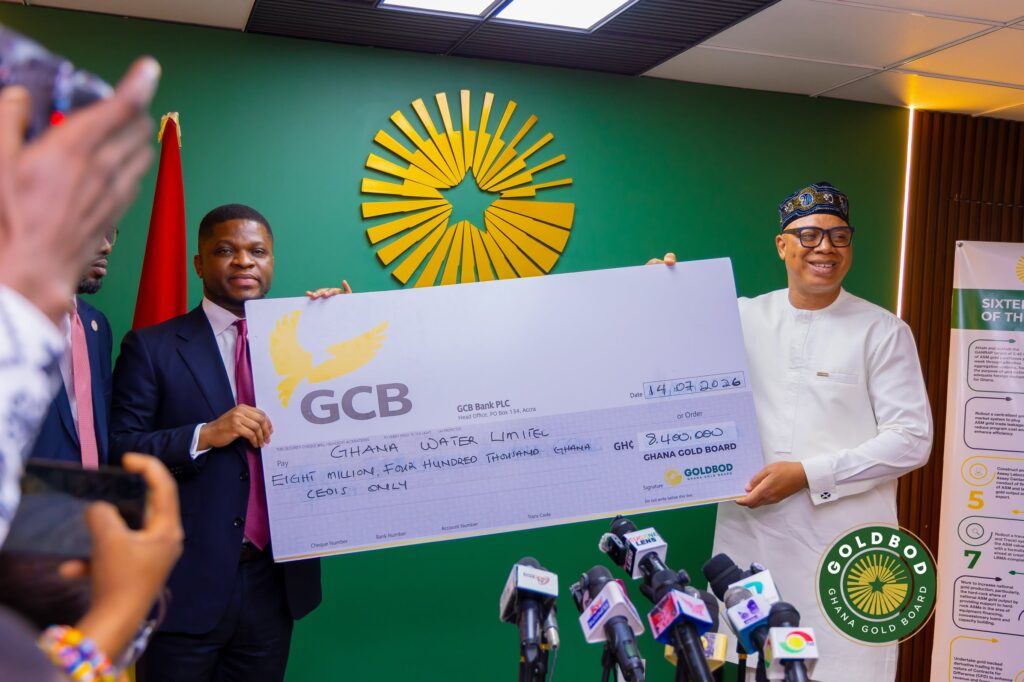

The Ghana Gold Board has committed GH¢8.4 million toward the rehabilitation of three strategically important water supply systems in the Western and Central Regions, marking a significant investment in public infrastructure, environmental restoration and access to safe drinking water for thousands of Ghanaians whose communities have endured years of declining water services.
The landmark agreement, signed between the Ghana Gold Board, widely known as GoldBod, and Ghana Water Limited, represents one of the most notable examples of collaboration between a state institution responsible for Ghana’s mineral resources and the country’s principal public water utility. The intervention is expected to restore the operational capacity of the Bonsa, Daboase and Sekyere Heman Water Supply Systems while strengthening the resilience of water infrastructure in regions where mining activities and ageing facilities have placed increasing pressure on the delivery of potable water.

The rehabilitation programme is expected to improve the reliability, quality and efficiency of water production across the three facilities, providing substantial relief to thousands of households, businesses, schools and healthcare institutions that have experienced recurring supply interruptions and operational difficulties over several years.

Addressing the signing ceremony, the Chief Executive Officer of the Ghana Gold Board, Sammy Gyamfi, explained that the decision to finance the rehabilitation project followed a comprehensive and independent technical assessment conducted to determine the condition of the affected water systems and identify the most urgent infrastructure requirements.

He indicated that the findings demonstrated the need for immediate intervention to restore the facilities and protect communities whose access to clean and safe water had become increasingly vulnerable because of deteriorating equipment and operational constraints.
According to Mr Gyamfi, the investment reflects GoldBod’s broader commitment to promoting responsible mineral resource governance while ensuring that the economic benefits derived from Ghana’s gold industry contribute directly to national development and the welfare of citizens. He emphasised that sustainable mining extends beyond mineral extraction and revenue generation, requiring meaningful investments in environmental protection, community development and the preservation of critical public infrastructure.

The initiative also underscores GoldBod’s growing emphasis on environmental sustainability, recognising that the long term success of Ghana’s mining sector depends upon balancing economic development with responsible stewardship of natural resources. By investing in the rehabilitation of essential water facilities, the institution aims to demonstrate that proceeds from the country’s mineral wealth can be channelled into projects that produce lasting social and environmental benefits for host communities.
Managing Director of Ghana Water Limited, Adam Mutawakilu, welcomed the partnership and described the financial support as both timely and transformative for the affected water systems. He explained that the rehabilitation works would restore water production capacity, improve operational efficiency and significantly strengthen the utility’s ability to deliver reliable services to communities that have faced persistent supply challenges.

He further observed that the collaboration highlights the importance of strategic partnerships between public institutions in addressing national development priorities. According to him, safeguarding water infrastructure requires collective responsibility, particularly in areas where environmental pressures, ageing facilities and increasing demand continue to strain existing systems.

The rehabilitation of the Bonsa, Daboase and Sekyere Heman Water Supply Systems carries significance that extends beyond the immediate improvement in water delivery. Access to clean drinking water remains one of the most important foundations for public health, economic productivity and sustainable development. Reliable water services reduce the incidence of waterborne diseases, improve sanitation, support agricultural production and enhance the quality of life for households while enabling businesses, educational institutions and healthcare facilities to operate more effectively.
The project is also expected to contribute to Ghana’s broader environmental objectives by strengthening infrastructure that supports responsible management of water resources in regions where mining activity has intensified concerns regarding water quality and ecosystem protection. Investment in modernised water systems can help improve treatment capacity, reduce operational losses and enhance the long term sustainability of water supply networks serving rapidly growing communities.
Development analysts have increasingly emphasised that investments of this nature illustrate the evolving role of state institutions in promoting inclusive national development. Rather than limiting their mandate to sector specific responsibilities, organisations such as GoldBod are beginning to integrate social investment, environmental stewardship and infrastructure development into their broader institutional strategies, thereby creating stronger links between natural resource management and community wellbeing.
The agreement therefore represents more than a financial commitment to repair ageing infrastructure. It signals a growing recognition that Ghana’s natural resource wealth must generate tangible improvements in the daily lives of citizens through investments that strengthen essential public services, protect the environment and promote sustainable economic development.
As rehabilitation work begins on the three water supply systems, thousands of residents in the Western and Central Regions are expected to benefit from improved access to safe and dependable drinking water. The initiative stands as an important example of how strategic collaboration between public institutions can transform critical infrastructure while reinforcing Ghana’s commitment to environmental sustainability, responsible resource management and inclusive national progress.

