
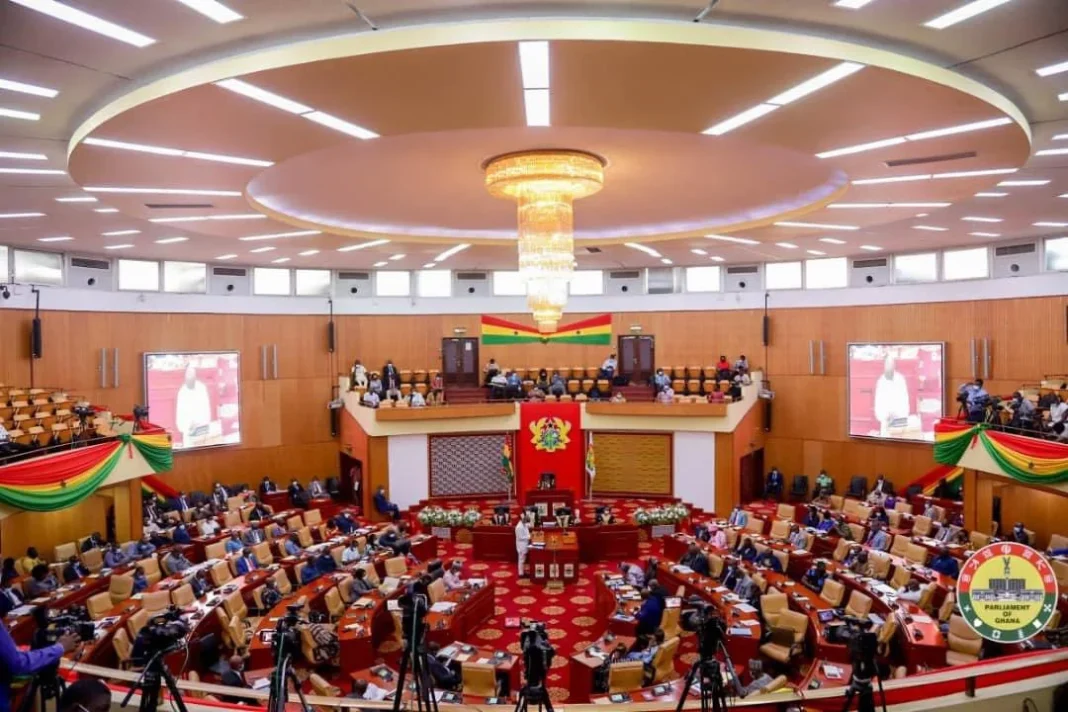

Parliament has passed the Community Service Bill, 2026, introducing a major reform to Ghana’s criminal justice system through the establishment of a National Community Service Secretariat and the creation of community service as an alternative punishment for persons convicted of selected offences.
The passage of the legislation marks a significant shift in Ghana’s approach to sentencing by expanding the options available to judges beyond traditional imprisonment and creating a structured framework that allows certain offenders to serve their sentences through supervised work that benefits communities.

The new law is expected to reduce pressure on Ghana’s overcrowded correctional facilities, lower the financial burden associated with maintaining inmates, and promote rehabilitation by allowing eligible offenders to remain connected to society while fulfilling court imposed obligations.

The Community Service Bill was introduced in Parliament by the Minister for the Interior, Mohammed Mubarak Muntaka, on March 4, 2026, in accordance with Article 106(1) of the 1992 Constitution. Following its presentation, the Bill was referred to the Parliamentary Committee on Defence and Interior for detailed consideration and subsequent recommendations to the House.

In its report to Parliament, the committee highlighted the challenges created by Ghana’s longstanding dependence on custodial sentences as the main form of punishment for convicted persons.
According to the committee, the heavy reliance on imprisonment has contributed significantly to congestion within Ghana’s prisons, placing enormous pressure on the Ghana Prisons Service and increasing government expenditure on inmate welfare, including feeding, healthcare, security, and infrastructure development.

The committee noted that the introduction of community service forms part of wider criminal justice reforms being pursued by the Ministry of the Interior to promote non custodial sentencing and create a more balanced approach to punishment.
Under the new framework, courts will have the authority to impose community service sentences for persons convicted of minor and specified offences where imprisonment may not be the most appropriate form of punishment.

The reform is designed to ensure that offenders are held accountable while also creating opportunities for rehabilitation, skills development, and eventual reintegration into society.

The Parliamentary Committee explained that the objective of the legislation is to provide courts with suitable alternatives to imprisonment, reduce repeat offending, and improve the management of correctional facilities across the country.
The committee further revealed that Ghana’s move towards a structured non custodial sentencing system has been under development for more than a decade.
According to the report, the process began in 2014 when the Ministry of the Interior, with support from the United Nations Children’s Fund, UNICEF, started developing a policy framework aimed at introducing alternatives to custodial punishment.
The committee stated that the new legislation gives practical effect to existing non custodial sentencing provisions contained in the Criminal and Other Offences Procedure Act, 1960, Act 30, as well as the Interpretation Act, 2009, Act 792.
The passage of the Bill represents an important development in Ghana’s justice administration system because it formally creates the institutional structures required to supervise and implement community service programmes nationwide.
The establishment of the National Community Service Secretariat is expected to provide coordination, monitoring, and oversight of community service activities, ensuring that sentences imposed by courts are properly administered and that offenders comply with established conditions.
Legal experts have long argued that imprisonment should not always be the default response to every criminal conviction, particularly in cases involving minor offences where rehabilitation and social reintegration may provide better outcomes.
The reform also reflects international trends in criminal justice systems where community based sentences are increasingly used to address prison overcrowding while maintaining accountability for unlawful conduct.
By introducing community service as a recognised sentencing option, Ghana joins a growing number of jurisdictions seeking to balance punishment with rehabilitation and public benefit.
The implementation of the new law will now become critical, as its success will depend on effective supervision mechanisms, adequate funding, cooperation among justice sector institutions, and public confidence in the alternative sentencing system.
The passage of the Community Service Bill, 2026, therefore represents more than a change in sentencing policy. It signals a broader transformation in Ghana’s criminal justice philosophy, moving from a system centred primarily on confinement towards one that also emphasises correction, rehabilitation, and responsible reintegration into society.

