
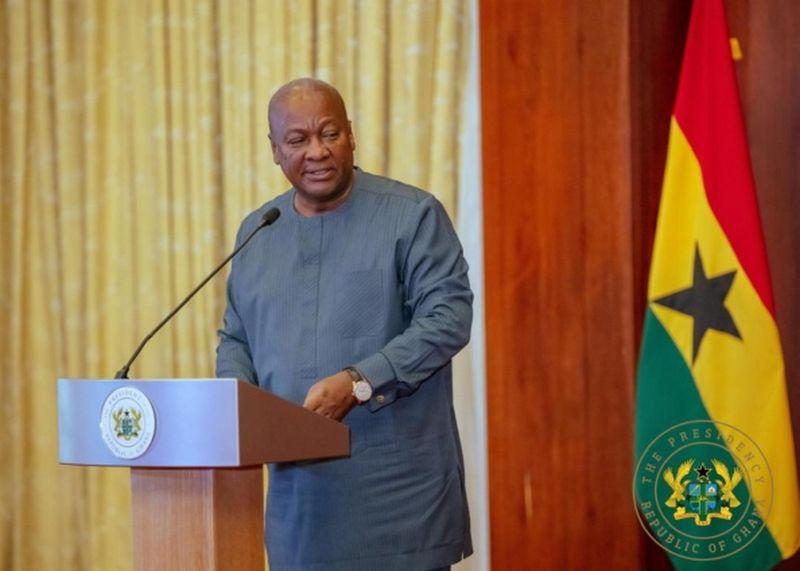

President John Dramani Mahama has announced plans by his administration to formally document and regulate chieftaincy succession arrangements in the Upper West Region in a major move aimed at reducing traditional conflicts, strengthening customary governance, and preserving peace within Ghana’s traditional areas.
The President said the government intends to support the codification of succession systems by clearly identifying legitimate royal families, recognised succession gates, and established rotational arrangements to eliminate uncertainty and prevent disputes over the rightful occupants of traditional stools and skins.

President Mahama disclosed the initiative on Wednesday, July 8, when members of the Upper West Regional House of Chiefs paid a courtesy visit to him at the Jubilee House.

The announcement comes amid long standing concerns over chieftaincy disputes across parts of Ghana, where disagreements over succession, competing claims to traditional authority, and allegations of manipulation during selection processes have sometimes resulted in prolonged conflicts affecting development and social stability.

The President praised traditional leaders in the Upper West Region for their commitment to maintaining peace and stability, particularly at a time when neighbouring countries within the Sahel region continue to experience insecurity, political instability, and violent conflicts.
He described peace as the foundation upon which economic progress and social development are built, commending the Regional House of Chiefs for helping to maintain the Upper West Region’s reputation as one of Ghana’s most peaceful areas.

“Peace remains the foundation of prosperity, and I commend the Regional House of Chiefs for its role in keeping the Upper West as one of Ghana’s most peaceful regions amid the instability in the wider Sahel area,” President Mahama stated.
However, the President warned that traditional governance systems must evolve to address emerging challenges, particularly disputes surrounding the nomination and installation of chiefs.

He argued that the absence of clearly documented succession arrangements has created opportunities for manipulation, disagreements, and conflicts among competing groups seeking traditional leadership positions.

President Mahama raised concerns about the growing influence of financial incentives in some traditional selection processes, suggesting that monetary inducements have, in certain instances, affected the decisions of kingmakers responsible for selecting chiefs.
“But like the President of the House of Chiefs said, we should continue and go ahead to codify the succession. Nowadays, the kingmakers have become corrupt. And so, even though they know who is the rightful person, a big envelope can change their minds,” he said.
The President expressed concern that financial influence could result in individuals without legitimate ancestral connections being selected to occupy traditional positions, creating disputes that could persist for generations.
“They go and bring somebody who has absolutely nothing to do with the royal family and want to install the person as the leader of the traditional area. And that is what creates the conflicts,” he added.
According to President Mahama, a formalised succession framework would establish greater transparency by documenting the recognised royal families entitled to provide chiefs, the various succession gates within traditional areas, and the accepted order of rotation where such arrangements exist.
He believes that removing ambiguity from traditional succession systems would reduce disagreements, prevent unnecessary litigation, and promote stronger cooperation between traditional authorities and local communities.
“If we codify the families and the various gates and the rotational succession, we should have more peace in this country than we have seen lately,” the President said.
The proposed initiative highlights the continuing importance of chieftaincy institutions within Ghana’s governance structure. Although traditional authorities do not exercise direct political power under Ghana’s constitutional democracy, chiefs remain influential custodians of culture, land, community identity, and local dispute resolution.
Chieftaincy disputes have historically affected several parts of Ghana, with conflicts sometimes delaying development projects, creating divisions among communities, and placing pressure on state security institutions.
By seeking to establish clearer succession guidelines, the government hopes to strengthen the credibility of traditional leadership selection processes while reducing opportunities for interference and manipulation.
The move also reflects broader national efforts to preserve Ghana’s traditional institutions while adapting them to modern governance demands. Experts have long argued that transparent customary procedures are essential for maintaining public confidence in traditional authorities.
The Upper West Region, which has largely maintained relative peace compared with some neighbouring areas, is expected to serve as a key testing ground for efforts to document and strengthen succession systems.
The proposed codification process will require collaboration between government institutions, traditional councils, customary authorities, and communities to ensure that existing traditions are accurately captured and respected.
President Mahama’s announcement therefore marks a significant policy direction in Ghana’s traditional governance landscape, with the potential to reshape how chieftaincy succession disputes are managed and resolved across the country.

