
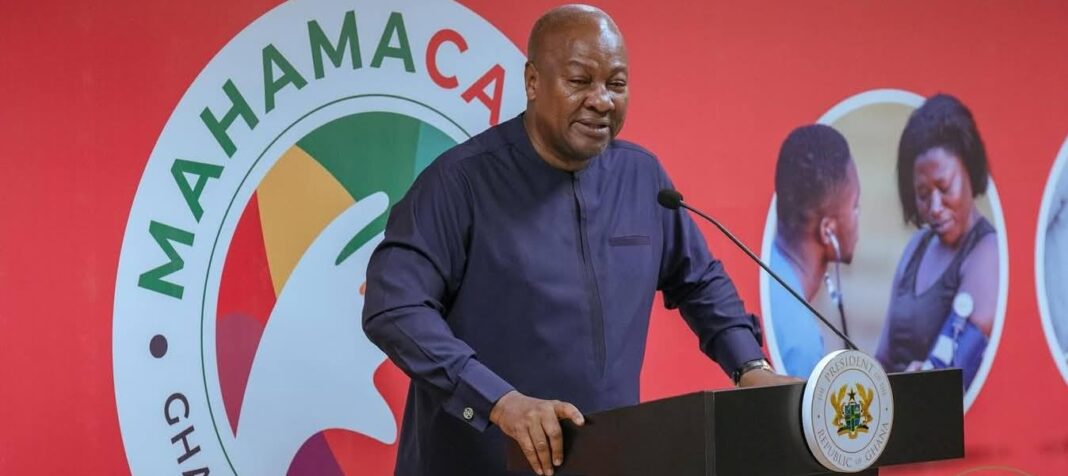

President John Dramani Mahama has announced that government will no longer approve blanket tax exemptions for imported medical equipment, declaring that all future requests for tax relief will undergo individual assessment under a stricter approval framework.
The President explained that institutions seeking concessions for specialised medical equipment imports would still have the opportunity to apply, but approvals would now be determined on a case by case basis depending on the merits of each application.

John Dramani Mahama made the announcement on Wednesday, May 13, 2026, during the commissioning of a positron emission tomography computed tomography facility at the Sweden-Ghana Medical Centre in Accra.

Responding to appeals from operators of the newly commissioned facility for tax concessions, the President indicated that the period of automatic exemptions had come to an end.

“In Twi, we say when someone climbs a good tree, you push them. Regarding tax exemptions, blanket exemptions are no longer granted. It is on a case by case basis,” he stated.
He nevertheless assured stakeholders within the healthcare sector that government remained prepared to favourably consider applications involving critical medical equipment imports where genuine need could be established.

“If you order any medical equipment, you can apply for exemption on that equipment, and I can assure you that we will look at it very favourably,” he added.
Ghana’s Exemptions Act, 2022 requires prior written authorisation from the Finance Minister before any tax exemption can be approved.

According to the Ministry of Finance, Ghana forfeited approximately GH¢4.6 billion through tax expenditures in 2023, while the World Bank estimated that the overall cost of tax exemptions amounted to nearly 3.9 percent of the country’s Gross Domestic Product.

Speaking further during the commissioning ceremony, John Dramani Mahama described the newly inaugurated PET CT facility as a transformative addition to Ghana’s healthcare infrastructure, particularly in the area of cancer diagnosis and treatment.
He explained that the advanced imaging technology would significantly improve early disease detection and enhance the ability of medical professionals to accurately monitor treatment progress and patient outcomes.
“Today’s event is not merely the unveiling of a machine. It marks the beginning of a new chapter in Ghana’s healthcare journey anchored in innovation, accessibility and renewed hope for our people,” he said.
The President observed that many Ghanaians had historically been compelled to travel abroad for specialised diagnostic services because of inadequate local facilities, often at enormous financial and emotional cost to families.
According to him, the introduction of the PET CT facility would substantially reduce dependence on overseas referrals while strengthening confidence in the country’s healthcare delivery system.
John Dramani Mahama further expressed optimism about positioning Ghana as a regional hub for specialised medical diagnostics within the West African subregion.
“I envision people coming from Côte d’Ivoire, Nigeria, Togo, Burkina Faso and other ECOWAS states to seek specialist medical diagnosis here in Ghana,” he stated.
The President subsequently appealed to private sector investors together with professional medical bodies to deepen investments in advanced healthcare infrastructure in support of government’s broader healthcare agenda.
He additionally announced that the PET CT facility would operate under the Ghana Medical Trust Fund, popularly known as MahamaCares, to provide financial support for eligible cancer patients requiring diagnostic and treatment services.
“The treatment and diagnosis of cancer can be very expensive. Many families are impoverished when a member of the family is afflicted by cancer,” he noted.
John Dramani Mahama also disclosed that government was accelerating the expansion of specialised healthcare infrastructure nationwide, including the procurement of catheterisation laboratories for the Korle Bu Teaching Hospital, the Komfo Anokye Teaching Hospital, and the Tamale Teaching Hospital.
He further revealed that plans were advancing for the construction of regional hospitals within Ghana’s newly created regions, alongside the establishment of cardiology centres aimed at reducing pressure on the country’s major referral hospitals.

