
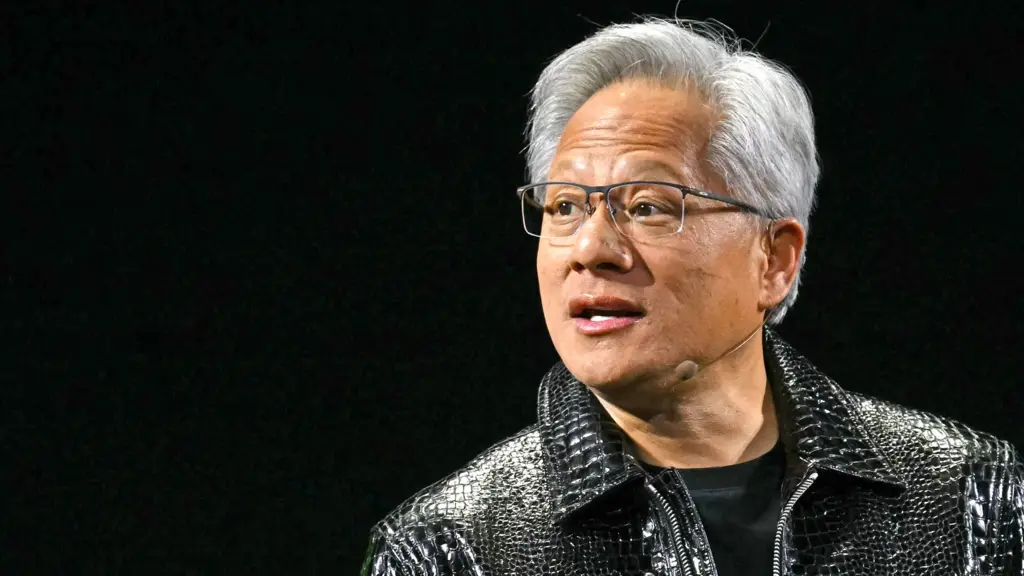

SOURCE: BBC
Trading on Wall Street has opened, with all eyes on US tech giant Nvidia after claims its CEO Jensen Huang had an affair with a Chinese spy

Pre-market trading suggests the firm – one of the most valuable firms in the world – will suffer a sharp fall in its share price

On Sunday, Nvidia opened an independent investigation into claims Huang “had been the target of a foreign intelligence effort”

Nvidia says it has no reason to believe its secrets or national security were compromised, but will “examine all available information”. Huang has admitted to being unfaithful to his wife and apologised
Donald Trump says Huang is “a fine person, but you never know what’s going on”, while the Chinese government says the claims are nothing more than a “smear intended to malign China”

The New York Times first reported last month that Huang had a close relationship with Alice Huang, a boss at a Singapore-based data centre company – and that she was suspected of giving information to China
Nvidia designs some of the most sophisticated AI chips on the planet – and since 2022 the US has used various export controls to keep its top tech out of China

Nvidia shares have fallen by 8% after it launched an investigation into chief executive Jensen Huang’s affair.

The company has announced it is bringing in outside counsel to oversee an independent probe into claims he had an affair with an alleged Chinese spy.
The comany’s shares had fallen sharply in pre-market trading, and at market open they were down by 8% to $171.80. The revelation has raised questions about Huang’s future in charge of the company he co-founded three decades ago, though some in the tech sector have rushed to his defence.
US markets have opened and all eyes are on Nvidia’s share price as investors weigh up the impact of its investigation into chief executive Jensen Huang.
The company suffered a sharp drop in pre-market trading, but the full extent of how damaging the revelations about Huang’s affair looks will become clear now regular trading has begun.
The company has already lost around a fifth of its value over the past month, with fears growing about a slowdown in the hitherto rapid growth of the AI sector.
Investors will also be watching for the impact on other tech companies, many of which had been recovering lost value towards the end of trading last week.
US tech giant Nvidia has announced it is launching an independent investigation into its CEO, Jensen Huang, over reports he had an affair with Alice Huang – who is suspected of being a Chinese spy.
If you are just catching up this lunchtime, here is what you need to know:
Nvidia has said it is opening an independent investigation into claims its CEO Jensen Huang had an affair with Alice Huang, an alleged Chinese spy
Jensen Huang has admitted to being unfaithful to his wife, adding he backs the investigation and is committed to “supporting America’s national security”
US stock markets are due to open at 14:30 GMT, with indicators predicting a sharp fall in Nvidia’s share price
Nvidia says it has no reason to believe its secrets or national security were compromised, but it will “examine all available information”
Alice Huang – also known as Huang Le – was previously managing director of Singaporean company Megaspeed, which has had dealings with Nvidia
The Chinese government says the claims of espionage are nothing more than a “smear intended to malign China”
It comes amid wider concerns about the AI industry, with tech firms seeing a slump in their share price following the US mid-term elections last week.
Ranked by market capitalisation, Nvidia comes in second behind Apple, and ahead of Microsoft, Alphabet – the parent company of Google – and Amazon.
There have been multiple links built recently between Nvidia boss Jensen Huang and the UK Royal Family.
The Nvidia boss was a prominent guest at the King’s artificial intelligence summit at Dumfries House in Scotland in September.
Huang was sitting in meetings with King Charles, along with other tech bosses, the UK’s AI minister Kanishka Narayan and Blaise Metreweli the head of MI6.
Afterwards, Jensen Huang said the King had personally given him a letter – which was the King’s speech with warnings about the dangers of AI – and it was Huang who was standing next to the King in the group photo.
Earlier in the year, Jensen Huang had been at Windsor Castle for US President Donald Trump’s state visit, with Huang’s wife Lori attending the state banquet with him.
In October, Nvidia was announced as a partner of Prince William’s Earthshot environmental prize, with the tech firm to provide training, engineering support and AI computing resources to the finalists.
The Court Circular, which records royal engagements, shows a meeting between Prince William and Jensen Huang on 14 October.
Nvidia has said it has no reason to believe there have been any security breaches – and China has dismissed the claims as unfounded smears, intended to malign China.
US stock markets do not open until 14:30 GMT, so the full impact of the investigation into Jensen Huang’s affair with an alleged Chinese spy will not become clear until later.
But pre-market trading, which allows investors to buy and sell shares before the regular session begins, suggests Nvidia will suffer a sharp fall in its share price.
Its shares have already fallen by around 6% as traders react to the news, wiping around $250bn (£190bn) from the value of the company.
It follows a wider fall in the company’s value sparked by fears the rapid growth of the AI sector could slow. Shares have fallen by around a fifth in the past month alone.
Huang owns around 3.5% of the company’s shares, meaning his own stake has fallen by billions in response to the investigation.
Even those who do not directly own shares in Nvidia can be affected by rises and falls in its value, for example through having pensions or savings invested in pots which have stakes in the company through index tracking funds.
It’s fair to say Jensen Huang has, in recent years, become a bit of a rock star in Big Tech.
His early bet on keeping Nvidia’s focus on producing and expanding its graphics processing units (GPUs) for gaming console and PC displays paid off. When the generative AI boom took hold in late 2023, demand for its hardware to train and develop large language models soared – and so did the company’s share price.
In the summer of 2024, Nvidia leapfrogged Microsoft and Apple to become the world’s most valuable company.
Huang himself is a popular figure, championed by many in tech for his work ethic, dedication to Nvidia (he has the company’s logo tattooed on his arm) and even for his style.
It became not uncommon to see images of Huang – in his signature black leather jacket and black t-shirt – being swarmed by fans seeking selfies and autographs.
But that celebrity, now mired in scandal, potentially risks hurting Nvidia’s image, the confidence investors have in the firm and its very position at the heart of the AI sector.
Nvidia has come to the fore in recent years, but it was established well before the generative AI trend, and its early business had little to do with it.
Established in 1993, Nvidia’s early business was mainly in computer graphics cards – hardware responsible for processing graphics. As graphics are especially important for gaming, the company became well known in the gaming community for producing high-quality cards.
One big difference between a computer’s graphics processing unit (GPU) and central processing unit (CPU) is that the GPU has more cores, as parallel processing is more important in graphics computing.
That is precisely why GPUs are widely used in AI computing, which also requires the ability to perform calculations simultaneously.
As a result, Nvidia has soared in the recent AI boom and become one of the most valuable companies in the world.
As the tech world gets to grips with the news that Nvidia’s CEO could have had an affair with an alleged Chinese spy, let’s see who’s saying what.
The man in question, Jensen Huang, says he has “fallen short” of his responsibility to serve his colleagues, in a statement shared with Nvidia staff.
After admitting he was “unfaithful” to his wife Lori Mills, Huang writes: “There is no excuse for what I did. I am deeply sorry.”
“I am committed to protecting Nvidia and supporting America’s national security. I am proud and grateful to be an American,” the Nvidia chief adds.
Nvidia itself said it has no reason to believe either national security or Nvidia secrets were compromised, which it says will be examined in the inquiry.
President Trump says he knows Juang is a “fine person” but “you never know what’s going on”.
Secretary of State Marco Rubio says he “just can’t comment”.
China’s Foreign Ministry calls allegations of a Chinese espionage operation targeting Jensen Huang “groundless speculation” and “nothing more than an attempt to smear China”.
Many US tech firms’ share prices sank across the board last week following fears that US Democrats elected in the mid-terms might pop the artificial intelligence (AI) bubble with tighter regulation.Now market traders face the unenviable task of trying to figure out what this latest news could mean.
The early signs are bad. Nvidia’s value has sunk in pre-market trading, which is hardly a surprise. Huang is the face of Nvidia, a popular chief executive, and the company’s success over the last three decades has run directly through him and his brand.
And while Nvidia insists it has no reason to believe company or national security secrets have been compromised, the very fact it is investigating the affair is worrying. Can it really stand by Huang after this? If it cannot, who on earth replaces him?
Then there is the question of contagion. On the one hand, this is an isolated story and there is no suggestion or evidence that it affects any other tech companies. Asian and European markets appear to have largely shrugged off the news for now.
On the other hand, bad news for Nvidia is potentially bad news for many other tech firms purely because of how many deals it has with them. And, simply by being the second most valuable US public company, any slump in Nvidia’s share price will drag down the whole US index and the value of any funds that track that index.
It could be a family affair. His daughter and son, Madison and Spencer Huang, and son-in-law Nico Caprez, all work at the company.
When asked about speculation his daughter could be the next boss, he told Bloomberg “I don’t hope the job on her” and that his children “would have to go earn it”.
Some Nvidia-watchers have speculated Ian Buck could be a contender. He invented Cuda, the software platform which helped cement Nvidia’s dominance in AI, and is Nvidia’s VP of Hyperscale and High-Performance Computing.
Others have pointed to fellow VP Bryan Catanzaro, who leads much of Nvidia’s generative AI work, as a potential future leader.
CFO Colette Kress could also be in the running – after all, she has helped oversee Nvidia’s rapid growth – and long-time Jensen Huang ally Jay Puri, who runs global sales and partnerships, could also be an option.
It’s truly astonishing to see Nvidia’s rock star CEO Jensen Huang, the absolute epicentre of the AI stock market boom, admitting an affair, and board initiating an independent investigation into “national security concerns”.
This comes at the precise moment of wider market jitters about the sustainability of the AI boom.
I actually interviewed Huang in September last year when he was visiting London for President Trump’s State Visit.
I asked him specifically as someone who could walk into the White House to see Trump one day, and speak to Xi in Beijing days later, whether the UK should take the US’ side in this AI battle.
His lengthy answer was really very interesting.
“President Trump wants America to win and President Xi wants China to win, and it’s possible for both of them to do so,” he told me.
More than that, he said that it’s important “that all AI companies, that all AI research is built on the American tech stack… if you would like America to be the global standard of technology, just as we are the global standard of the of currency, the US dollar, then you’re going to need to make sure that that people can access this technology from all over the world, including China”.
He told me President Trump “sees this clearly”.
The context here was that there was a vigorous debate ongoing about whether Nvidia’s most advanced AI chips should be banned from export to China.
What has happened in the past few days is also astonishing timing, at the exact moment that stock markets are wondering if a change in the US political climate will fundamentally restrain the build out of AI infrastructure, which means data centres, more often than not full of these same Nvidia chips.09:37
US tech giant Nvidia is investigating claims that its CEO Jensen Huang had an affair with a suspected Chinese spy.
If you’re just joining us, here’s what you need to know:
On Sunday, Nvidia opened an investigation into Huang following reports of the relationship, but said it had no reason to believe the company’s secrets or national security were compromised
Separately, Huang shared a statement with Nvidia staff, in which he admitted to having been “unfaithful” to his wife, who he met at university, and apologised for hurting her and their children
As our technology and AI editor writes, the news has stunned the tech world and is a big blow for a man who is renowned for being a workaholic, a perfectionist and someone who expects incredibly high standards from his staff
US President Donald Trump responded to the investigation last night, saying of Huang: “I just know he’s a fine person, but you never know what’s going on”
The allegations also come at a sensitive moment for the US and China, with Trump expected to travel to China next week for a high-stakes summit with President Xi Jinping over a crucial trade deal between the two global superpowers
China has previously rejected allegations of a Chinese espionage operation, with Chinese foreign ministry spokesman Guo Jiakun saying reports are “based on groundless speculation and is nothing more than an attempt to smear China”
Shadow foreign secretary Tom Tugendhat says “it wouldn’t at all surprise” him if the Chinese state had recruited Alice Huang after her alleged affair with Jensen Huang had begun.
He tells Radio 4’s Today programme that it “would not be beyond the Chinese state” to threaten sending Huang’s family to prison were she not to co-operate, now she was in a position to do so.
China has denied allegations of Huang being a Chinese spy, calling the allegations “entirely groundless, speculative and intended to smear and malign China.”
Nvidia’s share price has slumped in pre-market trading, after the news broke that the artificial intelligence (AI) chip maker is investigating its boss and founder Jensen Huang’s affair with an alleged Chinese spy.
There has been little to the news so far in Asian and European markets, but the effect on US markets when they open later today (14:30 GMT/ 09:30 ET) could be big.
Nvidia is vital to the US AI boom — and Huang is vital to Nvidia. As such, it’s hard to imagine this not causing at least some ripples.
Consider as well that Nvidia’s sheer size means many pension funds, including ones in the UK, will own some of the stock passively though their ownership of index trackers funds, which automatically buy up shares of the biggest companies listed on a given stock market.
Global Times, a Chinese state-run newspaper, has published a commentary on its website referring to what it calls a “speculative” New York Times report about Jensen Huang’s extramarital affair.
The Global Times acknowledges the reports that Huang’s affair was with a “Chinese spy”, and adds “the combustible mix of a tycoon, an extramarital affair and an alleged Chinese female spy has sent the US media into a frenzy”.
The piece questions why the story has emerged “at a time when hard-won momentum toward detente is emerging between China and the US” and asks whether “someone behind the scenes” is “pushing an agenda and stoking confrontation”.
The commentary says that if “the logic of ‘presumption of guilt’ is allowed to spread unchecked”, it will drag down both China and the US as well as the global supply chain.
“We urge some US media outlets to uphold basic journalistic standards. By promoting unfounded narratives about ‘Chinese espionage’, they are only further eroding their own credibility,” it adds.
I’ve just tried to visit the office of Megaspeed, the Singaporean company that employed Nvidia CEO Jensen Huang’s alleged lover and suspected Chinese spy Alice Huang.
The office is located at a skyscraper in the heart of Singapore’s central business district – but I was told by the building’s security that I couldn’t go up.
As I’ve reported earlier, Alice Huang – also known as Huang Le – was previously Megaspeed’s managing director. But in 2023 she handed the reins to a Singaporean man named Tan Yong Pong.
I managed to track down Tan’s registered address, which was a public housing flat in the east of Singapore.
A woman answered the door and identified herself as his relative. She said that Tan did not live at the flat and in fact has not lived in Singapore for many years.
She declined to say where Tan is currently. But according to local media reports, he is thought to have been living in.08:05
US tech giant Nvidia is one of the world’s most valuable companies.
As CEO Jensen Huang is now facing an investigation amid claims he had an affair with a suspected Chinese spy, here are some key things to know about the firm:
Founded: 1993.
Value: $4.5tn (£3.4tn)
What does Nvidia do? It’s a leading provider of advanced computer chips and provides this technology to major firms such as OpenAI, the company behind ChatGPT, and Meta.
Why is it so important? Essentially every notable tech company building AI tools and infrastructure, including Amazon, Meta, Google, Microsoft, use Nvidia chips.
Its chips have been a major focus of the rivalry between the US and China, who are locked in an AI race – with America having long been concerned about Beijing’s access to advanced computing technology.
CEO of technology manufacturer Logitech has reacted to claims that Nvidia boss Jensen Huang had an affair with a suspected Chinese spy.
Asked how big a concern allegations of spying by China are within the tech industry, Hanneke Faber tells the BBC World Service’s Newsday programme: “I think every country, every company is always trying to gain an edge.”
She adds Logitech is “super focused” on privacy, security and making sure data in its products and development plans “are safe from the world”.
She says that “in the world of AI – privacy security, cyber security are definitely more important than ever. And we are dedicating mores resources to that than ever”.
The Chinese Foreign Ministry would not comment further on claims that the CEO of the tech giant Nvidia had an affair with a suspected Chinese spy.
Foreign Ministry spokesperson Guo Jiakun tells reporters at the regular daily press briefing that he had already responded to the allegations.
He says: “We have already responded to this. The allegations about Chinese spies are entirely groundless, speculative and intended to smear and malign China.”

