
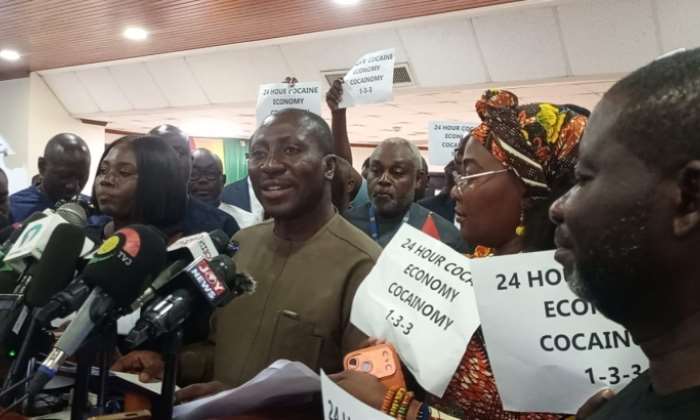

The Minority Caucus in Parliament has initiated proceedings to overturn Speaker Alban Bagbin’s decision rejecting its proposed parliamentary investigation into alleged drug trafficking activities involving consignments linked to Ghana.
The motion, submitted by First Deputy Minority Whip and Tolon MP Habib Iddrisu, invokes Standing Order 127 of Parliament’s Standing Orders and seeks a reconsideration of the Speaker’s September 29, 2026 ruling, which declared the proposed inquiry inadmissible.

Mr Bagbin had justified his decision on the grounds that a parliamentary investigation into the matter could potentially prejudice ongoing criminal proceedings involving approximately 21 individuals across four separate narcotics related cases.

The ruling followed an attempt by the Minority to establish a bipartisan parliamentary committee to investigate several significant drug interceptions involving shipments associated with Ghana.

Addressing journalists at a press briefing ahead of Parliament’s resumption on Tuesday, November 3, Minority Leader Alexander Afenyo-Markin explained that the application for a review was not intended to challenge the institutional authority of the Speaker but rather to contest what the caucus considers an unjustified restriction on Parliament’s constitutional oversight mandate.
He maintained that although the Minority recognised the constitutional responsibilities attached to the Speaker’s office, such recognition should not prevent parliamentarians from questioning decisions they believe could undermine the legislature’s constitutionally assigned functions.

Mr Afenyo-Markin subsequently drew attention to a series of major narcotics seizures involving consignments reportedly connected to Ghana, arguing that the developments demanded a comprehensive examination of the country’s capacity to prevent illicit substances from passing through its international ports and other entry points.
Among the incidents he highlighted was the interception of approximately 3.9 tonnes of cocaine at France’s Port of Dunkirk on September 7, 2026. The suspected narcotics were reportedly concealed within a consignment of plastic waste originating from Ghana, with the shipment estimated to be worth approximately €225 million.

The Minority Leader also referenced other reported seizures in Amsterdam, Antwerp and Sydney, alongside suspected cocaine interceptions within Ghana, including incidents around the Tema Harbour enclave and Pedu Junction.

According to him, the succession of these incidents raises significant questions about the effectiveness of Ghana’s maritime security arrangements, cargo examination procedures, customs enforcement mechanisms, intelligence sharing systems and the broader institutional capacity to combat international organised criminal networks.
The Minority Leader further argued that criminal prosecutions arising from narcotics investigations should not automatically prevent Parliament from examining potential administrative and regulatory shortcomings within state institutions responsible for safeguarding the country’s borders.
He cautioned that relying exclusively on pending criminal cases to prevent legislative investigations could leave important institutional deficiencies unidentified and unresolved.
Mr Afenyo-Markin stressed that prosecuting individuals suspected of involvement in drug trafficking, although necessary, did not remove the government’s obligation to explain whether weaknesses in public administration, regulation or institutional supervision contributed to the incidents.
He also clarified that the proposed parliamentary investigation was not designed to determine the criminal responsibility of individuals currently facing prosecution.
Rather, he distinguished between the constitutional responsibilities of the judiciary and those of Parliament, explaining that criminal courts determine whether accused persons are legally responsible for particular offences, whereas the legislature examines the performance of public institutions, the adequacy of existing laws and regulatory arrangements, and whether administrative failures require corrective intervention.
The Minority therefore maintains that its proposed inquiry would concentrate on identifying institutional weaknesses, assessing the effectiveness of regulatory safeguards and examining the performance of agencies responsible for preventing narcotics trafficking, without interfering with the determination of criminal cases before the courts.
The motion now places the question of parliamentary oversight and the Speaker’s authority to regulate the admissibility of proposed inquiries at the centre of the unfolding parliamentary debate.

