
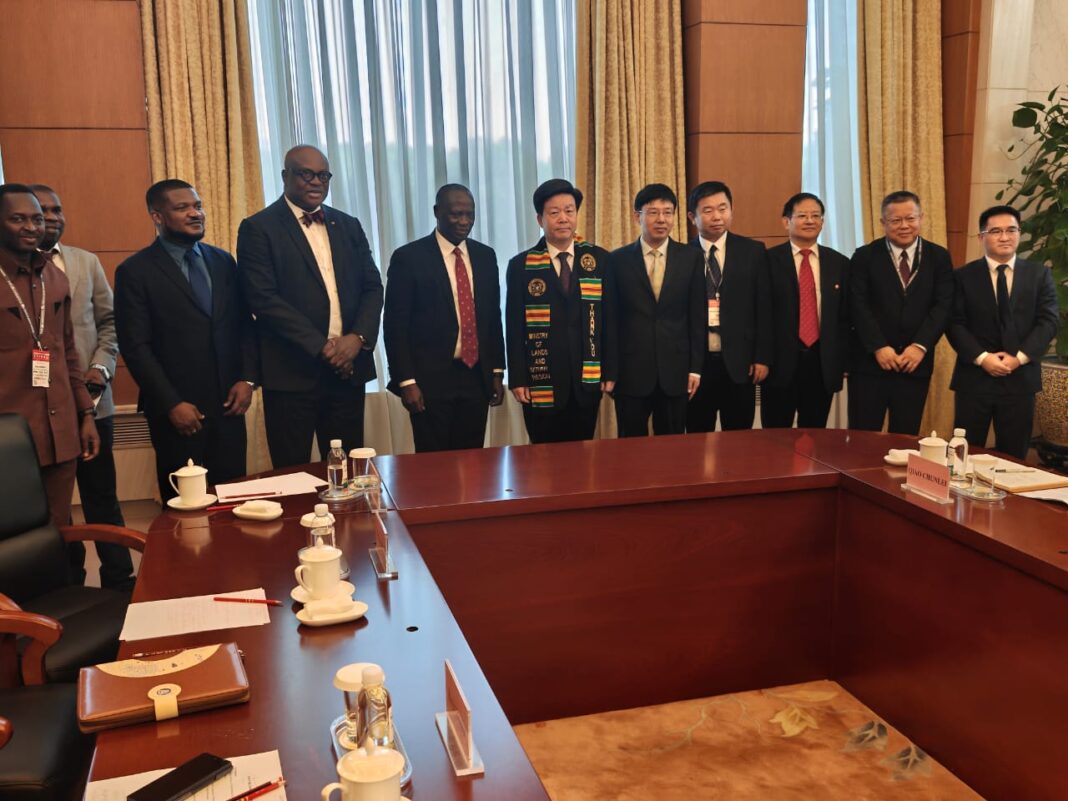

Ghana and China have reached a significant agreement to deepen cooperation in the mining sector, with both countries committing to a three point strategy aimed at combating illegal mining, expanding geological exploration and mapping, strengthening technological cooperation and attracting more responsible investment into Ghana’s mineral economy.
The understanding was reached during a high level meeting between Ghana’s Minister for Lands and Natural Resources, Emmanuel Armah Kofi Buah, and China’s Deputy Minister of Natural Resources, Sun Shuxian, on the sidelines of the 2026 China Mining Conference and Exhibition in Tianjin.

The development represents a potentially important new phase in Ghana China mining relations as the Government seeks to move the country away from a predominantly extraction based model towards a system centred on value addition, technological advancement, environmental restoration and stronger national participation in the mineral value chain.

Ghana has in recent days intensified its campaign to attract Chinese investment and technical expertise into the mining industry, with Mr Buah stressing that future partnerships must extend beyond the extraction and export of raw minerals to include processing, skills development, infrastructure, technology transfer and local supply chains.

Mr Buah, who led the Ghanaian delegation alongside Ghana’s Ambassador to China, Kojo Bonsu, described the ministerial engagement as a major breakthrough in efforts to strengthen governance within the mining sector and establish a more structured relationship with Chinese authorities over the activities of Chinese nationals and companies operating in Ghana.
He said the new cooperation framework would provide a mechanism for Ghana and China to work together in addressing illegal mining involving Chinese nationals, while ensuring that individuals who violate Ghanaian mining and environmental laws face appropriate sanctions.

“This is very important in how we collaborate on critical areas of the natural resources sector. This includes how to work with them in policing Chinese companies that are working in Ghana to make sure that they meet the highest standards,” he said.
According to the Minister, Chinese nationals found to have participated in illegal mining activities, popularly known as galamsey, would not only be subjected to Ghanaian law but could also be dealt with through appropriate mechanisms on the Chinese side.

He explained that the emerging cooperation would create a pathway through which the authorities of both countries could strengthen oversight of their nationals and companies operating within Ghana’s mining industry.

“Those who are found to have broken the law, especially those who engage in illegal mining activities, galamsey, are not only punished in Ghana, but we have a pathway where the Chinese will also police their people who are working in Ghana,” he said.
The agreement comes at a time when Ghana is intensifying enforcement against illegal mining and simultaneously attempting to reshape the structure of the formal mining industry.
The Government has repeatedly identified illegal mining as a major environmental and economic challenge, while the National Anti Illegal Mining Operations Secretariat has continued operations against illegal mining sites, forest reserves, river bodies and concession encroachments.
The second major component of the Ghana China understanding will focus on geological surveys, mapping and scientific assessment of Ghana’s mineral resources.
Mr Buah said cooperation with China would strengthen the capacity of the Ghana Geological Survey Authority and improve the country’s ability to generate reliable geological information required for responsible mineral development and investment.
He said the partnership would include geological mapping, technology transfer, green mining practices and environmental protection.
“We are also collaborating with them on green mining technology, environmental protection and technology transfer. Critically, we will be working with them on geological surveys and mapping. These are very critical breakthroughs,” he explained.
The emphasis on geological information is particularly important because the Government has been pursuing a more data driven approach to mineral development.
The Ghana Geological Survey Authority has already been working with other state institutions to undertake comprehensive geological investigations in selected areas, with the objective of identifying mineral deposits, assessing environmental risks and making responsible mining more targeted and economically viable.
Mr Buah said Ghana and China had therefore agreed to establish a technical team to translate the ministerial understanding into concrete programmes and measurable actions.
“We have all agreed to form a technical team to move this forward, and I want to thank Ghana’s Ambassador to China for his role,” he said.
The Minister described the engagement as particularly significant because, according to him, Ghana had not enjoyed direct ministerial level engagement with the Chinese authorities on these specific mining concerns for about five years.
He said the renewed dialogue could therefore provide a new institutional framework for dealing with longstanding challenges associated with Chinese participation in Ghana’s mining industry while creating opportunities for stronger cooperation in technology, investment and environmental management.
For China, the proposed partnership goes considerably beyond enforcement.
Deputy Minister Sun Shuxian said Beijing was prepared to expand cooperation with Ghana in geological exploration, technological innovation, geological mapping and the assessment of critical mineral resources.
“We are ready with you, and our proposal is that we suggest more collaboration on the Geological Survey and technological innovation,” he said.
Mr Sun proposed that the two countries work jointly on geological mapping and the assessment of the critical mineral potential of Ghana’s major mineral bearing belts.
He said China could provide satellite remote sensing, airborne geophysical surveys and other advanced technical assistance to help Ghana address gaps in its geological information, particularly in areas that have not yet been adequately mapped.
Such cooperation could significantly improve Ghana’s understanding of its mineral endowment and provide investors with more reliable information before committing capital to exploration.
The Chinese Deputy Minister also proposed the establishment of joint laboratories to support geological prospecting for minerals including gold and lithium.
He further called for expanded technical exchanges and professional training programmes between the two countries, saying Chinese technicians could periodically travel to Ghana while Ghanaian experts could undertake reciprocal training and field studies in China.
“On an annual basis, we can send our technicians to each other’s country to help with joint training on field studies so we can help Ghana with technical support,” he said.
The proposed technical exchanges are consistent with Ghana’s broader objective of ensuring that international mining partnerships leave behind stronger domestic expertise and institutions.
Mr Buah has previously stressed that technological cooperation must be accompanied by deliberate efforts to develop Ghanaian engineers, geologists and regulators rather than creating a situation in which advanced mining knowledge remains concentrated among foreign companies.
China Commits to Turning Agreement Into Action
Mr Sun also welcomed Ghana’s decision to designate a focal person to coordinate the implementation of the proposed areas of cooperation.
He said the appointment would help ensure that the latest agreement does not remain another diplomatic understanding without practical implementation.
“I’m happy that you have identified a focal person to follow up on our collaboration so that our meeting would not just be about talking but walking the talk,” he said.
China’s Department of International Cooperation is expected to serve as the principal contact point on the Chinese side for advancing the proposed mining partnership.
Mr Sun further suggested that Ghana and China establish a regular dialogue mechanism through which officials and technical experts could exchange views on sustainable mining, mineral development, the construction of mineral value chains and intelligent mining.
He described the ministerial engagement as constructive and substantive and expressed confidence that the two countries could build a mutually beneficial partnership based on what he described as a high quality relationship.
“Our meeting today is constructive and very in depth, so we hope in the future we can have a win win collaboration based on a high quality partnership,” he said.
Mr Sun subsequently invited Mr Buah and the Ghanaian delegation to visit China’s Ministry of Natural Resources in Beijing for further discussions on areas of future cooperation.
China Offers Ghana Mine Rehabilitation Experience
The discussions also extended to one of the most persistent consequences of illegal and irresponsible mining in Ghana, the degradation of land and the abandonment of mining pits.
The Chinese delegation shared its experience in rehabilitating abandoned mining sites and restoring degraded areas, highlighting environmental restoration as an essential component of responsible mineral development.
Mr Sun said China had adopted stringent environmental requirements for mining operations and committed substantial financial resources towards restoring degraded mining areas.
“I’m happy to hear that you emphasized the importance of the development of green mining, because that is what China is doing now,” he said.
According to him, China’s central government allocates approximately one billion Chinese yuan every year towards the rehabilitation of abandoned mining pits.
He said China had accumulated significant practical experience through the process and expressed his country’s willingness to share those methods and lessons with Ghana.
The offer is particularly relevant as Ghana continues to grapple with the environmental consequences of illegal mining, including the destruction of agricultural land, pollution of water bodies and degradation of forest ecosystems.
Mr Buah has previously identified green mining, environmental management, mine reclamation and land restoration as areas where Ghana intends to benefit from Chinese technological expertise.
The renewed Ghana China cooperation also fits into the Government’s wider effort to attract investment while demanding greater value from the exploitation of Ghana’s mineral resources.
At the 2026 China Mining Conference, Mr Buah told investors that Ghana was no longer prepared to rely exclusively on the export of raw minerals and wanted future partnerships to generate processing industries, skilled employment, technological capacity, infrastructure and stronger local supply chains.
He has also been exploring Chinese green mining technology, including electric mining equipment and environmental protection systems, as part of efforts to modernise Ghana’s mining industry and reduce its environmental footprint.
The latest ministerial understanding therefore places illegal mining enforcement, geological intelligence, technological advancement, environmental rehabilitation and responsible investment within a single framework of Ghana China cooperation.
For Ghana, the significance of the arrangement will ultimately depend on whether the proposed technical mechanisms translate into stronger enforcement, better geological information, greater technology transfer and more accountable participation by foreign mining companies.
The Ghanaian delegation included the Chief Executive of the Minerals Commission, Isaac Tandoh, the Director General of the Ghana Geological Survey Authority, Dr Prosper Aduah Akaba, and the Chief Executive Officer of the Ghana Integrated Iron and Steel Development Corporation, Williams Okofo Dartey.
The agreement now moves into an implementation phase, with the proposed technical team expected to provide the institutional mechanism through which the commitments made in Tianjin can be converted into practical cooperation.
For a country seeking to protect its mineral wealth while attracting investment capable of generating greater domestic value, the emerging Ghana China partnership could become an important test of whether international mining cooperation can simultaneously deliver investment, technology, environmental protection and stronger national control over the resources beneath Ghanaian soil.

