

A sweeping verification operation undertaken by the Ghana Audit Service in collaboration with global professional advisory giants Ernst & Young and PwC has uncovered a staggering financial irregularity involving the excessive remuneration and improper compensation of a private haulage enterprise engaged under the government’s Farmer Food Relief and Recovery Programme during the 2024 agricultural intervention cycle.
The extensive examination of financial records and contractual documentation revealed that public funds amounting to several millions of Ghana cedis were improperly disbursed through exaggerated logistical claims and questionable payment arrangements associated with the transportation of food commodities intended for farmers across the country.

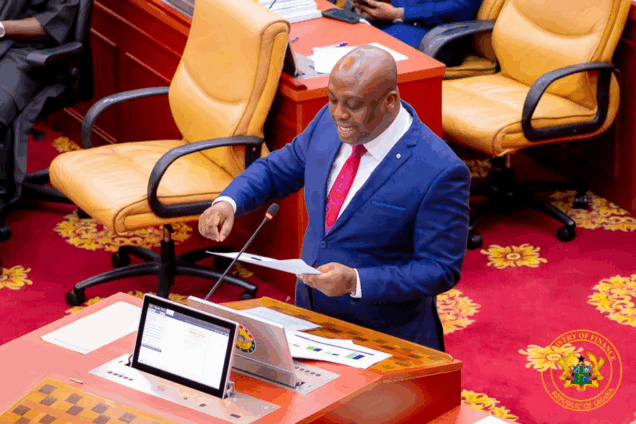
The revelations were formally presented before the national legislature when Thomas Nyarko Ampem, Deputy Minister for Finance, delivered the Auditor General’s assessment detailing government liabilities totalling approximately sixty eight point seven billion Ghana cedis during a parliamentary session held on Tuesday 10 March 2026. Addressing lawmakers, he explained that the investigation exposed a calculated manipulation of transport claims that resulted in a substantial diversion of state resources originally allocated to support the nation’s agricultural recovery programme.

The probe centred on a logistics agreement designed to facilitate the nationwide distribution of approximately one hundred and thirty four thousand metric tonnes of maize and rice to farming communities. The arrangement carried a contractual valuation estimated at about one hundred and fifteen point two million Ghana cedis and was expected to ensure that staple grains reached producers affected by market disruptions and climatic challenges.

However the audit determined that the transportation firm involved fulfilled only a fraction of the contracted obligation. Rather than moving the full consignment stipulated under the agreement, the company delivered approximately thirty five thousand metric tonnes of grain to beneficiary locations. Under the financial terms established in the contract, such a volume should have attracted remuneration of roughly thirty point nine million Ghana cedis. Despite this significantly reduced performance level, the enterprise nonetheless received a payment of fifty million Ghana cedis from public funds.
The investigators further uncovered a remarkably irregular arrangement that intensified the financial anomaly. In addition to the substantial cash disbursement, the transport operator was granted a quantity of rice as an alternative form of compensation. The commodity allocation amounted to about seven thousand three hundred and eleven metric tonnes, representing roughly fourteen thousand six hundred and twenty two individual bags weighing fifty kilograms each. The market valuation of this rice allocation was estimated at approximately eleven point seven million Ghana cedis. Audit officials determined that this commodity transfer had been authorised as a substitute payment for services that had never been delivered.

When the inflated cash payments and the commodity compensation were combined, the total value transferred to the logistics company reached an estimated sixty one point seven million Ghana cedis even though the contractual obligations had been only partially fulfilled.
According to the findings, the magnitude of the financial irregularities became even more alarming when subsequent actions by the Ministry of Food and Agriculture came under scrutiny. After the initial payments had already exceeded the value of services rendered, officials within the ministry reportedly submitted a request seeking the release of an additional sixty five point two million Ghana cedis to the same transport contractor.

This additional financial demand triggered closer examination by the Auditor General, whose office identified the glaring inconsistency between the volume of grain actually transported and the value of payments being requested. Acting on these findings, the Auditor General declined to authorise the additional disbursement, thereby preventing what officials described as a further substantial depletion of the national treasury.

The intervention was presented by Mr Ampem as an illustration of the government’s determination to restore financial discipline and enforce stricter controls over public expenditure following a fiscal period in 2024 that was characterised by widespread administrative lapses and questionable financial commitments.
Speaking before Parliament, the Deputy Finance Minister articulated what he described as a renewed policy posture within the Ministry of Finance, emphasising that future public spending would be governed by far more rigorous verification mechanisms.
He stated that from this point forward no financial settlement would be approved without comprehensive confirmation of services delivered and that no contractual obligation would be entered into unless an approved budgetary provision existed. He further stressed that individuals occupying public office would no longer be insulated from scrutiny or accountability irrespective of their institutional rank or administrative authority.
The transport contract controversy now joins a growing catalogue of financial irregularities connected to the Ministry of Food and Agriculture that have surfaced through recent investigative reviews. Earlier disclosures had already raised alarms concerning unexplained rice inventory shortfalls and questionable certification procedures involving maize procurement documentation.
Legal authorities have subsequently been drawn into the unfolding developments. The office of the Attorney General of Ghana has reportedly been mandated to initiate legal proceedings aimed at recovering the misappropriated public funds and determining the liability of both government officials and the private logistics operator implicated in the scheme.
Financial governance analysts note that the case underscores the importance of strengthened auditing frameworks and transparent procurement systems within Ghana’s public administration. By exposing the intricate methods through which public resources can be diverted through inflated service claims, the investigation has intensified calls for deeper institutional reforms capable of safeguarding state finances and ensuring that programmes designed to support farmers and vulnerable sectors genuinely achieve their intended national development objectives.

