
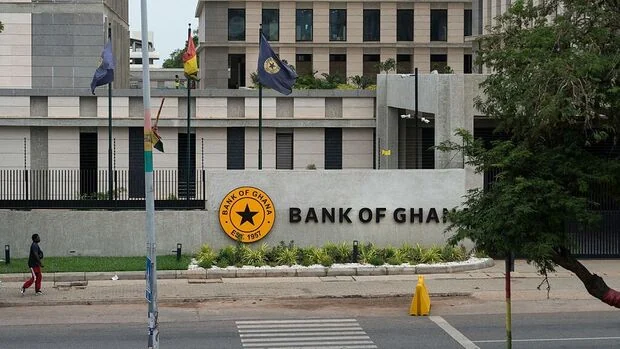

Commercial banks in Ghana are set to access overnight funding from the Bank of Ghana (BoG) at a significantly reduced cost following the central bank’s latest monetary policy adjustment, although a simultaneous narrowing of the policy corridor could exert upward pressure on short term interest rates across the money market.
The Monetary Policy Committee (MPC) lowered the benchmark policy rate by 300 basis points last week, bringing it down from 14 per cent to 11 per cent. Alongside the reduction, the committee also tightened the policy corridor from plus or minus 400 basis points to plus or minus 100 basis points around the benchmark rate.

The combined adjustments have reduced the central bank’s overnight lending rate to commercial banks from 18 per cent to 12 per cent, while maintaining the interest rate paid to financial institutions depositing excess liquidity with the central bank at 10 per cent.

The development is particularly significant given that short term money market interest rates had already been hovering around 10 per cent, despite the previous benchmark policy rate remaining at 14 per cent.

Under the former monetary policy arrangement, the corridor established a 10 per cent floor for the central bank’s deposit facility and an 18 per cent ceiling for its lending facility. The revised framework has consequently narrowed the range to between 10 per cent and 12 per cent.
Some financial analysts consider the latest policy adjustment largely a correction of the benchmark rate to reflect prevailing conditions within the domestic money market, where short term borrowing costs had already declined considerably.

However, other market observers believe the narrower corridor could introduce a tightening effect by encouraging overnight and other short term market rates to move away from the existing 10 per cent lower boundary and closer to the revised 11 per cent policy benchmark.
Such a development could increase certain borrowing costs within the interbank market, notwithstanding the reduction in the interest rate commercial banks pay when accessing emergency overnight funding directly from the central bank.

BoG Introduces Changes to Liquidity Management Framework

Explaining the committee’s latest decision, Bank of Ghana Governor, Dr Johnson Asiama, indicated that the adjustments formed part of a broader strategy to strengthen domestic liquidity management and improve the effectiveness with which monetary policy decisions influence interest rates across the financial system.
In addition to reducing the benchmark rate, the central bank announced two significant operational changes intended to improve the management of banking sector liquidity.
The first involves replacing the existing 14 day Open Market Operations instrument with a shorter seven day facility, while the second entails reducing the width of the monetary policy corridor from plus or minus 400 basis points to plus or minus 100 basis points.
Dr Asiama explained that the reduction in the policy rate was supported by improvements in domestic economic conditions, particularly declining inflation, stronger economic performance and easing credit conditions.
These developments, according to the governor, provided sufficient justification for adjusting the benchmark rate to better reflect the prevailing direction of the economy and financial markets.
Commercial Lending Rates Could Decline Further
Beyond its immediate implications for overnight borrowing, the latest monetary policy adjustment could also influence the Ghana Reference Rate (GRR), an important benchmark used by commercial banks in determining interest charges on loans extended to businesses and individual customers.
The reference rate currently stands at 10.04 per cent, with expectations that further adjustments could push it below the 10 per cent threshold.
Average commercial lending rates are estimated at approximately 15.8 per cent, with projections suggesting that they could decline by as much as 300 basis points following the central bank’s latest intervention. However, the actual reduction will depend on the extent to which individual financial institutions incorporate the lower benchmark rate into their lending arrangements.
The Ghana Association of Banks has indicated that certain businesses and individual borrowers already enjoy single digit lending rates, adding that the latest monetary policy decision could create additional opportunities for borrowing costs to decline.
If commercial banks transmit the benefits of the reduced policy rate to their customers, businesses and households could experience more affordable access to credit in the coming months, potentially supporting investment, commercial expansion and household spending.
Nevertheless, the extent of the anticipated relief will ultimately depend on banks’ lending decisions, prevailing liquidity conditions and the speed at which changes in the central bank’s monetary policy framework are reflected in the wider financial market.

