

Finance Minister Dr Cassiel Ato Forson has identified commercial agriculture as a significant avenue for addressing youth unemployment in Ghana, arguing that large scale agricultural production could create substantial employment opportunities while reducing the country’s dependence on imported food commodities.
He maintained that transforming agriculture and expanding domestic food production would generate jobs across several segments of the agricultural value chain, stimulate local industries and strengthen the national economy.

Speaking in an interview with Citi FM on Friday, November 13, Dr Forson disclosed that government assessments had identified agriculture as one of the sectors with considerable capacity to absorb a substantial proportion of Ghana’s working population.

He stressed, however, that achieving this potential would require a fundamental transformation of the country’s agricultural system, particularly through a deliberate transition from traditional subsistence farming to commercially oriented production capable of operating on a much larger scale.

“If there is one sector that can create jobs on a large scale, it is agriculture. In fact, the diagnostics we conducted identified agriculture as a sector capable of employing the majority of our people. I mean commercial agriculture. We need to commercialise agriculture, not peasant agriculture,” he said.
The Finance Minister identified rice, poultry, palm oil and sugar as some of the major commodities for which Ghana continues to depend on foreign supplies, explaining that expanding domestic cultivation, production and processing could unlock considerable employment opportunities.

According to him, the economic benefits of commercial agriculture would extend well beyond activities on farms, as the development of supporting industries would create additional employment across processing, storage, transportation, distribution and other essential components of the supply chain.
He argued that strengthening the entire agricultural value chain could generate considerable employment, particularly when local production is supported by efficient systems for handling, preserving and distributing agricultural commodities.

“The chain alone, if you are able to fix it, will create so much jobs,” he added.

To demonstrate the employment and production opportunities associated with agricultural investment, Dr Forson cited the proposed Pwalugu Dam project, which is expected to provide irrigation infrastructure for approximately 25,000 hectares of agricultural land.
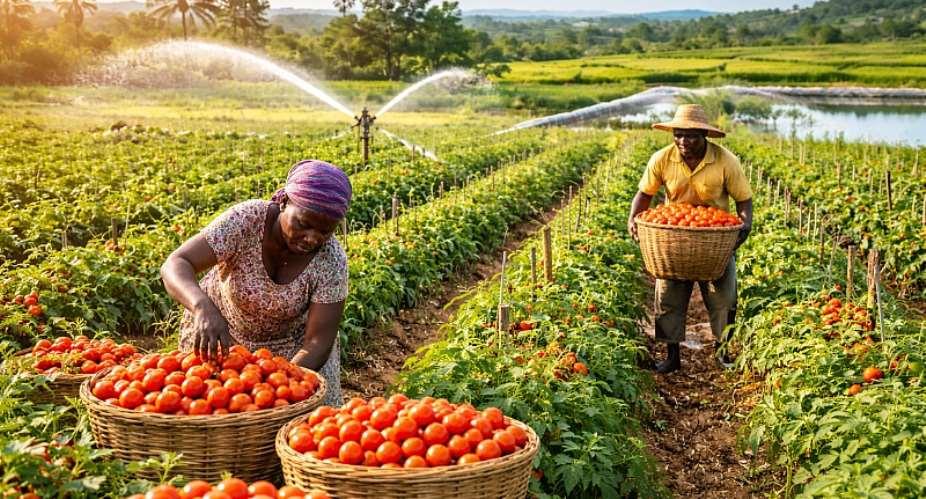
The initiative is expected to facilitate the establishment of an extensive vegetable production enclave, with particular attention to tomatoes and onions, two commodities for which Ghana relies considerably on supplies from neighbouring Burkina Faso.
Dr Forson explained that increasing domestic output of these vegetables would help reduce the country’s dependence on cross border purchases, while creating opportunities for farmers, traders, processors and other businesses operating within the agricultural sector.
Beyond its agricultural objectives, the proposed dam is also expected to generate approximately 70 megawatts of electricity, providing additional energy to support industrial development and economic activities within the surrounding area.
The Finance Minister further indicated that the planned agricultural production zone could stimulate investment in food processing and preservation, allowing businesses to transform locally cultivated produce into value added products while creating employment beyond primary agricultural activities.
He questioned why youth unemployment should remain a persistent national concern when Ghana possesses extensive arable land, significant water resources and climatic conditions that could support large scale agricultural production.
He maintained that these natural advantages presented considerable opportunities for expanding commercial farming, attracting investment and developing agricultural industries capable of employing thousands of people.
Dr Forson consequently argued that a coordinated approach to agricultural development, supported by irrigation infrastructure, reliable energy supplies, modern production methods and effective processing facilities, could help address unemployment while strengthening domestic food production.
His remarks place renewed emphasis on agriculture as an important component of Ghana’s economic diversification strategy, particularly at a time when reducing food imports, expanding local manufacturing and creating sustainable employment remain significant national priorities.

