
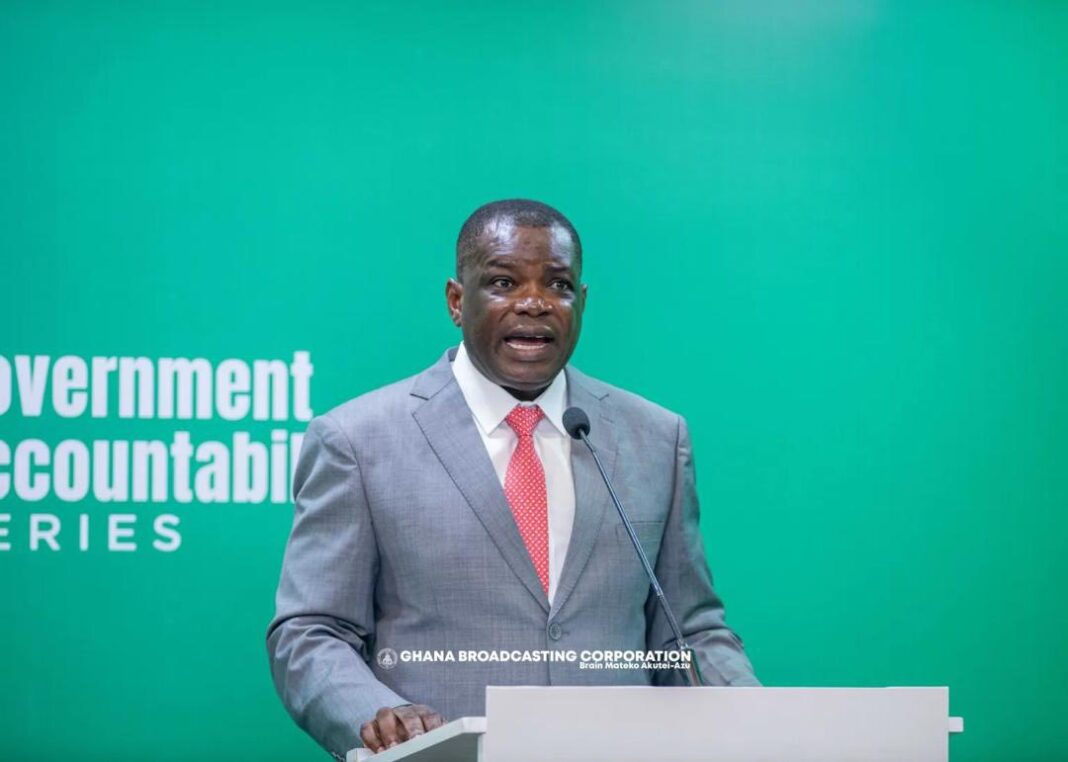

The Minister for Roads and Highways, Governs Kwame Agbodza, has launched a sharp critique of his immediate predecessor, Francis Asenso-Boakye, over prolonged delays surrounding the Suame Interchange project, arguing that flawed priorities under the previous administration significantly undermined the timely delivery of critical road infrastructure in Kumasi.
Speaking in response to recent criticisms from Mr Asenso-Boakye over the redesign of the interchange, Mr Agbodza contended that the former New Patriotic Party administration channelled vast public resources into projects that delivered limited economic utility while leaving essential transport infrastructure underfunded. He pointed in particular to the construction of the National Cathedral, noting that expenditure exceeding one hundred million United States dollars on the project could have substantially advanced the Suame Interchange.

According to the Roads Minister, the funds committed to the cathedral alone would have been sufficient to complete at least half of the interchange, a development he said would have spared residents and commuters in the Ashanti Region years of congestion, inefficiency, and economic loss. In his view, the contrast between the stalled interchange and the scale of cathedral spending exemplifies a broader pattern of misplaced development emphasis.

Mr Agbodza further defended the current government’s decision to redesign the Suame Interchange, clarifying that the removal of the originally planned fourth tier was not an abandonment of ambition but a rational response to changing traffic dynamics and fiscal realities. He explained that the construction of the Kumasi Outer Ring Road under the Big Push Programme is expected to redirect a substantial volume of northbound traffic away from the city centre, thereby reducing the long term capacity demands initially projected for the Suame corridor.

In this context, the minister argued that maintaining the original four level configuration would amount to overengineering, imposing unnecessary costs without corresponding traffic benefits. He maintained that infrastructure planning must remain adaptive and responsive to complementary developments rather than rigidly tied to outdated projections.
Beyond design considerations, Mr Agbodza also drew attention to unresolved expropriation and compensation obligations inherited from the previous administration. He indicated that these outstanding issues posed serious financial and logistical obstacles to the execution of the original plan. In particular, he noted that constructing the fourth tier would have required the displacement of several commercial properties, affected the Suame Police Station, and encroached upon land associated with the Garden City Mall, with compensation costs alone projected to exceed half of the original construction budget.

Taken together, he argued, these factors rendered the initial design both economically inefficient and operationally impractical under current conditions. The revised approach, he said, strikes a more realistic balance between capacity needs, cost control, and urban integration.
In closing, the Roads Minister urged members of the Minority and other critics to move away from partisan posturing and instead engage constructively with the technical and fiscal realities of infrastructure development. He emphasised that the ultimate objective should be the delivery of durable and efficient road systems that serve the long term interests of residents rather than the pursuit of political point scoring.

According to Mr Agbodza, Kumasi stands to benefit significantly from the modified interchange when combined with ongoing and planned road projects across the metropolis and the wider Ashanti Region. He expressed confidence that the integrated approach now being pursued will yield a modern transport network capable of supporting economic growth, easing congestion, and improving mobility, while also reflecting a more disciplined and strategic use of public funds.


