
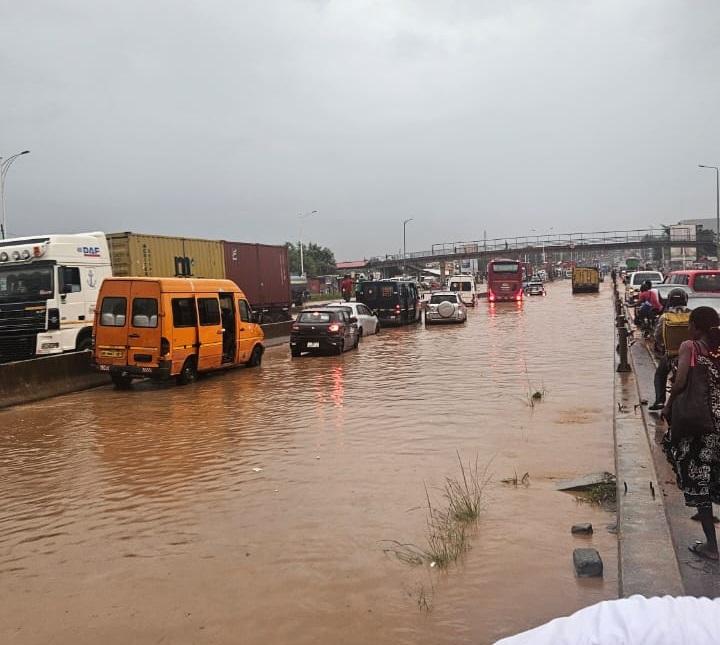

Ghana’s economic capital has been brought to a near standstill after severe flooding triggered by prolonged overnight rainfall disrupted transportation networks, immobilised commercial activity, stranded traders and transporters, and prompted an unprecedented appeal by government authorities for residents to work remotely as emergency services struggle to respond to the scale of the crisis. The flooding, which has submerged major highways, inundated homes and business premises, and severed critical supply routes into the capital, represents one of the most significant disruptions to economic activity in Accra in recent years.
The torrential rainfall, which began late Sunday evening and persisted through the early hours of Monday, overwhelmed drainage infrastructure across several parts of the Greater Accra Region, leaving strategic transportation corridors impassable and creating extensive traffic gridlock throughout the capital. Key arteries including the N1 Highway, the Accra Kasoa corridor, the Pokuase route, Achimota, Weija, Mallam, Spintex, Kaneshie, and sections of the Kwame Nkrumah Interchange were among the areas severely affected by rising floodwaters.

The immediate economic consequences of the disaster have been profound. Commercial activity across major trading centres in the capital has slowed dramatically as thousands of traders, transport operators, wholesalers, and retailers have been unable to access markets. Particularly affected are agricultural supply chains that depend on the timely transportation of highly perishable produce from farming communities to urban consumption centres.

According to the President of the Tomato Transporters Association of Ghana, Eric Tuffour, dozens of cargo vehicles transporting tomatoes and other agricultural commodities to Accra’s major markets have become stranded due to the flooding of the Pokuase corridor, one of the capital’s critical transportation gateways. He revealed that transporters arriving from various regions of the country have been forced to halt operations indefinitely while awaiting the recession of floodwaters.

Speaking about the unfolding crisis, Mr Tuffour explained that some drivers had contacted the association after becoming trapped near Nsawam, where the flooding had rendered sections of the road network inaccessible. Since the country’s principal wholesale markets are concentrated within central Accra, the transporters have been left with little option beyond parking their vehicles and waiting for conditions to improve. The situation is particularly devastating for traders dealing in tomatoes and other highly perishable commodities, which require immediate distribution upon arrival to avoid substantial financial losses.
The flooding has effectively fractured portions of major highways, leaving thousands of motorists trapped in extended queues while emergency services attempt to assess the extent of the damage. Monday traditionally represents one of the busiest commercial transportation periods in Ghana, with substantial volumes of agricultural produce transported from rural communities to urban markets in Accra and Kumasi for weekly commercial transactions. The interruption of this critical supply chain threatens not only immediate financial losses for traders but also potential disruptions in food availability and market pricing across urban centres.

In response to the escalating emergency, Muntaka Mohammed-Mubarak issued an extraordinary appeal urging residents of Accra to remain indoors and work remotely where possible. The Interior Minister disclosed that consultations with the Ghana Meteorological Agency indicated that additional rainfall systems approaching from neighbouring Togo could further worsen conditions throughout the day. He consequently advised employers to activate flexible working arrangements and prioritise employee safety over physical attendance requirements.
The Minister also appealed to workers already at their places of employment to remain there until conditions improve, while urging individuals yet to commence their journeys to stay at home and avoid unnecessary travel. He acknowledged that the scale of the flooding had stretched emergency response capacities and emphasised that no employment obligation should take precedence over the protection of human life.

Beyond the immediate humanitarian and economic consequences, the latest flooding disaster once again exposes the longstanding structural vulnerabilities confronting Ghana’s rapidly urbanising capital. Urban planners, environmental experts, and residents have repeatedly identified inadequate drainage infrastructure, unplanned urban expansion, encroachment on waterways, ineffective waste management systems, and the increasing impact of climate variability as major contributors to Accra’s recurring flood emergencies. Public frustration expressed across social platforms reflects growing concern that decades of warnings, studies, and policy discussions have yet to produce durable solutions capable of preventing the annual disruption of lives and livelihoods.

Historically, the significance of this latest flooding event extends beyond the immediate damage inflicted upon businesses and households. It underscores the increasing economic risks posed by climate related disasters to Ghana’s commercial infrastructure and national productivity. With Accra functioning as the country’s principal financial, transportation, and commercial hub, prolonged disruptions to mobility and supply chains carry substantial implications for economic output, food security, investment confidence, and urban resilience.
As authorities continue emergency response operations and meteorological agencies monitor evolving weather conditions, the events unfolding across Accra have once again elevated a longstanding national challenge into an urgent question of economic security, urban planning, and climate adaptation policy.

