
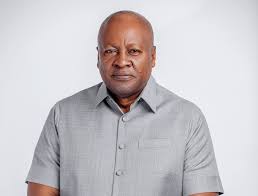

The Editor in-Chief of the Daily Searchlight, Mr. Kenneth Agyei Kuranchie, has called on the Supreme Court of
Ghana to settle once and for all whether Mr. John Dramani Mahama is eligible to contest as a candidate in Elections
2024.
Mr. Kuranchie filed a case early in 2024 at the Registry of the Supreme Court, challenging the eligibility of Mr.
Dramani Mahama to contest as a presidential candidate in Election 2024. Mr. Dramani Mahama is the flag bearer of
the National Democratic Congress (NDC) party. He is also a former President of Ghana.
Speaking after filing a memorandum of issues in the case on Monday, Mr. Kuranchie stated that in his opinion, Mr.
Mahama was not a person who was eligible to contest to become President of Ghana again.
“I am saying that if former President John Kufuor is not eligible to contest to be president, then Mr. John Mahama is
also not eligible to become President again. The supporters of Mr. Mahama, on the other hand, insist that he is
eligible. But which is which? I believe I am right, and they believe they are right. It is for the Supreme Court to
decide, one way or the other,” he said.
“But the decision must come before Election 2024. Otherwise it would become a largely academic exercise,” Mr.
Kuranchie stated.
Mr. Kuranchie stated that in his opinion, Mr. Mahama becoming President would amount to a constitutional
‘constitutional coup d’etat’.
“Here is a man who has had exactly the same opportunities like all Presidents before him to be elected to serve a
second term. Like Rawlings and Kufuor before, he was also given the opportunity, whilst he served a first term, to
be elected to serve a second term. Unfortunately, unlike Rawlings and Kufuor, he lost, and thence became a former
President with the same constitutional positions and privileges like Rawlings and Kufuor. If the Rawlings and
Kufuor cannot vie to become President, how can Mahama vie to become President? The Supreme Court has duty to
speak on this,” he stated.
MEMORANDUM OF ISSUES
Mr. Kuranchie yesterday filed a memorandum of issues that set out nineteen matters that he hoped the Supreme
Court would provide answers on.
He asked whether, the principle of equality under Article 17. (1) of the 1992 Constitution applies equally and in the
same measure to all persons elected to the Office of President under Article 66. (1) and (2) of the 1992 Constitution.
He asked whether the word ‘elected’ appearing in Article 66. (1) and (2) has the same effect as every other word in
the article and clauses of that provision.
He asked whether under Articles 17. (1) and 66.(1), all person serving a first presidential term have the equal
opportunity to be elected to serve a second presidential term under Article 66. (2) of the 1992 Constitution and
whether the 3 rd Defendant, Mr. John Dramani Mahama, whilst serving a first presidential term under Article 66.(1)
received the opportunity under Articles 17. (1) to be elected to serve a second presidential term under Article 66. (2);
Synonymously, he is also asking whether under Articles 17. (1) and 66. (1) and (2) the 3 rd Defendant, Mr. John
Dramani Mahama, having received the opportunity to be elected to serve a second presidential term, deserves more
opportunities to be elected to serve the second term.
Mr. Kurancchie is also asking whether Article 68. (2) of the 1992 Constitution requires the President, upon leaving
office, to seek parliamentary permission before accepting to occupy any office other than an Office of State;
He is also asking whether Article 68. (2) of the 1992 Constitution makes a President of Ghana who has left office an
Officer of the State and a Public Officer;
He also asks whether under Article 68. (4) of the 1992 Constitution a President of Ghana who has left office is
deemed to be on pension;
Cumulatively, he asks whether by Article 68. (2), (4) (5), (7) and (9) of the 1992 Constitution a President of Ghana
who has left office remains an Officer of the State and a Public Officer, and whether the President, upon leaving
office under Article 66. (1) of the 1992 Constitution, and failing to succeed to Article 66. (2), becomes eligible to the
conditions under Article 68. (2), (4) (5), (7) and (9) of the 1992 Constitution.
Former President Mahama, whilst serving as President in 2016, tried but failed to be elected to serve a second term,
and the question is to tease out whether he qualifies to receive all the entitlements and benefits of a former President
of Ghana.
Mr. Kuranchie is also asking whether the articles and clauses in the 1992 Constitution falling under Article 290. (1)
of the 1992 Constitution, described as entrenched clauses, have a mandatory effect requiring the fullest compliance
from all parties.
Mr. Kuranchie therefore asks whether, flowing from issues 1 to 11 above, and from the combined effect of Articles
17. (1), 66. (1), (2), (3), 68. (2), (4), (5), (7), and (9) and 290. (1) (f) as well as 290.(1) of the 1992 Constitution, the
person seeking a second presidential term can only be the person currently occupying the Office of President for a
first term.
On the basis of all the issues above, he poses the question whether, from the combined effect of Articles 17. (1), 66.
(1), (2), (3), 68. (2), (4), (5), (7), and (9) and 290. (1) (f) of the 1992 Constitution, the second presidential term is
consecutive.
Again he asks whether, under Article 68. (2) of the 1992 Constitution, a former President of Ghana falls under the
supervision and control of the Parliament of Ghana in all his/her future offices subsequent to leaving office;
Further, he asks whether on a true and proper interpretation 68. (2) of the 1992 Constitution, a former President of
Ghana requires parliamentary approval before he can occupy any other office that provides emolument.
Again he asks whether on a true and proper interpretation 68. (3) of the 1992 Constitution, the Office of President is
an office that provides emolument.
He asks whether on a true and proper interpretation of Article 68. (4), (5), (6), (7), (8) and (9), a former President of
Ghana remains in the employ of the State and a serving Public Officer to the intendments of Article 284 of the 1992
Constitution.
He is asking whether on a true and proper construction of Article 62 of the 1992 Constitution, a former President of
Ghana is qualified/eligible to seek election as President of Ghana.
Again, he asks whether or not on a true and proper interpretation of Article 68. (2) and 290 (1) (f) of the 1992
Constitution, the Parliament of Ghana has a mandatory duty to comply with the stipulations of Article 68. (2) in so
far as all former Presidents of Ghana are concerned.


