
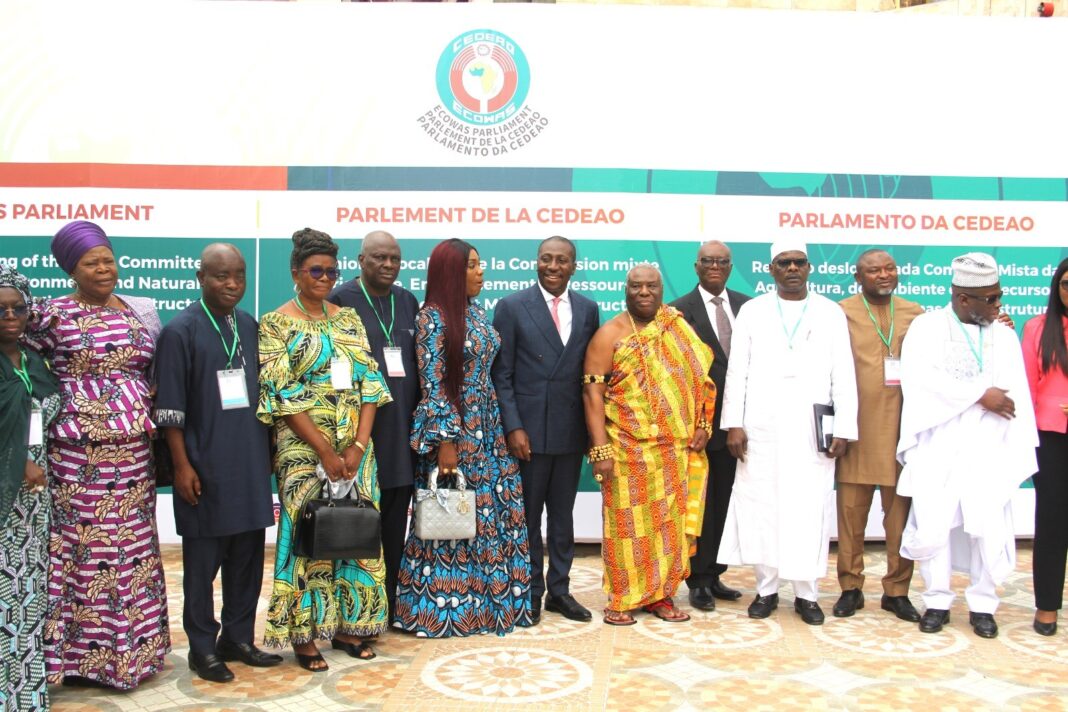

By Elsie Appiah-Osei, GNA
Winneba, Aug 1, GNA – Mr Alexander Afenyo-Markin, the Third Deputy Speaker of the ECOWAS Parliament, said
the state must significantly invest in innovative waste management strategies and turn the associated challenges into
opportunities.
The state, he said, must also enhance enforcement against illegal fishing practices by foreign trawlers, and push for
the establishment of an Economic Community of West African States (ECOWAS) Coastal Protection Fund to assist
communities most affected by plastic pollution and declining fish stocks.
He painted a gloomy picture of the negative effects of plastic littering on the coast and the beaches of countries in
the ECOWAS sub-region and urged member states to phase out single-use plastics and organise comprehensive
public education campaigns to change behaviours/attitudes toward plastic use and waste management.
Mr Afenyo-Markin, also the Majority Leader and New Patriotic Party (NPP) MP of Efutu, made the proposal in a
welcome address, read on his behalf at the opening of the ECOWAS Parliament's Delocalized Joint Meeting of the
Committees on Agriculture, Environment and Natural Resources, Energy, and Mining/Infrastructure at Winneba in
the Central Region.
The National Democratic Congress (NDC) Member of Parliament for Juaboso, Mr Sampson Ahi, and Member of
Ghana’s Delegation to the ECOWAS Parliament, represented the Third Deputy Speaker of the Community
Parliament, at the session.
Mr Afenyo-Markin said: "Our once-pristine beaches are now littered with the debris of our modern lives. Plastic
waste chokes our waterways, suffocates our marine life, and poisons the very waters that have nourished us for
millennia.”
The harmony enjoyed by countries along the region's coasts was under threat due to the ever-increasing plastic waste
and immediate action was required to protect livelihoods and the people, he said.
He advocated the adoption of pioneering initiatives such as Safisana in Ghana and Recuplast in Senegal.
The Safisana model combines faeces and organic waste treatment with renewable energy, nutrient production, and
water generation.
This innovative system not only addresses waste issues but also generates biogas for energy and organic fertilizer for
agriculture, resulting in a truly circular economy.
The Recuplast initiative collects up to 150 tonnes of plastic waste per month, providing livelihood for over 5,000
people.
There is a network that collects plastic from people for a fee or provides them with recycled products such as basins,
tables, and chairs.
Mr Afenyo-Markin urged his colleagues to come up with practical solutions for the needed relief.
This is the third time Ghana has hosted the ECOWAS Parliament, an institution of ECOWAS also known as the
Community Parliament which convenes twice a year.
It is the Assembly of Peoples of the Community serving as a forum for dialogue, consultation and consensus for
Representatives of the people of West Africa to promote integration.
Established under Articles 6 and 13 of the ECOWAS Revised Treaty of 1993, the initial Protocol establishing the
Parliament was signed in Abuja on August 6, 1994.
It provided for the Structure, Composition, Competence and other matters relating to Parliament.
The Community Parliament is composed of 115 seats, with each Member State having a guaranteed minimum of
five seats while the remaining 40 seats shall be shared based on population.
It provides a community mechanism to forge greater ties with the citizens of the West African Community serving
as momentum towards the creation of the Community Parliament, strengthens representative democracy in the
Community to contribute to the promotion of peace, security and stability in the West African Region.
This is achieved by informing and sensitising the population on issues of integration, promotion and defending
principles of human rights, democracy, the rule of law, transparency, accountability and good governance through
the practices of accountability.
The Ordinary Sessions provide a platform to deliberate and strengthen Member States' position on issues of regional
and continental importance.
As provided for in Article 32 of the supplementary Act, the Session also provides the President of the ECOWAS
Commission the opportunity to present a general report on the implementation of the Community Work Program to
the Plenary where the House would be updated with developments in the Community, and usually followed by
debates, expressed opinions as well as recommendations.
Further, National Delegates would also have the opportunity to present their country's reports as a means of
informing the Body on unfolding developments in their respective Member States and the status of implementation
of their community's texts.
GNA


